鲍默《东方教会:亚述基督教图史》第十章:南印度的多马基督徒(中英文对照版)
阿甲按:本连载以克里斯托夫·鲍默(Christoph Baumer)2016年英文新版为底本,采用人工智能辅助中译,以中英文对照形式供研读参考。译文及原文提取仍有待校订,人名、地名、专业术语和个别断句未必准确,欢迎读者与专家指正。
本章导读
本章介绍南印度多马基督徒与东方教会的历史联系,讨论欧洲传教活动带来的教会变革、冲突与分裂,以及当地叙利亚传统在不同教会中的延续。
凡例
- 翻译自:Christoph Baumer, The Church of the East: An Illustrated History of Assyrian Christianity, new edition, translated by Miranda G. Henry (London and New York: I.B.Tauris, 2016),第十章,原书第 235–246 页。
- 本连载保留英文原文、图版与原书页码,采用双语对照形式,便于参阅和引用。原作页码与 PDF 文件的物理页序不同,本文标示原书页码。
- 中文初稿由 DeepSeek 辅助生成,部分缺译和遗漏段落使用 GPT-6-luna 补译;本次整理不等同于完成学术校订。原文中的个别断句、图注拼接和脚注提取仍需对照原书核查。
- 人名、地名、书名与叙利亚语专业术语的译法仅供参考,相关条目可参阅《高尔吉亚叙利亚遗产百科辞典》。
- 引用建议:克里斯托夫·鲍默,《东方教会:亚述基督教图史》第十章“南印度的多马基督徒”,袁永甲整理(人工智能辅助中译,待校订),教父原文中译计划,2026年10月12日,本文网址,并注明原书页码及访问日期。
第十章:南印度的多马基督徒
The Thomas Christians
多马基督徒 (Thomas Christians)
of South India X
南印度的 X
The East Syrian community on the Malabar Coast
马拉巴尔海岸 (Malabar Coast) 的东叙利亚 (East Syrian) 社群
The first contact between the Thomas Christians of South India and the Church of the East occurred around 300, after which they were hierarchically integrated into the Iranian metropolitan see of Rew Ardashir in the early fifth century. [^1] Patriarch Ishoyahb III (in office 650–660) then elevated the India dioceses to the metropolitan see of India, directly under his authority, whose seat was in Angamali in the sixteenth century. [^2] As the copper documents from the eighth/ninth centuries show, the Thomas Christians were fully integrated into Indian society and enjoyed the protection of local princes. Their prosperity was based on their pepper plantations and the trade encouraged by the increasing significance of the port city of Quilon. Beginning in the ninth century Quilon was the most important port in south-western India and both Persian ships and Chinese junks put in there, which resulted in contact between the East Syrians of Quilon and those of Zaitun in China in the thirteenth and fourteenth centuries.
南印度的圣多马基督徒 (Thomas Christians) 与东方教会 (Church of the East) 之间的首次接触约发生在300年,此后,他们在5世纪初在教阶体制上被纳入伊朗的雷夫阿尔达希尔 (Rew Ardashir) 都主教区。1 宗主教伊绍雅布三世 (Ishoyahb III)(在位650–660年)随后将印度诸教区升格为印度都主教区,直接隶属于其权下;该都主教区在16世纪的教座设在安加马利 (Angamali)。2 正如8/9世纪的铜版文书所示,圣多马基督徒已完全融入印度社会,并享有当地王公的保护。他们的繁荣以胡椒种植园以及因奎隆 (Quilon) 港口城市日益重要而得到促进的贸易为基础。自9世纪起,奎隆 (Quilon) 是印度西南部最重要的港口,波斯船只和中国帆船均在此停靠,这促成了13至14世纪奎隆 (Quilon) 的东叙利亚人 (East Syrians) 与中国刺桐 (Zaitun) 的东叙利亚人之间的接触。
King Alfred the Great of England (†899) sent to Mylapore around 885.3 Between 1291 and 1293 two prominent Europeans visited Quilon and Mylapore: first Bishop Montecorvino on his way to China, and then Marco Polo on his return trip to Venice. Montecorvino’s companion, the Franciscan missionary Nicholas of Pistoia, died
英格兰的阿尔弗雷德大帝 (King Alfred the Great)(†899)于约885.3年遣使前往迈拉普尔 (Mylapore)。1291年至1293年间,两位著名的欧洲人访问了奎隆 (Quilon) 和迈拉普尔 (Mylapore):先是孟高维诺主教 (Bishop Montecorvino) 在前往中国的途中,随后是马可·波罗 (Marco Polo) 在返回威尼斯 (Venice) 的途中。孟高维诺的同伴、方济各会传教士皮斯托亚的尼古拉 (Nicholas of Pistoia) 去世
Thanks to the significance of Quilon and the purported apostle’s grave near Mylapore on the east coast of India, many Western European travellers came into contact with the Thomas Christians. Among the earliest was the Anglo- Saxon bishop Sigehelm of Sherbourne, whom
由于奎隆 (Quilon) 的重要性以及印度东海岸迈拉普尔 (Mylapore) 附近据称的使徒之墓,许多西欧旅行者接触到了圣多马基督徒 (Thomas Christians)。其中最早的一位是盎格鲁-撒克逊主教、舍伯恩的西格赫尔姆 (Sigehelm of Sherbourne),他
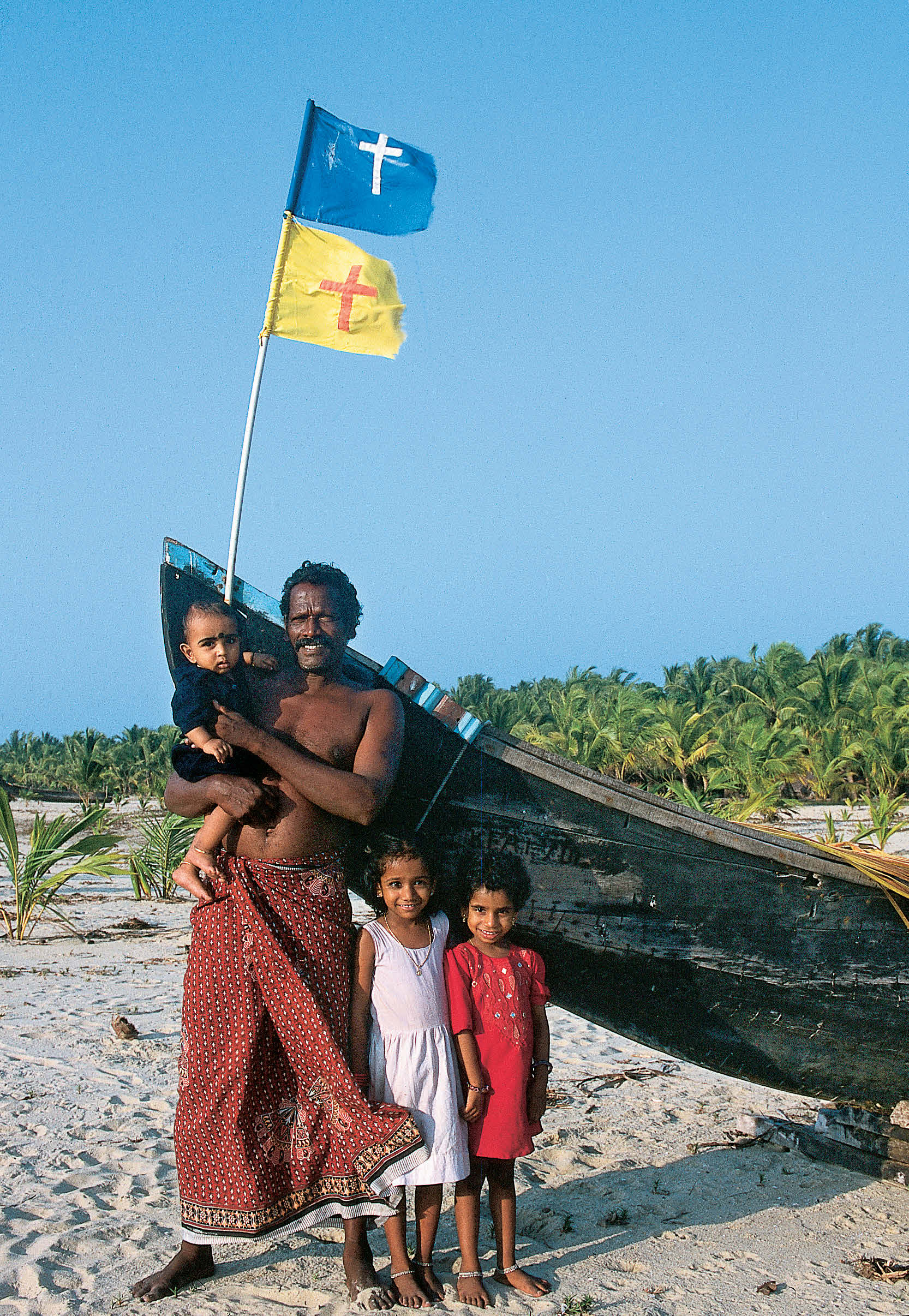
Nestorian fishermen in Kerala, southern India. Christian fishermen are proud of their religious affiliation for two reasons: first, Jesus Christ called his first earthly successor Peter, the ‘fisher of men’; 68 and, second, Christianity enables escape from the lower social classes of the caste system.
印度南部喀拉拉 (Kerala) 的聂斯托利派 (Nestorian) 渔民。基督徒渔民对自己的宗教归属感到自豪,原因有二:第一,耶稣基督 (Jesus Christ) 将其在尘世的第一位继承人彼得 (Peter) 称为“得人的渔夫”;68 第二,基督教使人们得以摆脱种姓制度中的较低社会阶层。
in Mylapore and was buried there in the East Syrian Church of St Thomas.4 When Pope John XXII resolved to carry out a mission to Iran and founded the diocese of Sultaniyeh in 1318, he sent the Dominican Jordanus Catalani to India. Around 1324 Jordanus visited the Nestorians of Thana, part of modern Mumbai (Bombay), and the nearby city of Sopara, where he boasted that he had converted ‘more than 10,000 schismatic infidels’.5 Even if Jordanus greatly exaggerated, his report indicates that there were still Nestorians in north-western India in the fourteenth century. When he returned to India the pope appointed him bishop of Quilon in 1329, and gave him a letter demanding that the leader of the Thomas Christians acknowledge the authority of Rome.6
在迈拉普尔 (Mylapore),并葬于那里的东叙利亚圣多马教堂 (East Syrian Church of St Thomas)。4 当教宗若望二十二世 (Pope John XXII) 决定向伊朗 (Iran) 执行传教使命,并于1318年创立苏丹尼耶教区 (diocese of Sultaniyeh) 时,他派遣多明我会士约尔达努斯·卡塔拉尼 (Dominican Jordanus Catalani) 前往印度 (India)。约1324年,约尔达努斯访问了塔纳 (Thana) 的聂斯托利派信徒——塔纳是今孟买 (Mumbai/Bombay) 的一部分——以及附近的索帕拉 (Sopara) 城;在那里,他夸口说自己使“一万多名裂教异教徒”皈依。5 即便约尔达努斯大大夸张,他的报告仍表明,14世纪时印度西北部仍有聂斯托利派信徒。当他重返印度时,教宗于1329年任命他为奎隆 (Quilon) 主教,并交给他一封信,要求圣多马基督徒 (Thomas Christians) 的领袖承认罗马 (Rome) 的权威。6
A Christian worship service in Kerala, southern India.
印度南部喀拉拉 (Kerala) 的一场基督教礼拜仪式。
Some twenty years after Jordanus, in 1348, the Franciscan bishop John of Marignolli (†1357) spent several months in Quilon. Regarding the Nestorians, he reported that they owned all the pepper plantations and held the public office of weights and measures; clearly, the privileges documented on the copper tablets were still in effect.7 Later, around 1430, the Venetian merchant Nicolo Conti (†1469) described the grave of Thomas in Mylapore.8 These reports, which also suggest the existence of Christian ministers and even kings, allowed for the development of the notion that the priest-king John could be found in South India. On the basis of these expectations, Vasco da Gama is said to have declared upon his arrival in Calicut (Kozhikode), ‘We have come seeking Christians and spices.’9 Da Gama was mistaken, however, when he took the Hindu Brahmans for Christians and their temples for churches. The Portuguese Pedro Alvares Cabral was the first to meet real Christians, which he did near Cochin in 1500. men’ to Patriarch Mar Shimun IV (in office 1437–1497) in northern Mesopotamia with a request for bishops. Two of the envoys reached their goal and were ordained as priests by the patriarch, whereupon he also consecrated two monks as bishops and gave them the names Thomas and John. All four reached Kerala. After a few years Bishop Thomas returned to Mesopotamia, whereupon Patriarch Elias V (in office 1502–1503) consecrated one monk as Metropolitan Yahballaha and two other monks as bishops James and George, who all returned to India in 1504. Because of their initiative, new churches were built and the grave of Thomas in Mylapore was restored. The letter goes on to report ‘that the king of the Christians of the West, the Franks, our brothers, sent to this
在约旦努斯(Jordanus)之后约二十年,即 1348 年,方济各会主教马里尼奥利的约翰(John of Marignolli,卒于 1357 年)在奎隆(Quilon)停留数月。谈到聂斯托利派人士时,他报告说,他们拥有所有胡椒种植园,并担任度量衡公职;显然,铜牌文书所记载的特权当时仍然有效。7 后来,约在 1430 年,威尼斯商人尼科洛·孔蒂(Nicolo Conti,卒于 1469 年)描述了迈拉坡尔(Mylapore)的多马墓。8 这些记述还显示,当地似乎有基督教教士,甚至国王;由此形成一种观念,认为司祭王约翰(Prester John)可以在南印度找到。基于这类预期,据说瓦斯科·达·伽马(Vasco da Gama)抵达卡利卡特(Calicut,Kozhikode)时宣称:‘我们来这里是为了寻找基督徒和香料。’9 然而,达·伽马把印度教婆罗门误认作基督徒,把他们的庙宇误认作教堂。1500 年,葡萄牙人佩德罗·阿尔瓦雷斯·卡布拉尔(Pedro Alvares Cabral)在科钦(Cochin)附近首次遇见真正的基督徒。[数名]男子前往美索不达米亚北部,拜见牧首马尔·示慕四世(Mar Shimun IV,在任 1437–1497 年),请求派遣主教。两名使者抵达目的地后由牧首祝圣为司祭;随后,牧首又将两名僧侣祝圣为主教,赐名多马和约翰。四人都抵达了喀拉拉(Kerala)。几年后,主教多马返回美索不达米亚,牧首以利亚五世(Elias V,在任 1502–1503 年)遂将一名僧侣祝圣为都主教雅巴拉哈(Yahballaha),又将另外两名僧侣祝圣为主教雅各(James)和乔治(George);三人于 1504 年一同返回印度。由于他们的倡议,人们建造了新教堂,并修复了迈拉坡尔的多马墓。信中接着报告说:‘西方基督徒之王、法兰克人、我们的弟兄,派遣到这里的……’
A Syrian letter from 1504 offers us a glimpse into the situation of the Thomas Christians at that time. It reports that the community included about 30,000 families – that is, 150,000 to 200,000 people. In 1490 they sent ‘three pious
一封来自1504年的叙利亚文信件让我们得以一窥当时圣多马基督徒 (Thomas Christians) 的处境。信中报告说,该社群约有3万个家庭——也就是说,有15万至20万人。1490年,他们派遣了‘三位虔诚的
country powerful ships, which reached the town of Calicut’.10 These ‘brothers with their mighty ships’ were Cabral and Vasco da Gama, who returned to South India in 1502. The Thomas Christians did not feel threatened by the militarily superior Portuguese; quite the opposite: they hoped for their protection in the face of the attacking Muslims. For this reason they sent a delegation to da Gama in November 1502 and placed themselves under the protection of the Portuguese crown. This alliance was very welcome to the Portuguese, since the Thomas Christians could provide over 25,000 soldiers in times of danger. The Muslim traders responded to this Christian alliance and to the encroachment by the Portuguese into their trade monopoly with the plundering of Quilon in 1505 and 1524.
该国的强大船只,它们抵达了卡利卡特 (Calicut) 城’。10 这些‘带着强大船只的兄弟’就是卡布拉尔 (Cabral) 和瓦斯科·达·伽马 (Vasco da Gama),他们于1502年返回南印度。圣多马基督徒 (Thomas Christians) 并未感到受到军事上占优势的葡萄牙人 (Portuguese) 的威胁;恰恰相反:面对来犯的穆斯林 (Muslims),他们希望得到葡萄牙人的保护。为此,他们于1502年11月派遣一个代表团前往达·伽马 (da Gama) 处,并将自己置于葡萄牙王室 (Portuguese crown) 的保护之下。这一联盟深受葡萄牙人欢迎,因为圣多马基督徒 (Thomas Christians) 在危险时刻能够提供超过25,000名士兵。穆斯林商人 (Muslim traders) 则以1505年和1524年劫掠奎隆 (Quilon) 的方式,回应这一基督教联盟以及葡萄牙人对其贸易垄断的侵犯。
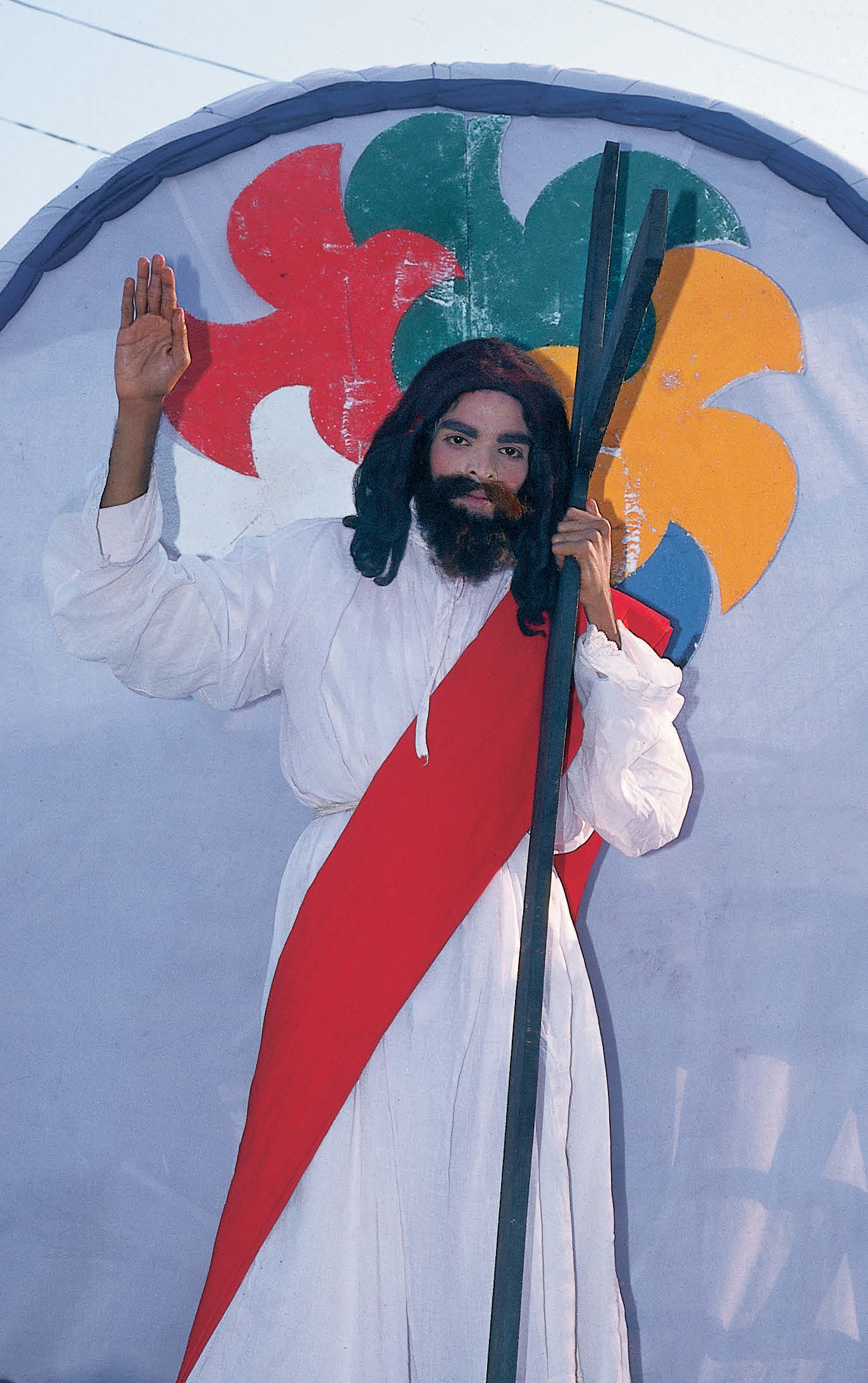
A Christian portraying Jesus in a street parade in Kerala. Here Christianity is also expressed in the form of large processions with tens of thousands of participants.
一位基督徒在喀拉拉邦 (Kerala) 的街头游行中扮演耶稣 (Jesus)。在这里,基督教也以数万人参与的大型游行形式得到体现。
The forced conversion of Nestori ans to Catholicism
聂斯托利派 (Nestorians) 被迫改宗天主教 (Catholicism)
During the first decades following the establish- ment of the Portuguese trading settlements relations with the Thomas Christians were quite harmonious, since the first Portuguese settlers were merchants rather than missionaries. Additionally, the Catholic priests did not know Syriac at first, so they did not notice the ‘Nestorian heresies’. The Thomas Christians could for a time retain their religious identity and their connection to the Church of the East under the leadership of their bishop James (†1552), who had come from Mesopotamia. The troubles began with the arrivals of Brother Alvaro Penteado in Goa in 1511, the Portuguese bishop João de Albuquerque in 1538 and the Jesuit Francis Xavier (†1552) in 1542. They despised both the Hindu heathens and the East Syrian Thomas Christians and began, with the help of the Portuguese civil authorities, to pressure the Nestorians to renounce their Eastern ideas of faith, adopt the Latin rite and acknowledge the authority of the pope. Since the Thomas Christians fiercely defended themselves against the Latinization of their Church and its rites, the Portuguese fleet, which controlled the sea lanes west of Kerala, tried to break the link to the Church of the East, in order to prevent the arrival of Nestorian bishops from Mesopotamia. The Nestorian bishop Mar Dinkha, who lived in Cranganore, feared for his life, or at least his freedom, and fled inland to Angamali in 1534.
在葡萄牙贸易据点建立后的最初几十年里,与圣多马基督徒 (Thomas Christians) 的关系相当和谐,因为最早的葡萄牙定居者是商人而非传教士。此外,天主教神父 (Catholic priests) 起初不懂叙利亚语 (Syriac),因此没有注意到“聂斯托利派异端” (Nestorian heresies)。圣多马基督徒 (Thomas Christians) 得以在一段时间内保留其宗教身份以及与东方教会 (Ch. of E.) 的联系,这得益于其主教雅各 (James, †1552) 的领导,雅各来自美索不达米亚 (Mesopotamia)。麻烦始于1511年阿尔瓦罗·彭特阿多修士 (Brother Alvaro Penteado) 抵达果阿 (Goa)、1538年葡萄牙主教若昂·德·阿尔布开克 (João de Albuquerque) 抵达,以及1542年耶稣会士 (Jesuit) 方济各·沙勿略 (Francis Xavier, †1552) 抵达。他们既鄙视印度教异教徒 (Hindu heathens),也鄙视东叙利亚圣多马基督徒 (East Syrian Thomas Christians),并开始借助葡萄牙民政当局 (Portuguese civil authorities) 的力量,向聂斯托利派 (Nestorians) 施压,要求他们放弃其东方信仰观念,采用拉丁礼 (Latin rite),并承认教宗 (pope) 的权威。由于圣多马基督徒 (Thomas Christians) 激烈抵抗其教会及礼仪的拉丁化 (Latinization),控制喀拉拉 (Kerala) 以西海上航线的葡萄牙舰队 (Portuguese fleet) 试图切断与东方教会 (Ch. of E.) 的联系,以防止来自美索不达米亚 (Mesopotamia) 的聂斯托利派主教 (Nestorian bishops) 到来。住在克兰加诺尔 (Cranganore) 的聂斯托利派主教马尔·丁哈 (Mar Dinkha) 担心自己的性命,或至少担心自己的自由,于1534年逃往内陆的安加马利 (Angamali)。
At the same time, Catholic missionaries carried out well-targeted mass conversions among poor Indian fishermen, who belonged to the lower castes and hoped their acceptance of the Catholic faith would enable them to break free from the chains of the Indian caste system. The Catholic missionaries cleverly exploited the gap left open
与此同时,天主教传教士在贫穷的印度渔民中开展了目标明确的大规模皈依活动。这些渔民属于低种姓,希望接受天主教信仰能使他们摆脱印度种姓制度的枷锁。天主教传教士巧妙地利用了留下的缺口
by the Thomas Christians, who were associated with a higher caste and had never made an active missionary effort among the lower classes. Thus did the Catholics create a clergy parallel to the Nestorians. Simultaneously, the Inquisition, demanded by Francis Xavier, began its terrifying work in 1560.
由圣多马基督徒 (Thomas Christians) 所行,他们与较高种姓相关联,从未在下层阶级中开展积极的传教活动。因此,天主教徒 (Catholics) 建立了一支与聂斯托利派 (Nestorians) 并行的神职人员队伍。与此同时,应方济各·沙勿略 (Francis Xavier) 的要求,宗教裁判所 (Inquisition) 于1560年开始其令人恐惧的工作。
The situation became still more complicated when part of the Mesopotamian Church of the East entered into union with Rome in 1553 under the leadership of John Sulaqa and established the rival patriarchate of the Chaldean Catholic Church. Sulaqa led it under the name of John VIII (†1555). Shortly before the Latin diocese of Goa was elevated to an archdiocese in 1558 the Chaldean patriarch John VIII, acting on the authority of a papal bull that had been granted to him, send the Chaldean bishops Mar Elias and Mar Joseph to Goa, where they arrived in 1555. While Mar Elias soon left India, the Portuguese authorities handed Mar Joseph over to the Inquisition, which twice sent him to Rome to clarify his orthodoxy. Only two years later the Nestorian patriarch Shimun VIII Dinkha (in office 1551–1558) dispatched Bishop Mar Abraham, who was at first able to elude the grasp of the watchful Portuguese. But he was arrested on account of the initiative of his Chaldean rival Mar Joseph and handed over to the Inquisition. In a genuine odyssey, he fled from his captivity in Mozambique to Mosul, whereupon he travelled voluntarily to Rome and pretended to have accepted the Catholic creed. Around 1565 he returned to South India, after the pope had divided the diocese of the Thomas Christians between Mar Joseph and him. After the second deportation of the Chaldean bishop Joseph, Mar Abraham publicly professed the East Syrian rite and fled to Angamali, where he died in office in 1597. Then, in accordance with East Syrian custom, Archdeacon George of the Cross led the Indian archdiocese of the Church of the East.11
当美索不达米亚东方教会 (Mesopotamian Church of the East) 的一部分于1553年在约翰·苏拉卡 (John Sulaqa) 的领导下与罗马联合,并建立了对立的迦勒底天主教会 (Chaldean Catholic Church) 宗主教区时,局势变得更加复杂。苏拉卡以约翰八世 (John VIII) 之名领导该教会(†1555)。就在果阿 (Goa) 的拉丁教区于1558年升格为大主教区前不久,迦勒底宗主教约翰八世依据授予他的教宗诏书之权,派遣迦勒底主教马尔·埃利亚斯 (Mar Elias) 和马尔·约瑟 (Mar Joseph) 前往果阿,他们于1555年抵达那里。马尔·埃利亚斯很快离开印度,而葡萄牙当局将马尔·约瑟交给宗教裁判所 (Inquisition),后者两次把他送往罗马以澄清其正统信仰。仅两年后,聂斯托利派宗主教西满八世·丁哈 (Shimun VIII Dinkha)(在任1551–1558)派遣主教马尔·亚伯拉罕 (Mar Abraham),后者起初得以躲开警觉的葡萄牙人的抓捕。但因其迦勒底对手马尔·约瑟的推动,他还是被捕并被交给宗教裁判所。在一次名副其实的奥德赛式漂泊中,他从莫桑比克 (Mozambique) 的囚禁中逃到摩苏尔 (Mosul),随后自愿前往罗马,并佯称已接受天主教信条。约1565年,在教宗将圣多马基督徒 (Thomas Christians) 的教区划分给他和马尔·约瑟之后,他返回南印度。在迦勒底主教约瑟第二次被驱逐之后,马尔·亚伯拉罕公开宣称信奉东叙利亚礼 (East Syrian rite),并逃往安加马利 (Angamali),于1597年在任内去世。随后,按照东叙利亚习俗,总执事十字架的乔治 (Archdeacon George of the Cross) 领导了东方教会的印度大主教区。11
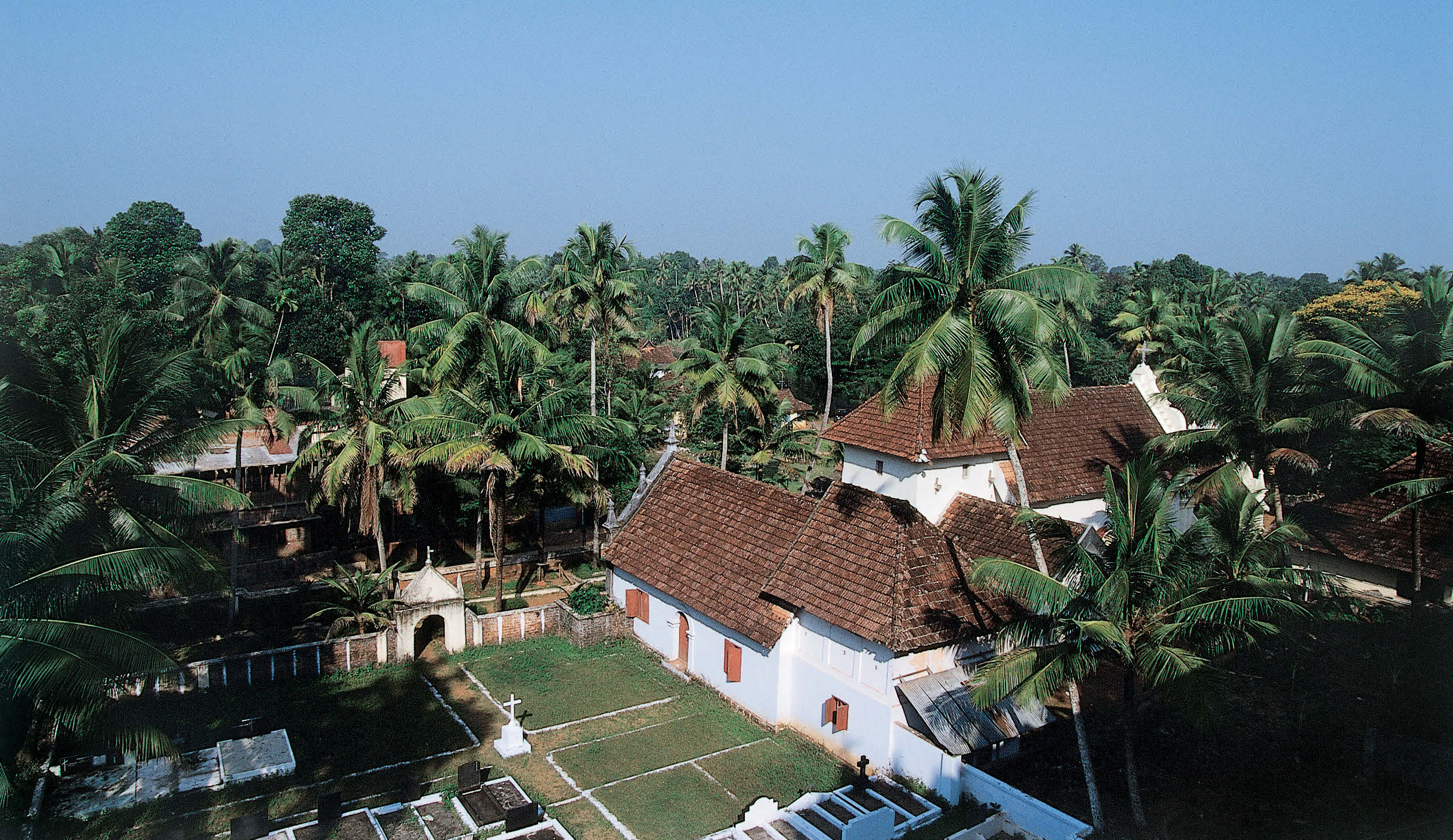
The Orthodox Syrian Church of Nivanam, Kerala, was, according to tradition, one of the seven churches of India founded by the apostle Thomas in the year 52. The building standing today was erected in 1910. century there were three Christian hierarchies in India – the Nestorian, the Chaldean Catholic and the Roman Catholic – which operated beside and against one another. The Catholic archbishop of Goa, Alexis de Menezes, appointed in 1597, decided to ‘resolve’ the turbulent situation in the spirit of the Portuguese administration through the complete Latinization of the Thomas Christians. He behaved like a Crusader battling the infidels rather than a diplomat seeking compromise. Under pain of military force, dispossession and excommunication, he convened the Synod of Dyamper (Udayamperu) near Cochin, after he had ordained over one hundred priests in order to ensure himself a majority. During this one-week blitz-synod Menezes forced through 267 decrees, including, among others, the decisions of the Council of Ephesus and the condemnations of the Church Fathers Theodore, Diodore and Nestorius, as
根据传统,喀拉拉邦尼瓦南的叙利亚正教会 (Orthodox Syrian Church of Nivanam, Kerala) 是使徒多马 (Thomas) 于公元52年在印度建立的七座教会之一。现今的建筑建于1910年。在16世纪,印度有三个基督教教阶——聂斯托利派 (Nestorian)、迦勒底天主教 (Chaldean Catholic) 和罗马天主教 (Roman Catholic)——它们彼此并存又相互对抗。果阿 (Goa) 的天主教大主教阿莱克西斯·德·梅内塞斯 (Alexis de Menezes) 于1597年被任命,他决定本着葡萄牙行政当局的精神,通过将圣多马基督徒 (Thomas Christians) 完全拉丁化来‘解决’这一动荡局势。他的行为更像是一个与异教徒作战的十字军战士,而不是一个寻求妥协的外交家。他以军事武力、剥夺财产和绝罚相威胁,在科钦 (Cochin) 附近召集了迪亚姆佩尔会议 (Synod of Dyamper, Udayamperu),此前他已祝圣了一百多名神父,以确保自己获得多数。在这场为期一周的闪电式会议中,梅内塞斯强行通过了267条法令,其中包括以弗所公会议 (Council of Ephesus) 的决定以及对教父狄奥多雷 (Theodore)、迪奥多雷 (Diodore) 和聂斯托利 (Nestorius) 的谴责,以及
Thus in the second half of the sixteenth
因此,在十六世纪下半叶
question marks.
问号。
With these events the last Nestorian metro- politan see ‘of the Exterior’ ceased to exist; the so-called Syrian Malabar Church was merely a daughter Church of Rome. Rome met East Syrian ideas and customs not with its own ideas and understanding but with brute force. Under Christian rule the Thomas Christians lost the level of freedom of belief and conscience they had enjoyed under the ‘heathen’ Hindus.12
随着这些事件,最后一个聂斯托利派 (Nestorian) 的“外域” (of the Exterior) 都主教区不复存在;所谓的叙利亚马拉巴尔教会 (Syrian Malabar Church) 不过是罗马 (Rome) 的一个子教会。罗马面对东叙利亚 (East Syrian) 的思想和习俗时,不是以自身的思想和理解,而是以野蛮的武力。在基督教统治下,圣多马基督徒 (Thomas Christians) 失去了他们在“异教”印度教徒 (Hindus) 统治下曾享有的信仰与良心自由的程度。12
The revolt of the Thomas Christians at the Cross of Koonan
圣多马基督徒 (Thomas Christians) 在库南十字架 (Koonan Cross) 的反抗
Although the submission of the Thomas Christians to Rome at first appeared complete, it did not last long. The reckless Latinization of their Church, the installation of Latin bishops and the arrogant behaviour of the Jesuits offended the faithful. Around 1650 they elected as archdeacon Thomas Palakomatta (†1670), who prohibited the Jesuit missionaries from entering the East Syrian churches and at the same time asked the Nestorian, Jacobite and Coptic patriarchs to send a non-Latin bishop. The East Syrian patriarch Mar Elias VIII Shimun (in office 1617–1660) sent Bishop Mar Ahatallah to India, where the Portuguese arrested him and handed him over to the Inquisition in Goa. The unfortunate bishop died at the stake in 1653.13 The enraged Thomas Christians then gathered in Cochin at the Cross of Koonan and swore no longer to recognize papal authority and to expel the Jesuits. They decided that twelve priests should consecrate Archdeacon Thomas as the new bishop, which they did in the Church of Alangad. The overwhelming majority of the faithful supported the separation from Rome, which was made easier by the Dutch conquest of Quilon in 1661, Cranganore in 1662 and finally Cochin in 1663, since the Protestant Dutch expelled the Latin bishops, priests and mission- well as their own patriarch. The synod adopted the Latin liturgy, adapted the sacraments to the Latin model, acknowledged belief in purgatory and the characterization of Mary as Theotokos and instituted priestly celibacy, which meant that those East Syrian priests who wanted to stay in office had to divorce their wives. The synod then acknowledged the sole primacy of the pope, which removed India from the authority of the Chaldean Catholic patriarch and reduced the metropolitan see of Angamali to a suffragan diocese of Goa. Finally, all the manuscripts of the Thomas Christians were systematically collected and burned, which amounted to the cultural destruction of a 1300-year-old Christian tradition. Thus the only branch of the Church of the East to escape Tamerlane’s frenzy of destruction was annihilated by Europeans. This auto-da-fé is the primary reason the history of the Thomas Christians remains filled with
Potential issue: “Thomas Christians” in Chinese: “圣多马基督徒” is common? In Chinese, “圣多马基督徒” (St. Thomas Christians) or “托马斯基督徒”. The source says “Thomas Christians” not “St. Thomas Christians”. But they are St. Thomas Christians. Chinese academic often “圣多马派基督徒” or “圣多马基督徒”. I’ll use “圣多马基督徒 (Thomas Christians)” first, then “圣多马基督徒”. Good. Potential issue: “East Syrian” = 东叙利亚. “East Syrian churches” = 东叙利亚教会. Good. Potential issue: “Nestorian” = 聂斯托利派. In Chinese, “聂斯托利派” or “景教”. But here patriarchs, use 聂斯托利派. Good. Potential issue: “Jacobite” = 雅各派. Good. Potential issue: “Coptic” = 科普特. Good. Potential issue: “Mar” title: In Chinese, “马尔” is common for Syriac “Mar”. Good. Potential issue: “Elias VIII Shimun” maybe “伊利亚八世·希蒙”. Good. Potential issue: “Ahatallah” maybe “阿哈塔拉”. Good. Potential issue: “Palakomatta” maybe “帕拉科马塔”. Good. Potential issue: “Koonan” maybe “库南”. Good. Potential issue: “Alangad” maybe “阿兰加德”. Good. Potential issue: “Quilon” = 奎隆. Good. Potential issue: “Cranganore” = 克兰加诺尔. Good. Potential issue: “Cochin” = 科钦. Good. Potential issue: “Goa” = 果阿. Good. Potential issue: “Angamali” = 安加马利. Good. Potential issue: “Chaldean” = 迦勒底. Good. Potential issue: “Theotokos” = 上帝之母. Good. Potential issue: “auto-da-fé” = 火刑判决. Good. Potential issue: “Tamerlane” = 帖木儿. Good. Potential issue: “purgatory” = 炼狱. Good. Potential issue: “sacraments” = 圣事. Good. Potential issue: “Latin liturgy” = 拉丁礼仪. Good. Potential issue: “priestly celibacy” = 司铎独身制. Good. Potential issue: “sole primacy” = 唯一首席权. Good. Potential issue: “metropolitan see” = 都主教区. Good. Potential issue: “suffragan diocese” = 附属教区. Good. Potential issue: “Inquisition” = 宗教裁判所. Good. Potential issue: “papal authority” = 教宗权威. Good. Potential issue: “pope” = 教宗. Good. Potential issue: “Protestant Dutch” = 新教荷兰人. Good. Potential issue: “mission-” missing. We’ll translate “传教士”. Good. Potential issue: “13” footnote marker. We’ll put “13” after period. Good. Potential issue: “1653.13” maybe “1653.13” means footnote 13. We’ll render “1653 年被火刑处死。13” Good. Potential issue: “The synod adopted” maybe “该会议” but which synod? The Synod of Diamper. We can say “该会议” as source. Good. Potential issue: “acknowledged belief in purgatory and the characterization of Mary as Theotokos” = 承认炼狱信仰以及将马利亚称为上帝之母的说法. Good. Potential issue: “instituted priestly celibacy” = 设立司铎独身制. Good. Potential issue: “which meant that those East Syrian priests who wanted to stay in office had to divorce their wives.” = 这意味着那些希望继续任职的东叙利亚司铎必须与妻子离婚。 Good. Potential issue: “removed India from the authority of the Chaldean Catholic patriarch” = 使印度脱离迦勒底天主教宗主教的管辖. Good. Potential issue: “reduced the metropolitan see of Angamali to a suffragan diocese of Goa” = 将安加马利都主教区降为果阿的附属教区. Good. Potential issue: “all the manuscripts of the Thomas Christians were systematically collected and burned” = 圣多马基督徒的所有手稿被系统地收集并焚毁. Good. Potential issue: “which amounted to the cultural destruction of a 1300-year-old Christian tradition” = 这相当于对一项长达1300年的基督教传统进行文化毁灭. Good. Potential issue: “Thus the only branch of the Church of the East to escape Tamerlane’s frenzy of destruction was annihilated by Europeans.” = 因此,东方教会 (Church of the East) 唯一逃脱帖木儿 (Tamerlane) 毁灭狂潮的分支,被欧洲人消灭了。 Good. Potential issue: “This auto-da-fé is the primary reason the history of the Thomas Christians remains filled with” = 这场火刑判决 (auto-da-fé) 是圣多马基督徒的历史仍然充满……的主要原因。 Good. Need maybe “auto-da-fé” in Chinese: “火刑判决” is okay. But “auto-da-fé” literally “信仰行动”. In Inquisition context, “火刑判决” is common. Good. Need final output. Ensure no extra text. Use <translated_text> …
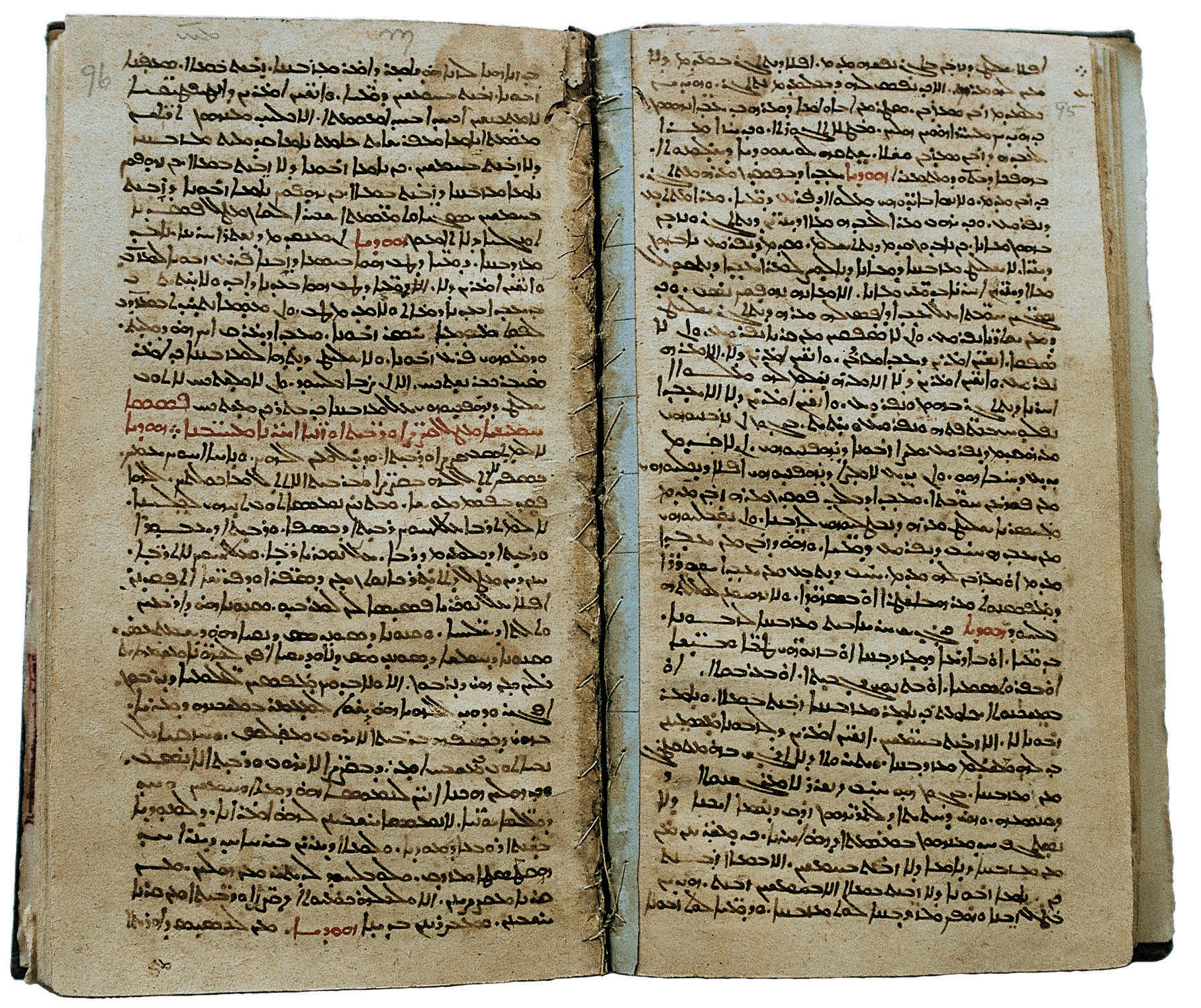
Presumably the oldest book preserved in Kerala is the Nomocanon, the book of monastic rules by Bar Hebraus (1226–1286). The colophon bears the date 1290. (Library of the Orthodox Syrian Church of St John in Pampakuda, Kerala, southern India.)
据推测,喀拉拉 (Kerala) 保存下来的最古老书籍是《教规汇编》(Nomocanon),即巴尔·赫伯拉乌斯 (Bar Hebraus, 1226–1286) 所著的修道规章书。其抄本尾题所载日期为1290年。(印度南部喀拉拉 (Kerala) 邦潘帕库达 (Pampakuda) 的圣约翰 (St John) 叙利亚正教会 (Orthodox Syrian Church) 图书馆。)
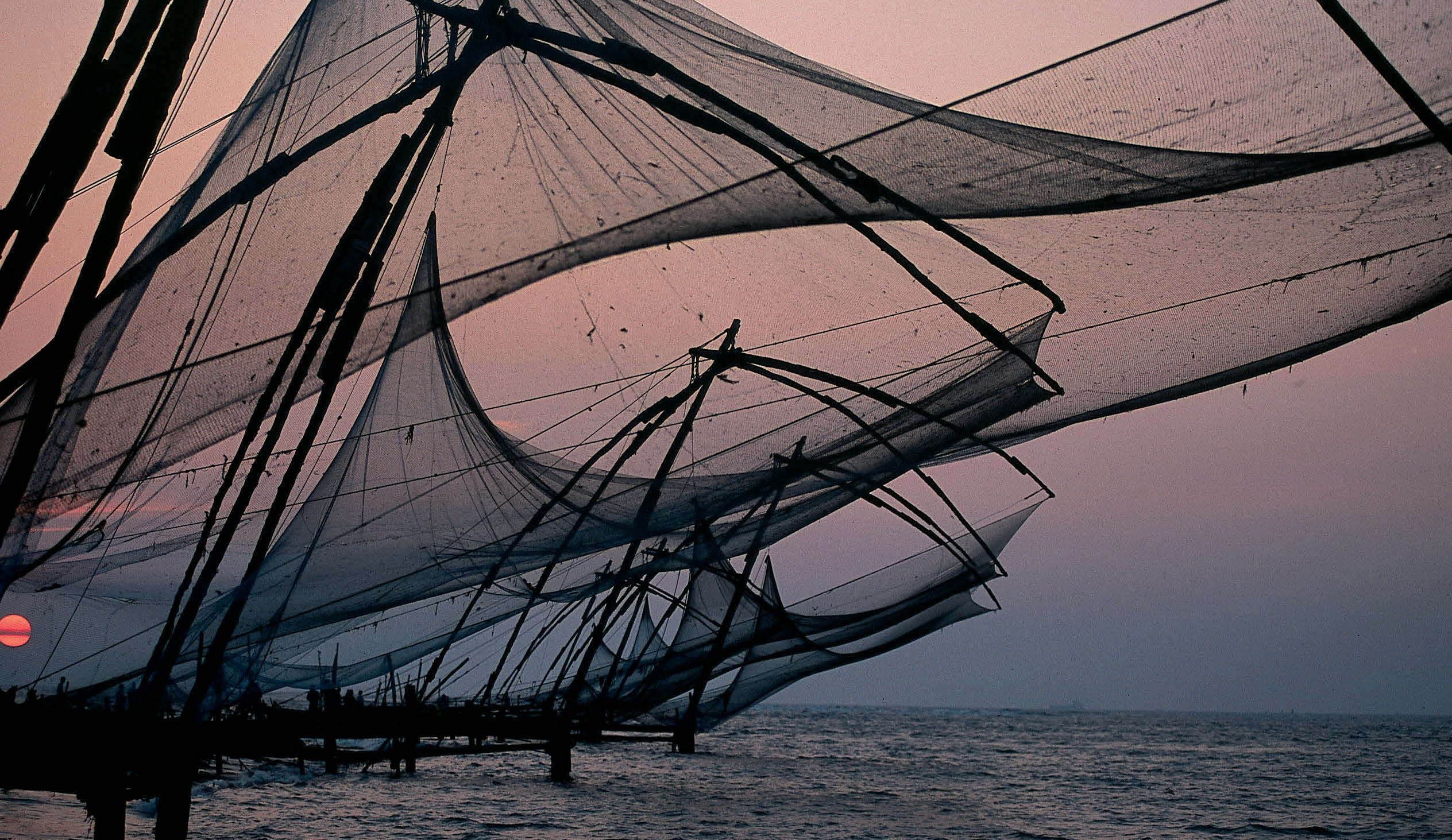
Fishing nets adopted from China and used by Christians in Cochin, Kerala, recall Kerala’s trade with China, which flourished until the fifteenth century. aries from their territories.
从中国 (China) 传入、由喀拉拉 (Kerala) 的科钦 (Cochin) 基督徒使用的渔网,令人回想起喀拉拉 (Kerala) 与中国 (China) 之间的贸易,这一贸易一直繁荣至十五世纪。阿里斯 (Aries) 来自他们的领土。
Dutch expelled the Portuguese soon thereafter, Bishop Joseph Sebastiani consecrated the native Alexander Palakomatta as bishop of the Catholic Syrian Malabar Church. But Palakomatta was a cousin of the rebellious Bishop Thomas.14 Although the majority of the Christians stood behind their Bishop Thomas, his position remained disputable on account of his irregular consecration by only priests, so he appealed again to the Coptic and the two Syrian patriarchs. This time the Syrian Orthodox bishop Mor Gregorius reached India in 1665, where he consecrated him again as Bishop Thomas I and introduced the Jacobite rite. That a Nestorian archdeacon was consecrated bishop by a Jacobite prelate indicates that the Thomas Christians were much less concerned with Christological questions than
此后不久,荷兰人驱逐了葡萄牙人。主教约瑟夫·塞巴斯蒂亚尼 (Joseph Sebastiani) 将当地人亚历山大·帕拉科马塔 (Alexander Palakomatta) 祝圣为天主教叙利亚-马拉巴尔教会 (Catholic Syrian Malabar Church) 的主教。但帕拉科马塔是叛乱的主教托马斯 (Bishop Thomas) 的表亲。14 尽管大多数基督徒都支持他们的主教托马斯,但由于他仅由司铎祝圣,其祝圣不合常规,他的地位仍有争议,因此他再次向科普特宗主教 (Coptic patriarch) 和两位叙利亚宗主教 (Syrian patriarchs) 提出上诉。这一次,叙利亚正教会 (Syrian Orthodox) 主教莫尔·格里高利 (Mor Gregorius) 于1665年抵达印度,在那里再次将他祝圣为主教托马斯一世 (Bishop Thomas I),并引入了雅各派礼仪 (Jacobite rite)。一位聂斯托利派总执事 (Nestorian archdeacon) 竟由一位雅各派教长 (Jacobite prelate) 祝圣为主教,这表明圣多马基督徒 (Thomas Christians) 对基督论问题的关注,远少于
The expulsion of the Portuguese saved Bishop Thomas from the flames of the Inquisition. Pope Alexander VII (in office 1655–1667) blamed the Jesuits for the debacle of the Oath of Koonan and sent in their place Carmelite monks led by Joseph Sebastiani. By means of threats and bribes, he succeeded in returning a minority of the Thomas Christians to the pale of the Catholic Church. Because Bishop Thomas refused to give up his office and acknowledge the authority of the pope, Bishop Sebastiani had Portuguese soldiers search for the obstinate cleric in order to hand him over to the Inquisition in Goa. When they threatened to arrest him in the Church of Mulamthuruty the endangered bishop traded clothing with a layman and escaped. Since the
葡萄牙人 (Portuguese) 被驱逐,使托马斯主教 (Bishop Thomas) 免于宗教裁判所 (Inquisition) 的火刑。教宗亚历山大七世 (Pope Alexander VII)(在位 1655–1667 年)将《库南誓言》(Oath of Koonan) 的惨败归咎于耶稣会士 (Jesuits),并派由约瑟夫·塞巴斯蒂亚尼 (Joseph Sebastiani) 率领的加尔默罗会修士 (Carmelite monks) 取而代之。他通过威胁和贿赂,成功使少数托马斯基督徒 (Thomas Christians) 重新回归天主教会 (Catholic Church) 的怀抱。由于托马斯主教拒绝放弃其职位并承认教宗的权威,塞巴斯蒂亚尼主教 (Bishop Sebastiani) 让葡萄牙士兵搜寻这位顽固的神职人员,以便将他移交给果阿 (Goa) 的宗教裁判所。当他们在穆拉姆图鲁蒂教堂 (Church of Mulamthuruty) 威胁要逮捕他时,这位身处险境的主教与一名平信徒交换了衣服并逃脱。由于
with the defence of Syrian traditions and their antipathy towards the Latin Christians. metropolitan Mar Athanasius (in office 1843–1877) implemented far-reaching Anglican-inspired reforms, resulting in schism and the founding in 1888 of the Mar Thoma Syrian Church of Malabar with its see at Tiruvalla. As his first acts, Mar Athanasius translated the liturgy from Syriac into the native language of Malayalam and abolished Masses for the dead, the use of incense and the invocation of saints and Mary. In the Mar Thoma Church belief in transubstantiation is also rejected, and the sacraments are limited to baptism, Eucharist and holy orders. Scripture is given a more prominent place, and the Eucharist is open to all Christians: ‘The Lord’s table is open to all, only Christ may turn someone away.’19 The Mar Thoma Church, which today includes ten bishops, a thousand priests and about 800,000 laypeople, features an unusual organization. While the bishops’ synod, presided over by the patriarch, is responsible for doctrine and dogma, an assembly of delegates from the faithful, called Sabha Prathinidhi Mandalam, oversees Church business. Each parish delegates one to five elected representatives, plus the vicar, and when there are two or more lay representatives they must include a woman. The Mandalam, which resembles a parliament, thus consists mostly of laity. In the process of making decisions, the bishops’ synod and the patriarch can either put a resolution of the delegates’ assembly into effect or reject it, in which case it will be treated again. If the Mandalam confirms its decision and the patriarch again vetoes it, he must dissolve it and call for new elections. Then the newly elected parliament finally resolves the disputed matter in its first session.20
以捍卫叙利亚传统,并表现出他们对拉丁基督徒的反感。都主教马·阿塔纳修斯 (Mar Athanasius)(任期1843–1877)实施了受圣公会 (Anglican) 启发的、影响深远的改革,导致分裂,并于1888年成立了马拉巴尔马·多马叙利亚教会 (Mar Thoma Syrian Church of Malabar),其教座设在蒂鲁瓦拉 (Tiruvalla)。作为其最初举措,马·阿塔纳修斯将礼仪从叙利亚语翻译成当地语言马拉雅拉姆语 (Malayalam),并废除了为亡者举行的弥撒、使用香以及呼求圣人和马利亚 (Mary)。在马·多马教会 (Mar Thoma Church) 中,变体论 (transubstantiation) 信仰也被拒绝,圣事仅限于洗礼、圣餐和圣秩 (holy orders)。圣经被赋予更突出的地位,圣餐向所有基督徒开放:“主的餐桌向所有人开放,唯有基督可以将人拒之门外。”19 马·多马教会今天包括十位主教、一千名司铎和约80万平信徒,其组织架构不同寻常。由宗主教主持的主教会议负责教义与信条,而一个由信众代表组成的、称为萨巴·普拉蒂尼迪·曼达拉姆 (Sabha Prathinidhi Mandalam) 的议会则监督教会事务。每个堂区派出1至5名当选代表,外加堂区牧师 (vicar);当平信徒代表为两名或以上时,其中必须包括一名女性。因此,这个类似议会的曼达拉姆 (Mandalam) 主要由平信徒组成。在决策过程中,主教会议和宗主教既可以使代表议会的决议生效,也可以予以否决;若遭否决,该决议将再次被处理。如果曼达拉姆 (Mandalam) 确认其决定,而宗主教再次否决,则他必须解散该议会并召集新的选举。随后,新选出的议会将在其第一次会议上最终解决争议事项。20
Because of this consecration, there was a hierarchical and legitimate connection of part of the Thomas Christians to Antioch, which simultaneously implied the dissolution of the bond with the East Syrian patriarchate. This development laid the cornerstone for the mosaic of various Churches that exists in Kerala today, since there were then three parallel hierarchies: first, the Syrian Malankara Orthodox Church, which was dependent on Antioch; second, the Syro-Malabar Catholic Church, recognized by Rome but autonomous; and, third, the community of Latin Christians, which included the Hindus converted by European missionaries and the descendants of these converts.
由于这次祝圣,一部分托马斯基督徒 (Thomas Christians) 与安条克 (Antioch) 之间形成了一种教阶性的、合法的联系,同时这也意味着与东叙利亚宗主教区 (East Syrian patriarchate) 联系的解除。这一发展为今日喀拉拉 (Kerala) 存在的诸教会拼图奠定了基石,因为当时存在三个并行的教阶体系:第一,依附于安条克 (Antioch) 的叙利亚马兰卡拉东正教会 (Syrian Malankara Orthodox Church);第二,得到罗马 (Rome) 承认但自治的叙利亚-马拉巴尔天主教会 (Syro-Malabar Catholic Church);第三,拉丁基督徒 (Latin Christians) 群体,其中包括由欧洲传教士 (European missionaries) 皈依的印度教徒 (Hindus) 以及这些皈依者的后裔。
The Oriental Christians of South India found no peace in the eighteenth century either. It seems that Syrian Malankar Christians, who rejected the West Syrian rite, appealed again to the Nestorian patriarch. In 1701 one Bishop Mar Simon reached Kerala, where the Catholic Inquisition arrested him and imprisoned him until his death.15 Seven years later the Nestorian bishop Mar Gabriel arrived; he oversaw the 22 Syrian Malankar parishes from his residence in Kottayam and died there in 1731.16 After Mar Gabriel’s death, the East Syrian patriarch sent Bishop John to Kerala in order to grant episcopal consecration to the native priest Thomas. But this did not occur, since the Hindu ruler of Cochin had him arrested on the instigation of the Catholics.17 A further crisis arose in 1774, when the Syrian Malankar bishop Mor Koorilose, whose consecration had not been properly carried out, founded the independent church of Thozhiyur. Later the massacres of Thomas Christians by Muslim and Hindu rulers severely tested the communities.18
南印度的东方基督徒在18世纪同样未能获得安宁。看来,拒绝西叙利亚礼仪 (West Syrian rite) 的叙利亚马拉卡尔基督徒 (Syrian Malankar Christians) 再次向聂斯托利派宗主教 (Nestorian patriarch) 求助。1701年,一位马尔·西蒙主教 (Bishop Mar Simon) 抵达喀拉拉 (Kerala),天主教宗教裁判所 (Catholic Inquisition) 在那里将他逮捕并监禁,直至他去世。15 七年后,聂斯托利派主教马尔·加百列 (Nestorian bishop Mar Gabriel) 抵达;他从科塔亚姆 (Kottayam) 的住所管理着22个叙利亚马拉卡尔堂区,并于1731年在那里去世。16 马尔·加百列 (Mar Gabriel) 去世后,东叙利亚宗主教 (East Syrian patriarch) 派遣约翰主教 (Bishop John) 前往喀拉拉 (Kerala),以便为本地司铎托马斯 (Thomas) 授予主教祝圣。但此事未能实现,因为科钦 (Cochin) 的印度教统治者在天主教徒的煽动下将他逮捕。17 1774年又爆发了一场危机,当时祝圣未按正当程序进行的叙利亚马拉卡尔主教莫尔·库里洛塞 (Mor Koorilose) 创立了独立的托齐尤尔教会 (Thozhiyur)。后来,穆斯林和印度教统治者对圣多马基督徒 (Thomas Christians) 的屠杀使这些社群经受了严峻考验。18
At the beginning of the twentieth century a conflict in the leadership of the Syrian Orthodox Church led to a division in the Indian daughter Church that persists to this day. In 1912 the deposed patriarch of Antioch, Abd el-Massiah II, consecrated the first independent catholicos of South India, Mor Basilios Paulos I, while another
二十世纪初,叙利亚正教会 (Syrian Orthodox Church) 领导层的一场冲突导致其印度子教会 (Indian daughter Church) 发生分裂,这一分裂延续至今。1912年,被废黜的安条克牧首 (Patriarch of Antioch) 阿卜杜勒·马西赫二世 (Abd el-Massiah II) 祝圣了南印度首位独立的大公牧首 (catholicos) 莫尔·巴西利奥斯·保罗斯一世 (Mor Basilios Paulos I),而另一位
The arrival of Protestant missionaries, who built their first church in 1809, and Anglican priests led to another split. The Syrian Malankar
新教传教士(他们于1809年建立了第一座教堂)的到来以及圣公会牧师 (Anglican priests) 导致了另一次分裂。叙利亚马兰卡拉 (Syrian Malankar)
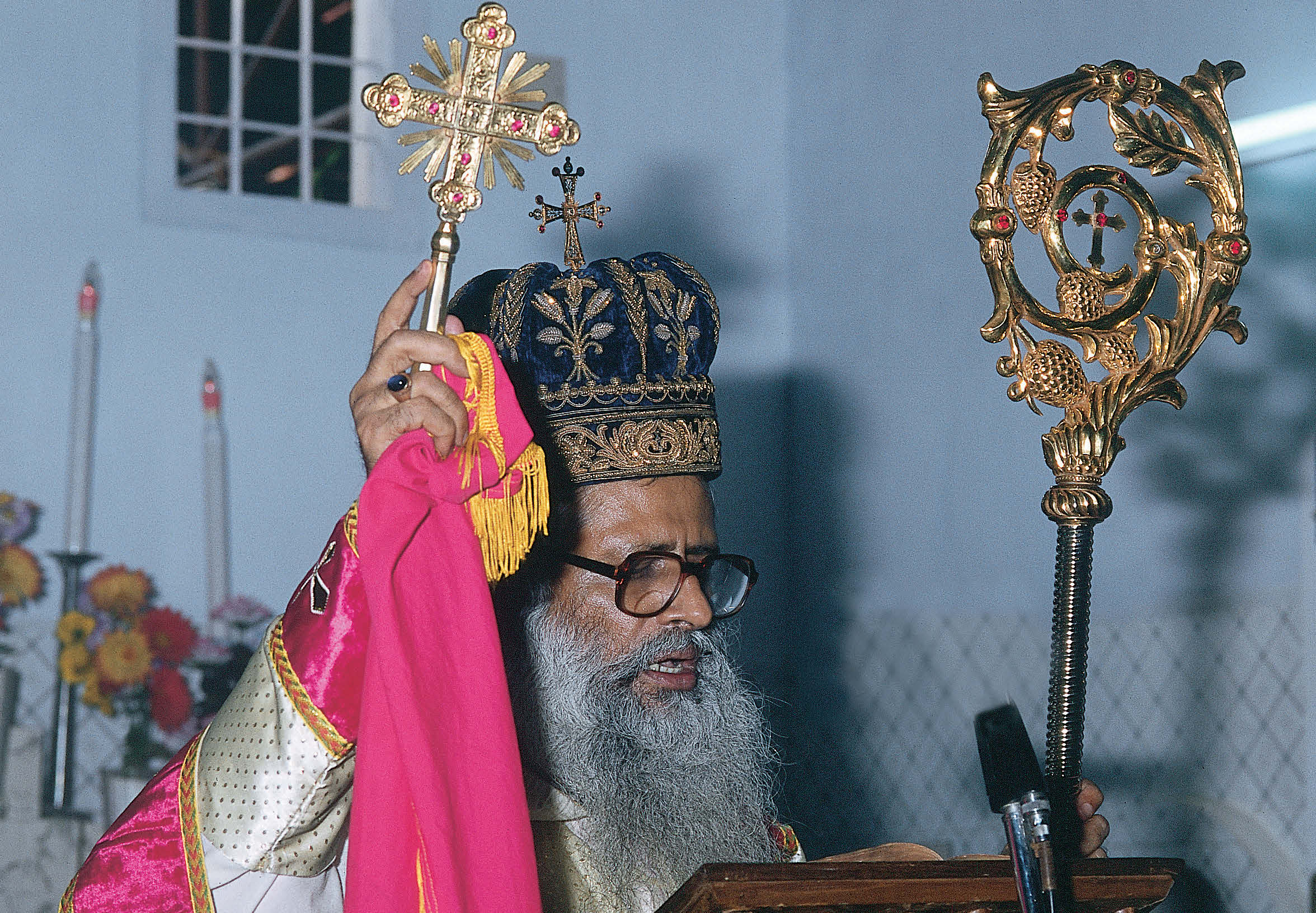
The Orthodox-Syrian bishop Mor Pachomios in front of his Cathedral of St Mary in Aluwa, Kerala, which, on account of an intra-Syrian- Orthodox legal dispute, has been closed by law since 1975. He wears the bulbous headdress typical of Miaphysite bishops. group of Syrian Orthodox Christians remained loyal to the legitimate patriarch of Antioch. Legal battles over Church property began immediately. In 1930 a minority of the autocephalous group under the mystic Mor Ivanios joined the Roman Catholic Church, from which emerged the Syro- Malankar Catholic Church. The reunification of the two Jacobite Churches, which succeeded in 1964, was short-lived, as eleven years later the patriarch in Antioch excommunicated Catholicos Mor Basilios Augin I and named as his replace- ment Mor Basilios Paulos II (†1996). Since then two catholicoi have competed in Kerala; the Church loyal to Antioch calls itself the Syrian Orthodox Church, and the autocephalous Church the Malankara Orthodox Syrian Church. Together the two Churches number two to three million members. Unfortunately, the renewed schism of 1975 brought violence and further legal debates about the ownership of churches. In 1995 the High Court of India decided for the autocephalous Church, since there could be only one catholicos and one Church association in India. Because the court did not address the apportioning of churches in detail, there are, as the author observed in 2001, still many churches that have been closed since 1975; lack of maintenance threatens them with collapse.21 It is certainly no benefit to the image of Christianity in India that two long-established Churches cannot find a compromise and must instead call upon the civil authorities. It appears that a few dignitaries expend more energy before the court than before the altar. The dispute is all the more fallacious given that the liturgy in the two Churches is identical and the quarrel is only over property, titles and power.
叙利亚正教主教莫尔·帕霍米奥斯(Mor Pachomios)站在喀拉拉邦(Kerala)阿卢瓦(Aluwa)圣母主教座堂前。由于叙利亚正教内部的法律纠纷,该堂自1975年以来依法关闭。他戴着合性论派主教典型的球状头饰。一群叙利亚正教徒仍忠于合法的安提阿(Antioch)宗主教。教会财产的法律诉讼随即开始。1930年,自治派中的少数人在神秘主义者莫尔·伊瓦尼奥斯(Mor Ivanios)带领下加入罗马天主教会(Roman Catholic Church),后来形成叙利亚—马兰卡拉天主教会(Syro-Malankar Catholic Church)。1964年,两座雅各派教会实现重归合一,但这段合一为时短暂:11年后,安提阿宗主教将天主教宗莫尔·巴西里奥斯·奥金一世(Mor Basilios Augin I)逐出教会,并任命莫尔·巴西里奥斯·保禄二世(Mor Basilios Paulos II)(†1996)接替他。自此,喀拉拉邦有两位天主教宗彼此竞争;忠于安提阿的教会称自己为叙利亚正教会(Syrian Orthodox Church),自治教会则称为马兰卡拉正教叙利亚教会(Malankara Orthodox Syrian Church)。两座教会合计拥有2,000,000至3,000,000名成员。遗憾的是,1975年再次分裂导致暴力事件,并引发关于教堂所有权的进一步法律争论。1995年,印度高等法院判决支持自治教会,理由是印度只能有一位天主教宗和一个教会团体。由于法院没有详细裁定教堂如何分配,据作者2001年的观察,至今仍有许多自1975年以来关闭的教堂;缺乏维护使它们面临坍塌危险。21 两座历史悠久的教会无法达成妥协,只能诉诸民事当局,这显然无助于基督教在印度的形象。看来,少数显贵在法庭上耗费的精力比在祭坛前还多。鉴于两座教会的礼仪完全相同,而争执仅涉及财产、头衔和权力,这场纠纷更显荒谬。
The rebuilding of the
……的重建
Church of the East in India
印度 (India) 的东方教会 (Ch. of E.)
It is not without irony that one of the youngest ecclesiastical groups of South India is the successor to the oldest, the Nestorian Church. In 1856 unhappy members of the Syro-Malabar Catholic Church appealed to the Chaldean patriarch Mar Joseph VI Audo (in office 1848–1878), who saw an opportunity to expand his jurisdiction to the Thomas Christians. Despite the fervent protest of the Vatican, he sent the patriarchal vicar Thomas Rokos in 1860 and Bishop Elias Mellus in 1874, who established a Chaldean hierarchy in the region of Trichur. Upon his return in 1882 the native priest Antonius Thondanatta (†1900) became his successor as metropolitan of the Chaldean Syrian Church of Trichur, under the name Mar Odisho. Because, however, the Chaldean patriarch had in the interim submitted again to Rome and could not name a successor for Mar Odisho, the leaderless
不无讽刺意味的是,南印度最年轻的教会团体之一,竟是历史最悠久的聂斯托利派教会 (Nestorian Church) 的继承者。1856年,叙利亚-马拉巴尔天主教会 (Syro-Malabar Catholic Church) 中一些心怀不满的成员向迦勒底宗主教 (Chaldean patriarch) 马尔·约瑟六世·奥多 (Mar Joseph VI Audo,在任 1848–1878) 提出申诉,后者看到了将其管辖权扩展至圣多马基督徒 (Thomas Christians) 的机会。尽管梵蒂冈 (Vatican) 强烈抗议,他仍于1860年派遣宗主教代牧托马斯·罗科斯 (Thomas Rokos),并于1874年派遣主教伊利亚斯·梅卢斯 (Elias Mellus),后者在特里丘尔 (Trichur) 地区建立了迦勒底圣统 (Chaldean hierarchy)。1882年他返回后,本地司铎安东尼乌斯·通达纳塔 (Antonius Thondanatta,†1900) 成为其继任者,出任特里丘尔的迦勒底叙利亚教会 (Chaldean Syrian Church of Trichur) 都主教,取名马尔·奥迪绍 (Mar Odisho)。然而,由于迦勒底宗主教在此期间已再次归顺罗马 (Rome),无法为马尔·奥迪绍 (Mar Odisho) 指定继任者,群龙无首的
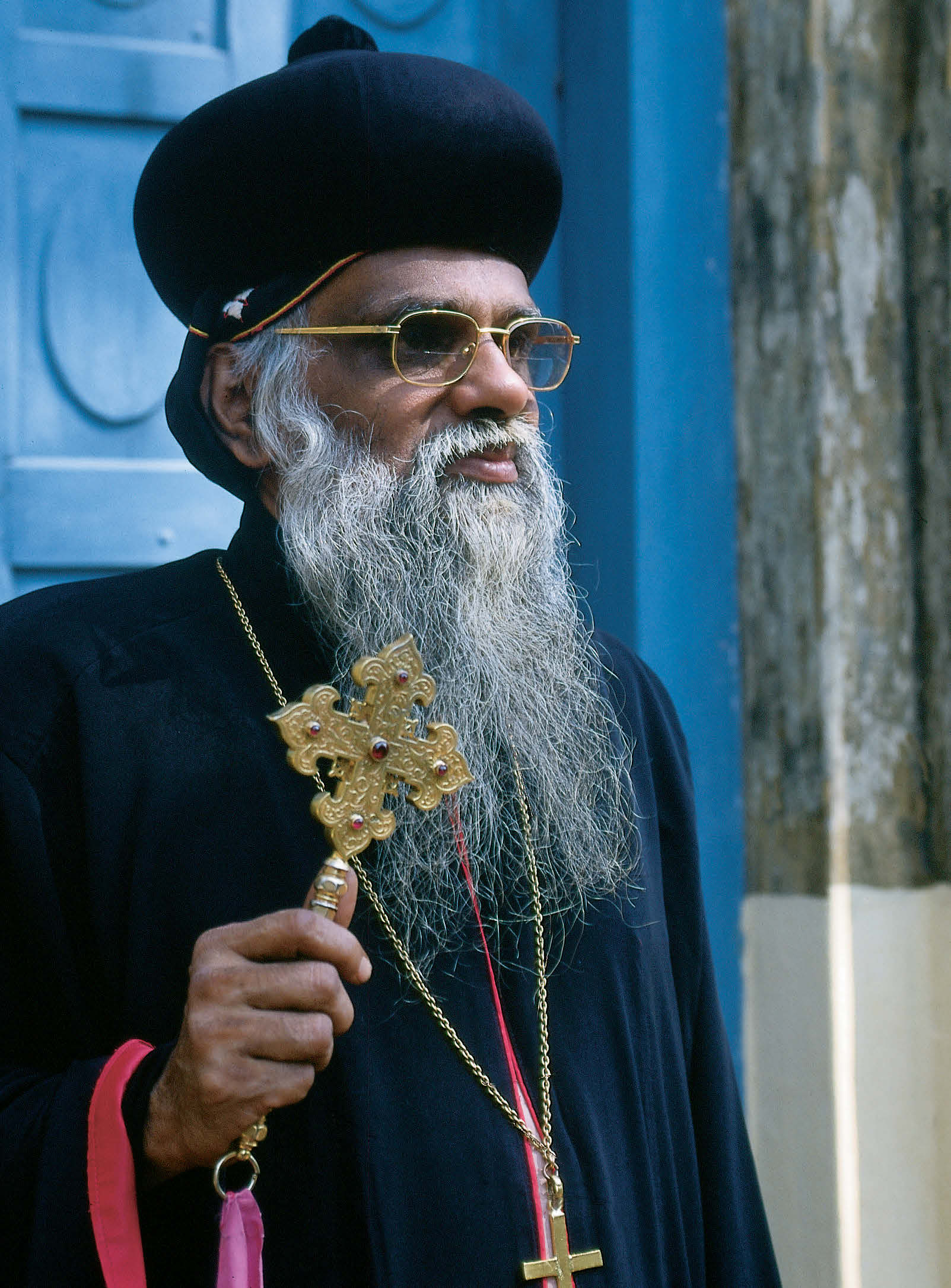
The Cathedral of St Mary in Trichur, built in 1814, is the see of the Indian metropolitan of the Church of the East. It is an outstanding example of Indian–Syrian church architecture. community of Trichur appealed to the Nestorian patriarch Mar Shimun XIX, who sent them the bishop and metropolitan Mar Timothy (1878– 1945) from Kurdistan in 1907.22 plotted with the British authorities against the regent and in the summer of 1927 brought about his deportation to India. After his death in 1945 the diocese remained vacant for seven years.23
特里苏尔 (Trichur) 的圣玛丽主教座堂 (Cathedral of St Mary in Trichur) 建于1814年,是东方教会 (Ch. of E.) 印度都主教的教座。它是印度-叙利亚教会建筑的杰出典范。特里苏尔 (Trichur) 的社群向聂斯托利派宗主教马尔·西满十九世 (Mar Shimun XIX) 求助,后者于1907年从库尔德斯坦 (Kurdistan) 派给他们主教兼都主教马尔·提摩太 (Mar Timothy, 1878–1945)。22 与英国当局合谋反对摄政者,并于1927年夏促成了其被驱逐至印度 (India)。他于1945年去世后,该教区空缺达七年。23
But the small, now Nestorian community of Trichur found no peace, as their metropolitan became involved in the fight over hereditary succession to the patriarchate. When Patriarch Shimun XX Paulose died in 1920, the sister of the late patriarch, Surma, had her twelve-year- old nephew consecrated as Patriarch Mar Shimun XXI Eshai (in office 1920–1975) before Metropolitan Timothy, who was travelling from India, arrived in Baghdad. Since Timothy was the best-educated and most senior bishop of the church, those Assyrians who did not accept hereditary succession and the election of a child as their leader rallied around him. As a compro- mise Timothy was appointed regent. But Lady Surma (†1975), who did not want to surrender the power of Church leadership to the regent,
但是,特里丘尔 (Trichur) 那个规模不大、如今属聂斯托利派 (Nestorian) 的社群并未得到安宁,因为他们的都主教 (metropolitan) 卷入了围绕宗主教 (Patriarch) 职位世袭继承权的争斗。1920年,宗主教西满二十世保禄 (Shimun XX Paulose) 去世时,已故宗主教之妹苏尔玛 (Surma) 在从印度 (India) 出发的都主教提摩太 (Timothy) 抵达巴格达 (Baghdad) 之前,便让她十二岁的侄子被祝圣为宗主教马尔·西满二十一世伊沙伊 (Mar Shimun XXI Eshai,在位 1920–1975)。由于提摩太是教会中受教育程度最高、资历最深的主教,那些不接受世袭继承、也不接受一个孩子被选为领袖的亚述人 (Assyrians) 便团结在他周围。作为妥协,提摩太被任命为摄政。但苏尔玛夫人 (Lady Surma, †1975) 不愿将教会领导权让渡给这位摄政,
The new bishop, Mar Thoma Darmo (†1969) was likewise a determined opponent of hereditary succession, which brought him into conflict with Patriarch Mar Shimun XXI Eshai. The conflict broke out openly when Mar Shimun instituted reforms without any corresponding synodal resolution. First Mar Shimun suspended the rebellious metropolitan Mar Thoma Darmo in 1964. In 1968 Mar Thoma Darmo consecrated three priests as bishops and metropolitans, whereupon these newly appointed bishops named him rival patriarch of the Ancient Church of the East a week later; Mar Shimun, however, declared them deposed. One of the three new bishops was George Mooken from Trichur, born in 1940, who took the name Mar Aprem and was appointed metropolitan of
新任主教马尔·托马·达尔莫 (Mar Thoma Darmo)(卒于1969年)同样坚决反对世袭继承,这使他与牧首马尔·希蒙二十一世·伊沙伊 (Patriarch Mar Shimun XXI Eshai) 发生冲突。当马尔·希蒙在没有任何相应主教会议决议的情况下推行改革时,冲突公开爆发。1964年,马尔·希蒙首先将反叛的都主教马尔·托马·达尔莫停职。1968年,马尔·托马·达尔莫将三名司铎祝圣为主教和都主教,随后这些新任主教在一周后拥立他为东方古教会 (Ancient Church of the East) 的对立牧首;然而,马尔·希蒙宣布将他们废黜。三位新主教之一是来自特里丘尔 (Trichur) 的乔治·穆肯 (George Mooken),生于1940年,他取名马尔·阿普雷姆 (Mar Aprem),并被任命为……的都主教
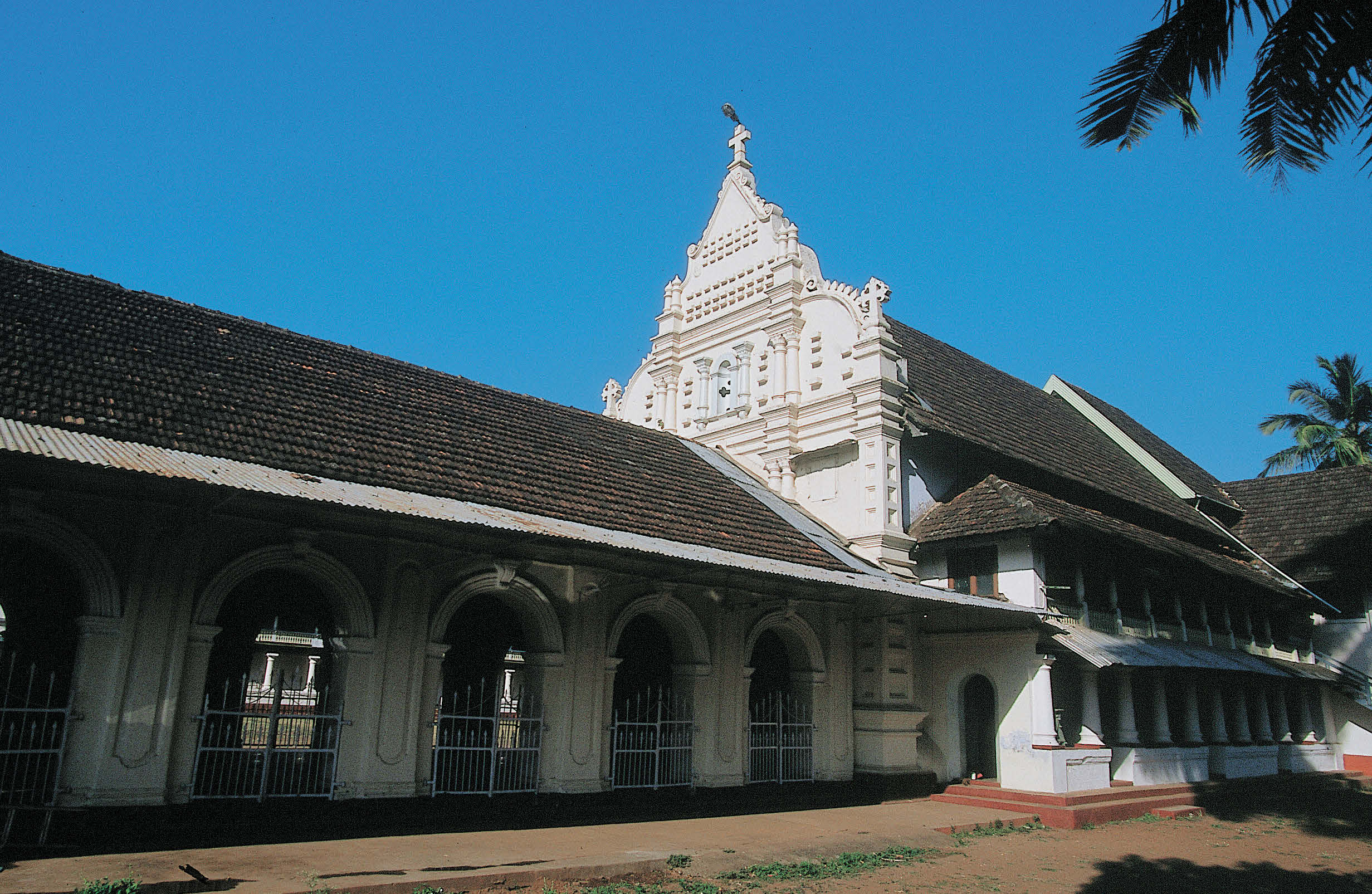
Metropolitan of the Church of the East of India, Mar Timothy II, who died on 7 August 2001. Since a bishop, like an apostle, remains in office spiritually after his death, he is placed immediately after his death in full regalia upon his Episcopal throne, so that he can continue to bless the faithful from whom he has taken his leave.
印度东方教会 (Church of the East of India) 都主教马尔·提摩太二世 (Mar Timothy II),于2001年8月7日去世。由于主教如同使徒一样,死后仍在灵性上继续履职,因此他死后随即身着全套礼服,被安置于主教宝座上,以便能继续祝福那些他已与之告别的信众。
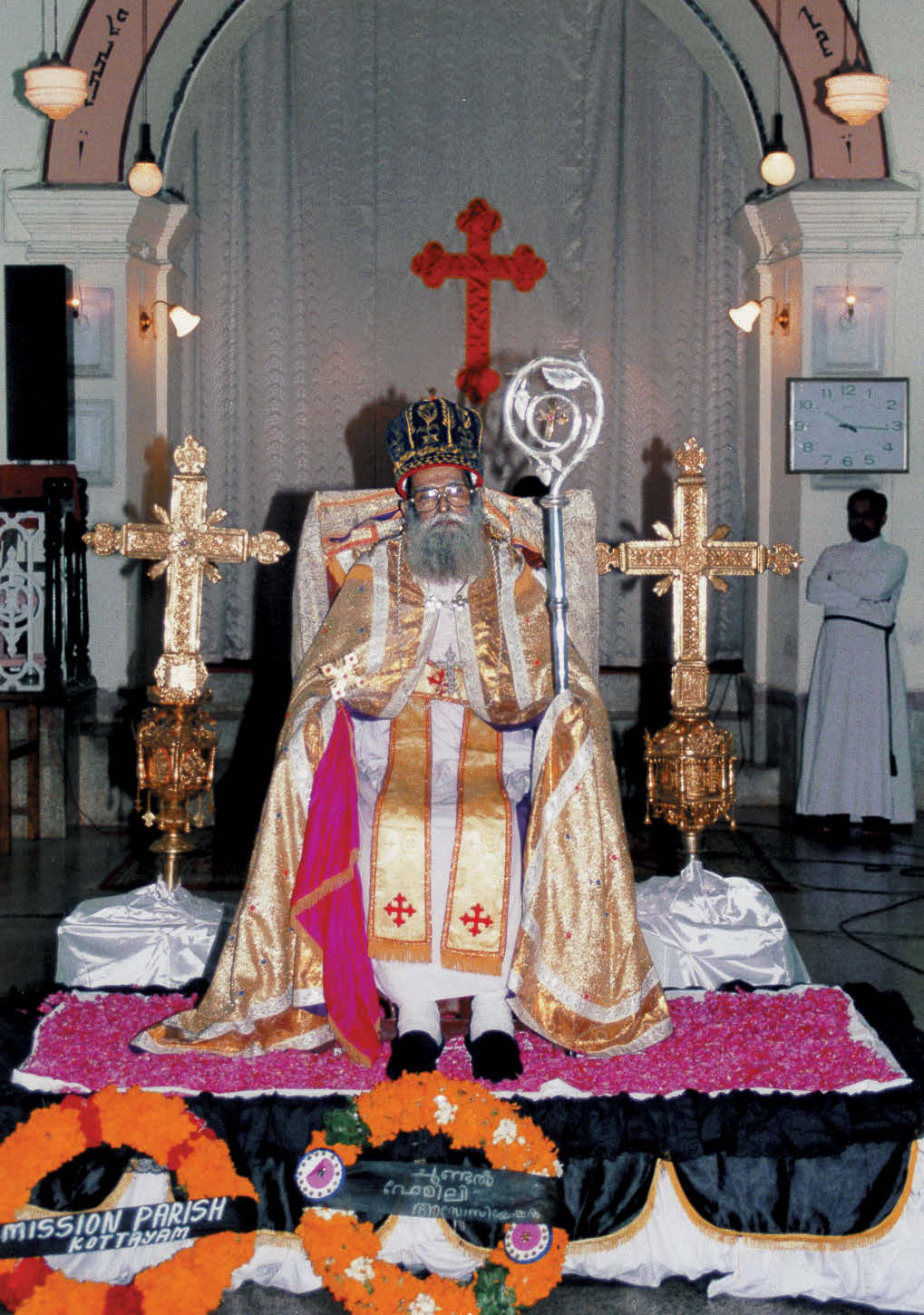
A Prathana-gathering of charismatic Christians in Cochin, southern India. Each person venerates the divine in others.
在印度南部的科钦 (Cochin),一场灵恩派基督徒的祈祷聚会 (Prathana-gathering)。每个人都敬奉他人身上的神性。
India. The new schism was especially painful in the East Syrian communities of India, as Mar Shimun XXI elevated Mar Timothy (1920–2001) to metropolitan of India for the Church of the East in 1971. There were now two Nestorian metropolitans in the small diocese. numerous ecumenical working groups and academic conferences. In 2016 the East Syrian Church of India includes 30,000 members, two additional bishops, 48 priests, 27 deacons, three deaconesses and three nuns.
印度 (India)。新的分裂在印度 (India) 的东叙利亚 (East Syrian) 社群中尤为痛苦,因为马尔·希蒙二十一世 (Mar Shimun XXI) 于1971年将马尔·提摩太 (Mar Timothy, 1920–2001) 擢升为东方教会 (Ch. of E.) 的印度都主教 (metropolitan of India)。此时,这个小小的教区中已有两位聂斯托利派 (Nestorian) 都主教。众多普世教会工作小组和学术会议。2016年,印度东叙利亚教会 (East Syrian Church of India) 拥有3万名成员、两名额外主教、48名司铎、27名执事、3名女执事和3名修女。
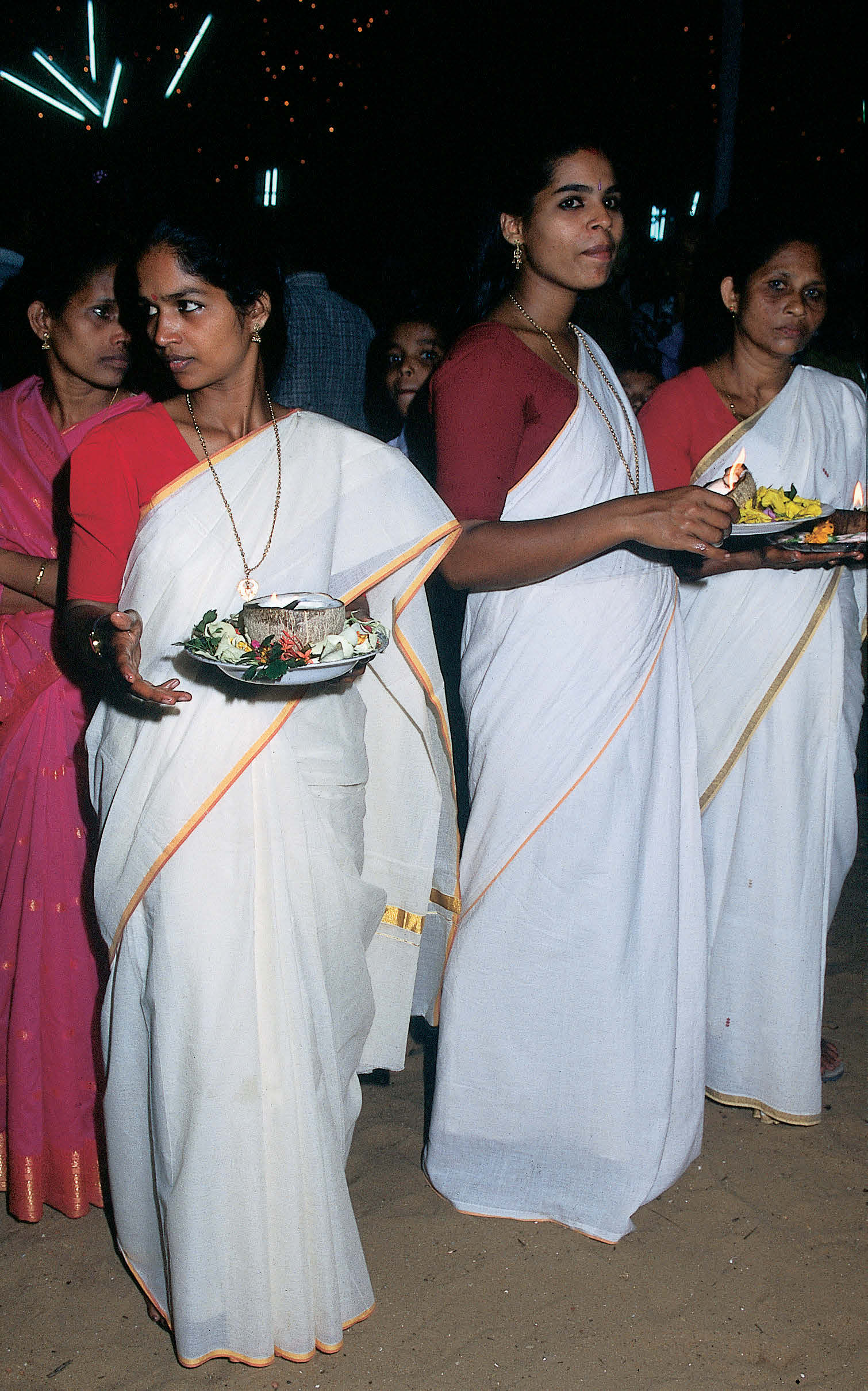
The East Syrian and both West Syrian Churches have maintained their Christian-Oriental character; the faithful really are ‘Hindus in their culture and Christians in their faith and their Syrian rite’.25 Many ritual activities, such as, for instance, the offering of lights, floral garlands or fruit, may be observed both in churches and Hindu temples. An ancient peculiarity of the Syrian Churches is their charismatic character, which is expressed in the religious gatherings called Prathana. There a household or up to several hundred people come together to offer prayers, which are sung in time with rhythmic clapping. In between there are moments of meditative silence, which are interrupted by
东叙利亚教会以及两个西叙利亚教会都保持了其基督教东方特性;信众确实是“在文化上是印度教徒,在信仰和叙利亚礼仪上是基督徒”。25 许多仪式活动,例如献灯、花环或水果,在教堂和印度教寺庙中均可见到。叙利亚诸教会的一个古老特点,是其灵恩特征,这表现在称为“普拉塔纳”(Prathana)的宗教聚会中。在那里,一个家庭或多达数百人聚在一起祈祷,祈祷时随着有节奏的拍手声吟唱。其间有默想静默的时刻,这些时刻会被……打断
The abolition of patriarchal hereditary succession in 1976 opened the way to reconcil- iation. Although power conflicts have prevented to this day a universal reunification of the two Nestorian Churches, reunion was accomplished in India in 1995. The metropolitan see is again entirely under the patriarch of the Church of the East, Mar Dinkha IV (in office since 1976). While Mar Aprem oversees the business of the Church, Mar Timothy, who died in 2001, led the bishops’ conferences.24 This reconciliation demonstrates that schisms may also be resolved without the involvement of civil courts. The current metropolitan, Mar Aprem, is very active in
1976年废除宗主教世袭继承制,为和解开辟了道路。尽管权力冲突至今仍阻碍着两个聂斯托利派教会 (Nestorian Churches) 的全面重新统一,但1995年在印度实现了重新统一。都主教教座再次完全隶属于东方教会 (Ch. of E.) 的宗主教马尔·丁哈四世 (Mar Dinkha IV)(自1976年起在位)。马尔·阿普雷姆 (Mar Aprem) 负责教会事务,而于2001年去世的马尔·提摩太 (Mar Timothy) 则领导主教会议。24 这一和解表明,分裂也可以在不涉及民事法庭的情况下得到解决。现任都主教马尔·阿普雷姆 (Mar Aprem) 在……中非常活跃
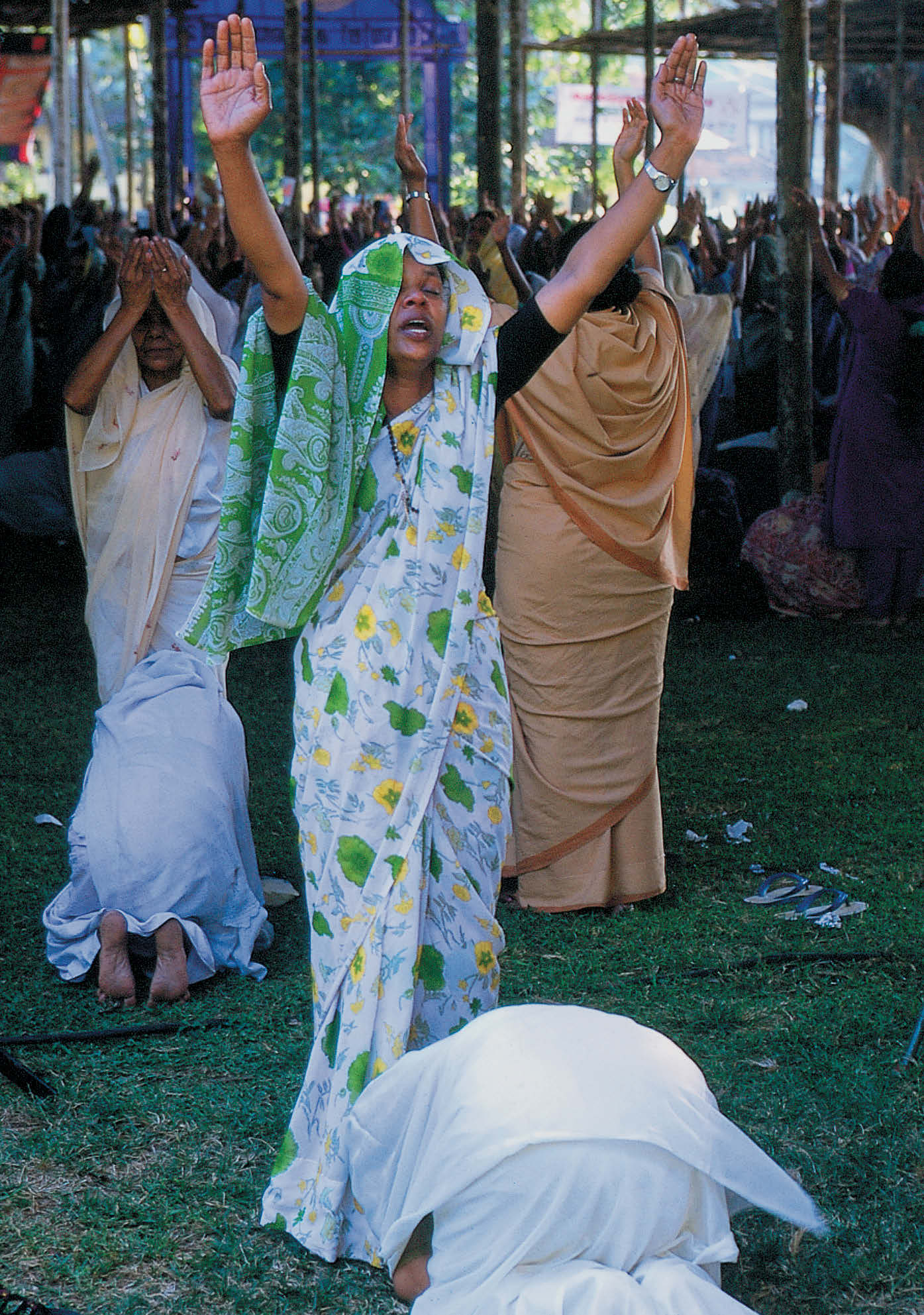
Dr Dr Mar Aprem, Metropolitan of the Church of the East of India, during a worship service in the Church of Mar Narsai, Trichur, southern India. isolated prayers offered aloud. The gathering concludes, like Sunday worship on special feast days, with a shared meal, the agape of the early Church.26 the awareness that, as the ancient copper plates attest, this community once belonged to a higher caste. In fact the Thomas Christians belong to the middle and upper class of Kerala, while Catholics and Protestants are found more in the lower social classes. Both Christianity and Islam offer their adherents from the lower castes, the so-called ‘untouchables’, the only way out of the degrading restrictions of the Indian caste system. However, such converts then lose civil allowances that poor Hindus receive and risk becoming the targets of violent Hindu fundamentalists.
印度东方教会 (Church of the East of India) 都主教马尔·阿普雷姆双博士 (Dr Dr Mar Aprem),在印度南部特里丘尔 (Trichur) 的马尔·纳尔赛教堂 (Church of Mar Narsai) 的一次礼拜仪式中。个别祈祷被高声献上。聚会像特殊节日的周日礼拜一样,以共享一餐——即早期教会的爱宴 (agape)——结束。26 这种意识,即:正如古代铜板 (copper plates) 所证明的那样,这个群体曾属于较高的种姓。事实上,多马基督徒 (Thomas Christians) 属于喀拉拉邦 (Kerala) 的中上层阶级,而天主教徒和新教徒则更多见于较低的社会阶层。基督教和伊斯兰教都为来自低种姓——即所谓“不可接触者” (untouchables)——的信徒提供了摆脱印度种姓制度中那些有辱人格的限制的唯一出路。然而,这类皈依者随后会失去贫穷印度教徒所获得的公民津贴,并有可能成为暴力印度教原教旨主义者的攻击目标。
Among the Syrian Thomas Christians, marriages usually take place within the com- munity. In the case of a mixed marriage, a regulation exists between the East Syrian Church and the Catholics that either an East Syrian or a Catholic pastor can legitimately bless the marriage. Since no such agreement exists with the West Syrians, a mixed marriage can lead to the excommunication of the West Syrian spouse. In order to spare the West Syrian spouse this painful experience, the Nestorian Church permits the East Syrian spouse-to-be to convert to one of the two West Syrian Churches on the day of the wedding, provided he or she returns to the ancestral Church the following day. The restriction to intra-Church marriages also reflects
在叙利亚圣多马基督徒 (Syrian Thomas Christians) 中,婚姻通常在本群体内缔结。就混合婚姻而言,东叙利亚教会 (East Syrian Church) 与天主教徒 (Catholics) 之间存在一项规定:东叙利亚教会或天主教的司铎均可合法地为该婚姻祝福。由于与西叙利亚人 (West Syrians) 之间不存在此类协议,混合婚姻可能导致西叙利亚一方配偶被绝罚。为了使西叙利亚一方配偶免于这一痛苦经历,聂斯脱利派教会 (Nestorian Church) 允许即将结婚的东叙利亚一方在婚礼当天改宗加入两个西叙利亚教会 (West Syrian Churches) 之一,条件是其次日返回祖传教会 (ancestral Church)。对教会内通婚的限制也反映出
The relationship of the Thomas Christians to a milder form of the caste concept can also be seen in the centuries-old priestly traditions within the same families and in the extraordinary respect the priests enjoy within the local community. The same respect is enjoyed by the wife of the priest, who generally must marry before ordination to the diaconate. A few priests live celibately, and
圣多马基督徒 (Thomas Christians) 与一种较为温和的种姓观念形式之间的关系,也可以从同一家族内延续数百年的司铎传统,以及司铎在地方社群中所享有的非凡尊敬中看出来。司铎的妻子也享有同样的尊敬;司铎通常必须在被祝圣为执事之前结婚。少数司铎过独身生活,而
The Catholic St George Church is one of the innumerable churches of Kottayam, which is nicknamed ‘Rome of the Mar Thomas Christians’. from these the bishops are chosen.
天主教圣乔治教堂 (Catholic St George Church) 是科塔亚姆 (Kottayam) 无数教堂之一,科塔亚姆被昵称为“圣多马基督徒的罗马” (Rome of the Mar Thomas Christians)。主教就是从这些教堂中选出的。
Ricci (1552–1610) in China and Roberto de Nobili (1577–1656) in India to adapt the external forms of Christianity to the cultural environment were disavowed by Rome. In this context, the American Protestant missionary Justin Perkins, who went to the Nestorians of Urmiah in 1834 and lived there for 36 years, proved to be more discerning: ‘The oriental [Christian] house must be built of oriental material and adapted to the oriental environment, not the Western.’27
利玛窦 (Ricci)(1552–1610)在中国 (China) 和罗伯托·德·诺比利 (Roberto de Nobili)(1577–1656)在印度 (India) 为使基督教的外部形式适应文化环境而做的努力,被罗马 (Rome) 否定。在此背景下,美国新教传教士贾斯汀·珀金斯 (Justin Perkins) 于1834年前往乌尔米亚 (Urmiah) 的聂斯托利派信徒 (Nestorians) 中,并在那里生活了36年,他表现出更强的洞察力:“东方的[基督教]房屋必须用东方的材料建造,并适应东方的环境,而不是西方的。”27
The example of the Thomas Christians of South India shows that Christianity can only successfully expand and maintain itself in Asian lands with strong, deeply rooted native religions if it creates a cultural synthesis with its host country. Although the c.7.5 million Christians make up about 23 per cent of the overall population of Kerala, in the rest of India they constitute only 1.6 per cent. From the Christian standpoint it is regrettable that the attempts undertaken by the far-sighted Jesuits Matteo
南印度圣多马基督徒 (Thomas Christians) 的例子表明,基督教若要在拥有强大且根深蒂固的本土宗教的亚洲诸地成功扩展并维持自身,就必须与其所在国形成一种文化融合。尽管约750万基督徒约占喀拉拉邦 (Kerala) 总人口的23%,但在印度其他地区,他们仅占1.6%。从基督教的角度看,令人遗憾的是,有远见的耶稣会士马泰奥 (Matteo) 所进行的尝试……