沙托内与德比耶《叙利亚语世界:探寻被遗忘的基督教》第一章(中英文对照版)

阿甲按:这本中文译作参考了DeepL的翻译,经笔者修订而成,其中定有许多不足之处,欢迎各位读者,专家指正。
凡例:
- 翻译自:Briquel Chatonnet, F. & Debié, M. (2023). The Syriac World: In Search of a Forgotten Christianity. Yale University Press. (Originally published as Le Monde Syriaque, 2017, Les Belles Lettres.)
- 本连载中的人名,地名,书名和专业术语的中译未必 accurate「有很多是第一次出现,也请各位方家指正」,若要参考具体细节,欢迎请参考这里
- 翻译采用双语对照模式,并附上原作页码信息,以方便读者参阅原文,引用具体出处。
- 版权申明:若要引用,请采用以下格式:Briquel Chatonnet & Debié,《叙利亚语世界:探寻被遗忘的基督教》第一章,袁永甲中译(伦敦:教父原文中译计划,2026年4月26日),某年某月某日引用,本文网址。
Origins
A Culture of Encounter and Contact
Aramaic Origins
起源
相遇与接触的文化
阿拉米语 (Aramaic) 起源
S yriac is a dialect of Aramaic, a Semitic language that is most no- tably related to Hebrew and Arabic but which is more precisely part of the Northwest Semitic language group. The culture that is known as “Syriac” is the heir to a millennium of Aramaic culture and history. The fact that the Syriac language can be known as surya¯ya¯ (the adjectival form of “Syrian” in the old sense), ara¯ma¯ya¯ (formed from “Aramean”), or urha¯ya¯ (formed from the Aramaic name of Edessa, Urhay) shows the complexity of identity and self-defi nition within this culture. Aramaic Origins The fi rst known mention of the Arameans dates from 1111 BC and is found in the annals of the Assyrian king Tiglath-Pileser I. The record mentions a campaign led in that year by the Assyrian army against the “Ahlamu-Arameans,” in the region between the H. abur and the Euphra- tes in the northeast of modern-day Syria, as well as the region beyond the river in the Syrian plain north of Palmyra, known as Jabal Bishri. These Arameans are descendants of the Amorites who lived in Syria in the second millennium BC, rather than being new arrivals as had long been thought. The records of the Assyrian kings mention several towns
叙利亚语 (Syriac) 是阿拉米语 (Aramaic) 的一种方言,阿拉米语 (Aramaic) 属于闪米特语系 (Semitic),与希伯来语 (Hebrew) 和阿拉伯语 (Arabic) 关系最为密切,但更准确地说,它属于西北闪米特语族 (Northwest Semitic)。所谓“叙利亚” (Syriac) 文化,是千年阿拉米语 (Aramaic) 文化与历史的继承者。叙利亚语 (Syriac) 可被称为 叙利亚语 (suryāyā,古义“叙利亚人”的形容词形式)、阿拉米语 (arāmayā,由“阿拉米人”构成) 或 乌尔哈语 (urhāyā,由埃德萨 (Edessa) 的阿拉米语名称乌尔哈 (Urhay) 构成),这一事实揭示了该文化内部身份与自我定义的复杂性。 阿拉米语起源 (Aramaic Origins) 关于阿拉米人 (Arameans) 的最早已知记载可追溯至公元前 1111 年,见于亚述 (Assyrian) 国王提格拉特帕拉沙尔一世 (Tiglath-Pileser I) 的年鉴中。该记录提及了当年亚述 (Assyrian) 军队针对“阿赫拉米 - 阿拉米人” (Ahlamu-Arameans) 发动的一次战役,地点位于现代叙利亚 (Syria) 东北部哈布尔 (Habur) 与幼发拉底河 (Euphrates) 之间的地区,以及帕尔米拉 (Palmyra) 以北叙利亚 (Syria) 平原上河对岸的被称为比什里山 (Jabal Bishri) 的地区。这些阿拉米人 (Arameans) 是公元前二千年生活在叙利亚 (Syria) 的阿摩利人 (Amorites) 的后裔,而非如长期以来认为的那样是新来的移民。亚述 (Assyrian) 国王的记录提及了若干城镇
THE ARAMAIC KINGDOMS
阿拉米诸王国 (THE ARAMAIC KINGDOMS)
but no fortifi cations or sieges. This suggests that at the end of the second millennium, the Aramaic population was living in a tribal society and leading the kind of semi-nomadic life that had become widespread in the area since the end of the Bronze Age empires around 1200 BC. THE ARAMAIC KINGDOMS At the beginning of the fi rst millennium, Aramaic tribes organized themselves into small kingdoms along the arc of the Fertile Crescent, from the southwest of Syria (the kingdom of Damascus), to the north- east in the region of the H. abur. They developed towns, an architectural and artistic style that already showed a culture of intermixture and con- tact, and notably a strong Neo-Hittite infl uence. inscription of zakkur
但没有防御工事或围城战。这表明,在第二千年纪末 (end of the second millennium),阿拉米人 (Arameans) 生活在部落社会中,过着半游牧生活,这种生活方式自公元前 1200 年左右青铜时代 (Bronze Age) 帝国终结以来已在该地区广泛流行。 阿拉米诸王国 (Aramaic Kingdoms) 在第一千年纪初 (beginning of the first millennium),阿拉米 (Aramaic) 部落沿着新月沃地 (Fertile Crescent) 的弧形地带组织成小王国,从叙利亚 (Syria) 西南部[大马士革王国 (kingdom of Damascus)],到东北部的哈布尔 (Ḫabur) 地区。他们发展了城镇,以及一种建筑和艺术风格,这已显示出一种混合与接触的文化,尤其是强烈的新赫梯 (Neo-Hittite) 影响。 扎库尔铭文 (Inscription of Zakkur)
The stele that Zakkur, king of H. amath and Luʾaš, has set up for Ilu-We¯r [his god]. I am Zakkur, king of H. amath and Lu’aš. I was an oppressed man, but Baal Shamain [delivered] me and stood by me, and Baal Shamain made me king in Hazrak. Now Bar-Hadad, the son of Hazael, king of Aram, united against me se[ven]teen kings. Bar-Hadad and his army, Bar-Gu¯š and his army … they were with their armies. And all these kings set up a bulwark against Hazrak and they erected a wall higher than the wall of Hazrak and they dug a moat deeper than its moat. But I lifted up my hands to Baal Shamain and Baal Shamain answered me. And Baal Shamain spoke to me through seers and through messengers. And Baal Shamain said to me: “Do not fear, for I made you king, and I shall stand with you, and I shall deliver you from all these kings who have raised a bulwark against you.” inscription of tell fekheriye
扎库尔 (Zakkur),哈马特 (Hamath) 与卢阿什 (Luʾaš) 之王,为伊卢韦尔 (Ilu-Wer) [其神] 所立之石碑。我乃扎库尔 (Zakkur),哈马特 (Hamath) 与卢阿什 (Luʾaš) 之王。我本是一个受压迫之人,但巴力沙明 (Baal Shamain) [拯救] 了我并站在我身旁,巴力沙明 (Baal Shamain) 立我为哈兹拉克 (Hazrak) 之王。如今,亚兰 (Aram) 王哈扎埃尔 (Hazael) 之子巴尔哈达德 (Bar-Hadad) 联合了十 [七] 位君王反对我。巴尔哈达德 (Bar-Hadad) 及其军队,巴尔古什 (Bar-Guš) 及其军队……他们皆率其军队而至。所有这些君王皆针对哈兹拉克 (Hazrak) 设立壁垒,他们筑起的城墙高于哈兹拉克 (Hazrak) 的城墙,挖掘的壕沟深于其壕沟。但我向巴力沙明 (Baal Shamain) 举手祷告,巴力沙明 (Baal Shamain) 应允了我。巴力沙明 (Baal Shamain) 藉着先见和使者向我说话。巴力沙明 (Baal Shamain) 对我说:“不要惧怕,因我立你为王,我必与你同在,我必拯救你脱离所有这些针对你设立壁垒的君王。” 泰勒费赫里耶 (Tell Fekherye) 铭文
The fi gure of Hadad-yisʿi, which he placed before Hadad of Sikka¯n, water controller of heaven and earth, who brings down prosperity, and provides pasture and watering place for all the lands, and provides water-supply and jugs to all the gods his
哈达德 - 伊西 (Hadad-yisʿi) 的雕像,他将其安置于西坎的哈达德 (Hadad of Sikkan) 面前,这位天地之水的主宰,赐下繁荣,为所有土地提供牧场和饮水处,并向众神提供供水和水罐,他的
Inscription of Zakkur: a basalt stele found at Afi s, not far from Aleppo in Syria. Dated to the end of the 9th century BC. Musée du Louvre, Paris, France. © RMN-Grand Palais / Art Resource, NY. brothers, water controller of all the rivers, who makes all the lands luxuriant, the merciful god to whom praying is sweet, who dwells in Sikka¯n, the great lord, the lord of Hadad-yisʿi, king of Goza¯n, son of Sasnu¯rı¯, king of Goza¯n, for enlivening his soul, and for lengthening his days, and for multiplying his years, and for safeguarding his house, and for safeguarding his offspring, and for safeguarding his people, and for removing illness from him, and that his prayer may be heard, and that the utterance of his mouth may be acceptable, he set [it] up and gave to him. The oldest Aramaic inscriptions date to the 9th century BC. The script is a linear alphabet often described as Phoenician, but which was common to all West Semitic peoples at this time. These are royal
扎库尔 (Zakkur) 铭文:一块发现于叙利亚 (Syria) 阿勒颇 (Aleppo) 附近阿菲斯 (Afis) 的玄武岩石碑。年代定为公元前 9 世纪末。法国 (France) 巴黎 (Paris) 卢浮宫 (Musée du Louvre)。© 法国国家博物馆联合会 - 大皇宫 (RMN-Grand Palais) / 艺术资源 (Art Resource), 纽约 (NY)。 兄弟们,众河之掌控者,使万地繁茂者,祈祷为之甘甜的仁慈之神,居于西坎 (Sikka¯n) 者,伟大的主,哈达德 - 伊西 (Hadad-yisʿi) 之主,古赞 (Goza¯n) 之王,萨斯努里 (Sasnu¯rı¯) 之子,古赞 (Goza¯n) 之王,为使其灵魂苏醒,为延长其时日,为增加其年岁,为护佑其家室,为护佑其后裔,为护佑其子民,为祛除其疾病,为使其祈祷得蒙垂听,为使其口中所出之言蒙悦纳,他树立 [它] 并献予他。 最古老的阿拉米语 (Aramaic) 铭文可追溯至公元前 9 世纪。其文字是一种线性字母,常被称为腓尼基 (Phoenician) 字母,但在当时为所有西闪米特 (West Semitic) 民族所通用。这些是皇家
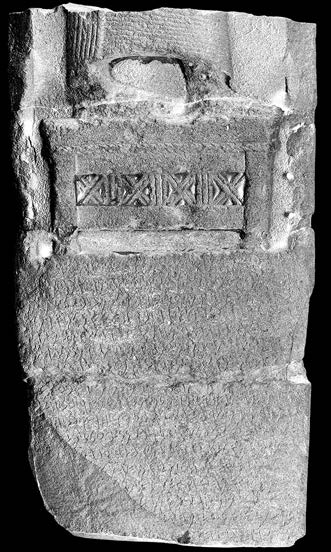
扎库尔 (Zakkur) 铭文:一块发现于叙利亚 (Syria) 阿勒颇 (Aleppo) 附近阿菲斯 (Afis) 的玄武岩石碑。年代定为公元前 9 世纪末。法国 (France) 巴黎 (Paris) 卢浮宫 (Musée du Louvre)。© 法国国家博物馆联合会 - 大皇宫 (RMN-Grand Palais) / 艺术资源 (Art Resource), 纽约 (NY)。
inscriptions, either commemorative or dedicatory, which can be iden- tifi ed chronologically by their connection with the history of Israel or Assyria; for example, the inscription of the king of H. amath and Luʿash, Zakkur, mentions the war waged against him by the king of Damas- cus, Bar Hadad, who is also referenced in the book of Kings under the Hebrew name of Ben Hadad in the context of his siege of the Israelite capital of Samaria (2 Kgs. 6:24). In the inscription, Zakkur calls on the aid of his god, Baal Shamin, who speaks to him by the mediation of seers and prophets. The pressure of these fi rst Assyrian campaigns caused the Arameans to gather themselves together into kingdoms and principali- ties, but these kingdoms were progressively subdued and then annexed during the 9th and 8th centuries BC. However, their rulers were some- times left on the throne as Assyrian governors, as shown, for example, in the inscription on the statue of Hadad-yisʿi discovered at Tell Fekheriye. By 720 BC, all of Syria had been integrated into the Assyrian Empire. THE SPREAD OF THE ARAMAIC LANGUAGE If the political history of the Arameans more or less stops there after only a brief existence, the same cannot be said for Aramaic cultural his- tory; the Assyrian conquest, far from breaking Aramaic culture, was un- doubtedly the driving force that caused it to spread. The usual practice of the Assyrians during their conquests was to deport important fi gures from the local population. This was partly meant to prevent resistance after the conquest by breaking local solidarity but was also a way to bring specialized labor to the capital or other places in need of develop- ment. The book of Kings in the Bible, for example, mentions how the Assyrians deported the inhabitants of the kingdom of Samaria into their empire. As a result, this practice spread the Aramaic-speaking popula- tion across the Near East. Arameans found a place in the administra- tion of the Assyrian Empire at all levels, including the very highest ones. The empire became bilingual, speaking both Assyrian and Aramaic, and employed two scripts (using both the logo-syllabic cuneiform writing system and a linear alphabetic script). By the 7th century BC, Aramaic was already the lingua franca of the people of the Near East, as shown by the instance where Hezekiah,
铭文,无论是纪念性的还是奉献性的,可以通过其与以色列 (Israel) 或亚述 (Assyria) 历史的联系来确定年代;例如,哈马特 (Hamath) 和卢阿什 (Luʿash) 之王扎库尔 (Zakkur) 的铭文提到了大马士革 (Damascus) 之王巴尔·哈达德 (Bar Hadad) 对他发动的战争,他在围攻以色列 (Israel) 首都撒玛利亚 (Samaria) 的背景下,也在《列王纪》(Kings) 中以希伯来名便·哈达德 (Ben Hadad) 被提及(《列王纪下》6:24 (2 Kgs. 6:24))。在铭文中,扎库尔 (Zakkur) 呼求他的神巴尔·沙明 (Baal Shamin) 的帮助,后者通过先见和先知的中介向他说话。这些早期亚述 (Assyrian) 战役的压力促使亚兰人 (Arameans) 聚集成为王国和公国,但这些王国在公元前 9 世纪和 8 世纪期间逐渐被征服并随后被吞并。然而,他们的统治者有时被保留在王位上作为亚述 (Assyrian) 总督,例如在泰勒·费赫里耶 (Tell Fekheriye) 发现的哈达德 - 伊西 (Hadad-yisʿi) 雕像上的铭文所示。到公元前 720 年,整个叙利亚 (Syria) 已被整合进亚述帝国 (Assyrian Empire)。 亚兰语的传播 如果说亚兰人 (Arameans) 的政治历史在短暂存在后或多或少就此止步,那么亚兰文化史则不能这么说;亚述 (Assyrian) 征服非但没有破坏亚兰文化,无疑是促使其传播的驱动力。亚述人 (Assyrians) 征服期间的通常做法是流放当地人口中的重要人物。这部分是为了通过打破地方团结来防止征服后的抵抗,但也是一种将专业劳动力带到首都或其他需要发展的地方的方式。例如,圣经中的《列王纪》(Kings) 提到了亚述人 (Assyrians) 如何将撒玛利亚王国 (Kingdom of Samaria) 的居民流放到他们的帝国中。结果,这种做法将讲亚兰语的人口分散到了整个近东 (Near East)。亚兰人 (Arameans) 在亚述帝国 (Assyrian Empire) 的行政机构中各级别都找到了位置,包括最高层。帝国变得双语化,同时使用亚述语和亚兰语,并采用两种文字(既使用语素音节楔形文字书写系统,也使用线性字母文字)。到公元前 7 世纪,亚兰语已经是近东 (Near East) 人民的通用语,希西家 (Hezekiah) 的例子就说明了这一点,
Tablet inscribed in Aramaic from around 570 BC. It is dated to the reign of Nebuchadnezzar (r. ca. 605– 562 BC). © Musée du Louvre, Dist. RMN-Grand Palais / Raphaël Chipault / Art Resource, NY. the king of Judah, wanted to conduct negotiations in Aramaic with the commander leading the Assyrian army that besieged Jerusalem (2 Kgs. 18:26). At the same time, Mesopotamian culture increasingly became part of Syria. This mixed culture produced the oldest text in Aramaic literature, The Story and Wisdom of Ah.iqar, the story of an Assyrian notable of Aramaic origins, a minister at the court of the Assyrian kings Sennach- erib and Esarhaddon. Ah.iqar was betrayed by his nephew Nadin, dis- missed by the king, and fi nally rehabilitated, following a literary motif that was already well known in the ancient world. Preserved in a papy- rus from the 5th century BC found in Elephantine in Egypt, this text consists of two independent parts, assembled later and written in two slightly different dialects. The fi rst part consists of wisdom proverbs in a classical Aramaic dialect, doubtless a remnant of traditional Aramaic culture, while the second is the story itself, in an Aramaic style full of Assyrian infl uences. The reach of The Story and Wisdom of Ah.iqar was considerable. It was integrated into Jewish culture (there is a reference to it in the biblical book of Tobit) and, most likely through the Jewish
约公元前 570 年的阿拉米语 (Aramaic) 铭文石板。其年代定于尼布甲尼撒 (Nebuchadnezzar) 统治时期(约公元前 605–562 年)。© 卢浮宫博物馆 (Musée du Louvre),发行 (Dist.) RMN-Grand Palais / 拉斐尔·奇波尔特 (Raphaël Chipault) / Art Resource, 纽约 (NY)。 犹大 (Judah) 王想用阿拉米语 (Aramaic) 与围困耶路撒冷 (Jerusalem) 的亚述 (Assyrian) 军队指挥官进行谈判(《列王纪下》(2 Kgs.) 18:26)。与此同时,美索不达米亚 (Mesopotamian) 文化日益成为叙利亚 (Syria) 的一部分。 这种混合文化产生了阿拉米语 (Aramaic) 文学中最古老的文本,《阿希卡尔的故事与智慧》(The Story and Wisdom of Ahiqar),讲述了一位具有阿拉米语 (Aramaic) 出身的亚述 (Assyrian) 显贵的故事,他是亚述 (Assyrian) 国王辛那赫里布 (Sennacherib) 和以撒哈顿 (Esarhaddon) 朝廷的大臣。 阿希卡尔 (Ahiqar) 被他的侄子纳丁 (Nadin) 背叛,被国王罢免,最终得以恢复名誉,遵循的是古代世界已广为人知的文学母题。 该文本保存于埃及 (Egypt) 埃勒凡蒂尼 (Elephantine) 发现的一份公元前 5 世纪的纸草 (papyrus) 中,由两个独立部分组成,后来汇编而成,并用两种略有不同的方言写成。 第一部分由古典阿拉米语 (Aramaic) 方言写成的智慧箴言组成,无疑是传统阿拉米语 (Aramaic) 文化的残余,而第二部分则是故事本身,采用充满亚述 (Assyrian) 影响的阿拉米语 (Aramaic) 风格。 《阿希卡尔的故事与智慧》(The Story and Wisdom of Ahiqar) 的影响范围相当广泛。它被融入犹太 (Jewish) 文化(圣经《托比传》(Tobit) 中有一处提及),并且最有可能通过犹太 (Jewish)
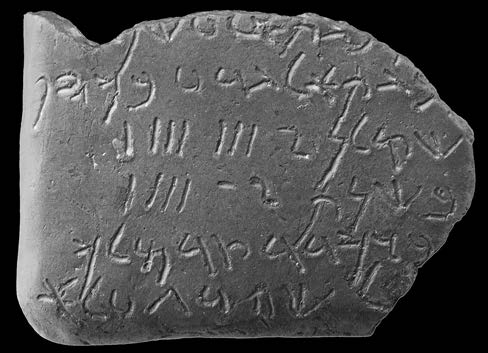
约公元前 570 年的阿拉米语 (Aramaic) 铭文石板。其年代定于尼布甲尼撒 (Nebuchadnezzar) 统治时期(约公元前 605–562 年)。© 卢浮宫博物馆 (Musée du Louvre),发行 (Dist.) RMN-Grand Palais / 拉斐尔·奇波尔特 (Raphaël Chipault) / Art Resource, 纽约 (NY)。
THE SPREAD OF THE ARAMAIC LANGUAGE
阿拉米语的传播
community of Edessa, entered Aramaic Christian culture. There are fi ve extant Syriac versions, forming the basis of an Armenian version (itself the foundation of later Georgian and Old Turkic versions) as well as Arabic versions, which would be the root of an Ethiopic adapta- tion. Versions of the story in modern Syriac depend on both Classical Syriac and Arabic. The story of Ah.iqar also passed into European cul- ture, where it was adapted in the fi rst century in Greek as the life of the fable-writer Aesop and then translated into French by La Fontaine in the 17th century. the story of ah. iqar, according to the aramaic version
埃德萨 (Edessa) 社群,进入了阿拉米语 (Aramaic) 基督教文化。现存有五部叙利亚语 (Syriac) 版本,构成了一个亚美尼亚语 (Armenian) 版本的基础(该版本本身又是后来的格鲁吉亚语 (Georgian) 和古突厥语 (Old Turkic) 版本的基础),以及阿拉伯语 (Arabic) 版本,后者将成为埃塞俄比亚语 (Ethiopic) 改编本的根源。现代叙利亚语 (Modern Syriac) 中的故事版本依赖于古典叙利亚语 (Classical Syriac) 和阿拉伯语 (Arabic) 两者。阿希卡尔 (Ahiqar) 的故事也传入了欧洲 (European) 文化,在那里它于 1 世纪被改编成希腊语 (Greek),作为寓言作家伊索 (Aesop) 的生平,随后在 17 世纪由拉封丹 (La Fontaine) 译为法语 (French)。 阿希卡尔 (Ahiqar) 的故事,依据阿拉米语 (Aramaic) 版本
The account of the words of the one named Ah.iqar, a wise and expert scribe who taught the son of his sister after he had prayed to god and had said, “May I have a son?” The beginning of his words: I am Ah.iqar, and I dwelt in the Gate of the Palace, in the house of the seal [bearer] of Sennacherib, king of Assyria. And I said, “I have no children to give my home or my words to.” [Now] Sennacherib was king of Assyria. After Sennacherib, the king of Assyria, had died, I served the one named Esarhaddon, his son. And he was king in Assyria; he replaced Sennacherib, his father. […] old … So I took my nephew. And I said, “He shall be my son. At my death he will bury me.” And I taught him wisdom. the wisdom of ah. iqar, according to the aramaic version: from the maxims of wisdom
关于名为亚希卡尔 (Ahiqar) 者之言的记述,他是一位智慧且精通的文书,在向神祈祷并说“愿我得一子?”之后,教导了他姐妹之子。 其言之始:我是亚希卡尔 (Ahiqar),我居于宫殿之门 (Gate of the Palace),在亚述 (Assyria) 王辛那赫里布 (Sennacherib) 的印玺之家 [持有者] (house of the seal [bearer]) 中。我说:“我没有子女可以将我的家业或我的言论托付给。”[如今] 辛那赫里布 (Sennacherib) 曾是亚述 (Assyria) 王。在亚述 (Assyria) 王辛那赫里布 (Sennacherib) 去世后,我侍奉名为以撒哈顿 (Esarhaddon) 者,即其子。他在亚述 (Assyria) 为王;他接替了其父辛那赫里布 (Sennacherib)。[…] 年老 … 于是我收养了我的外甥。我说:“他将成为我的儿子。我死后他将埋葬我。”我教导他智慧。 《亚希卡尔 (Ahiqar) 的智慧》(The Wisdom of Ahiqar),据阿拉米语 (Aramaic) 版本:出自《智慧箴言》(Maxims of Wisdom)
My son, do not damn the day until you see night. Do not let it come into your mind that in every place their eyes and their ears are near your mouth. Watch yourself; let it not be their prey. More than all watchfulness watch your mouth and over what you heard harden your heart. For a bird is a word and he who sends it forth is a person of no heart … Do not cover (= ignore) the word of a king; let it be healing for your heart. Soft is the speech of a king, yet it is sharper and mightier than a double-edged knife. See before
我儿,未见夜晚,勿咒诅白日。莫让 你心想处处皆有耳目 贴近你的口舌。当谨慎自守,勿成为他们的猎物。胜过 一切谨慎的是谨慎你的口,对于所听见的 要坚定你的心。因为言语如鸟,放飞它的人 是无心之人……勿掩盖(=忽视)君王的话语; 愿它成为你心灵的良药。君王的言语柔和, 却比双刃刀更锋利、更有力。先察看
you a hard thing: against the face of a king, do not stand. His rage is swifter than lightning. You, watch yourself. Let him not show it because of your sayings lest you die not in your days. See the good of a king. If something is commanded to you, it is a burning fi re. Hurry, do it. Do not kindle it against you and do not cover your palms. Moreover, do the word of the king with heat/delight of the heart. How can wood contest with fi re, fl esh with knife, man with king? After the Assyrian period, Aramaic continued to spread widely. The Persian conquest of the Near East (including the taking of Babylon by Cyrus in 539 BC) gave a new impetus to the spread and infl uence of Aramaic. From Egypt to Uzbekistan and from Anatolia to northern India, the administration of the Persian Empire was conducted not in Persian but in Aramaic: for instance, a recently published administrative archive of Aramaic documents recorded on leather and wooden rods recounts the administration of Bactria by the Persian satrap. During this period, Aramaic became the language in which people wrote—the language of culture, different from the local dialects that they spoke, a phenomenon that remained one of the characteristics of the Syriac world much later. Rod of wood inscribed in Aramaic, from Bactria, third year of Darius III, 333 BC. It acted as an accounting tool, with numbers being marked by its notches. Khalili Collection.
我要告诉你一件难事:不可站在君王面前对抗。他的怒气比闪电更快。你当谨慎,勿因你的言语惹他显怒,免得你不得善终。要寻求君王的好处。若你有受命之事,它便是烈火;速速去行。勿引火烧身,勿缩手不干。更要热心且乐意地遵行王命。木岂能与火争?肉岂能与刀争?人岂能与王争? 亚述时期 (Assyrian period) 之后,阿拉米语 (Aramaic) 继续广泛传播。波斯 (Persian) 对近东 (Near East) 的征服(包括居鲁士 (Cyrus) 于公元前 539 年 (539 BC) 攻占巴比伦 (Babylon))为阿拉米语 (Aramaic) 的传播和影响力增添了新的动力。从埃及 (Egypt) 到乌兹别克斯坦 (Uzbekistan),从安纳托利亚 (Anatolia) 到印度 (India) 北部,波斯帝国 (Persian Empire) 的行政管理并非使用波斯语 (Persian),而是使用阿拉米语 (Aramaic):例如,最近出版的一部记录在皮革和木棍上的阿拉米语 (Aramaic) 文献行政档案,讲述了波斯总督 (Persian satrap) 对巴克特里亚 (Bactria) 的管理。 在此期间,阿拉米语 (Aramaic) 成为人们的书写语言——即文化语言,不同于他们所说的当地方言,这一现象后来仍是叙利亚语世界 (Syriac world) 的特征之一。 刻有阿拉米语 (Aramaic) 的木棍,出自巴克特里亚 (Bactria),大流士三世 (Darius III) 第三年,公元前 333 年 (333 BC)。它作为一种会计工具,数字通过其刻痕标记。哈利利收藏馆 (Khalili Collection)。
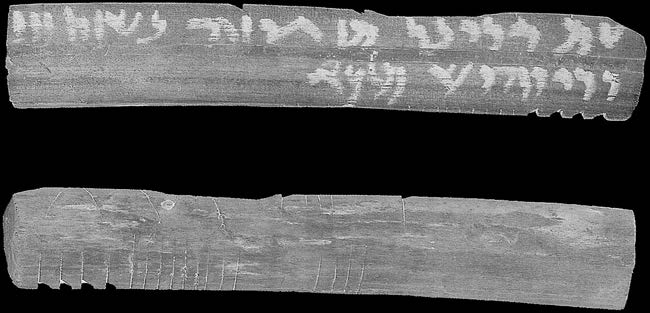
刻有阿拉米语 (Aramaic) 的木棍,出自巴克特里亚 (Bactria),大流士三世 (Darius III) 第三年,公元前 333 年 (333 BC)。它作为一种会计工具,数字通过其刻痕标记。哈利利收藏馆 (Khalili Collection)。
ARAMAIC AND GREEK
亚兰语与希腊语
If the Near East was already in contact with Greek merchants and Greek culture very early on, the Greco-Macedonian conquest (333–331 BC) truly made it part of the Greek world. Greek gradually replaced Aramaic as the language of power, administration, and culture, and became the language spoken both by elites and by a large part of the population. The dialect of Greek from this period is known as koine, or the common language of the Hellenistic kingdoms. Aramaic barely appears in docu- ments dating from the Hellenistic period, except in the Jewish world (for instance, certain passages of the Bible are written in Aramaic) or in the regions on the edge of the Hellenistic world, such as the Caucasus, Iran, and India. Around 300 BC, the emperor Ashoka, who founded the fi rst empire in India and was a convert to Buddhism, wrote inscriptions in several languages, including Aramaic. Only at the end of the Hellenistic period, during the weakening of the Seleucid Empire, would Aramaic become visible again and new inscriptions be written. Although it had always been spoken, it had been eclipsed by Greek as the offi cial language for writing and public dis- play. Now it reappeared in different small kingdoms on the edge of the Roman world—Nabatea, Osrhoene (Edessa), H. atra—and, in the most unusual case, in a city within Roman territory as well, Palmyra. In the Jewish world, inscriptions on ossuaries show the emergence of a style of writing known as “Square Hebrew,” deriving from Ara- maic origins and still in use. Aramaic forms of the alphabet were used to engrave funerary inscriptions and votive offerings, along with other inscriptions relevant to political and local social life. On perishable ma- terial, such as papyrus or parchment, some contracts have been pre- served. The written records from this period reveal forms of Aramaic that are very different from the unifi ed language of the Achaemenid era, because there was no longer a government that could maintain a single written version of Aramaic or a political and administrative context that centralized the use of the language. As a result, Aramaic evolved, tak- ing on different local and provincial characteristics in both written and spoken forms: for instance, the Nabatean dialect is markedly different from Palmyrene, from Edessan, from the Aramaic spoken in H. atra, or
如果近东 (Near East) 早已与希腊 (Greek) 商人和希腊 (Greek) 文化有所接触,那么希腊 - 马其顿 (Greco-Macedonian) 征服(公元前 333–331 年)才真正使其成为了希腊世界 (Greek world) 的一部分。希腊语 (Greek) 逐渐取代阿拉米语 (Aramaic),成为权力、行政和文化的语言,既为精英阶层所用,也为大部分人口所讲。这一时期的希腊语方言被称为柯因内语 (koine),即希腊化王国 (Hellenistic kingdoms) 的通用语言。阿拉米语 (Aramaic) 几乎不见于希腊化时期 (Hellenistic period) 的文献,除非是在犹太世界 (Jewish world)(例如,《圣经》(Bible) 的某些段落是用阿拉米语 (Aramaic) 写成的),或是位于希腊化世界 (Hellenistic world) 边缘的地区,如高加索 (Caucasus)、伊朗 (Iran) 和印度 (India)。公元前 300 年左右,皇帝阿育王 (Ashoka) 建立了印度 (India) 的第一个帝国并皈依了佛教 (Buddhism),他用包括阿拉米语 (Aramaic) 在内的多种语言刻写了铭文。 直到希腊化时期 (Hellenistic period) 末期,在塞琉古帝国 (Seleucid Empire) 衰落期间,阿拉米语 (Aramaic) 才再次显现,新的铭文才得以书写。尽管它一直作为口语使用,但作为书写和公共展示的官方语言,它已被希腊语 (Greek) 所掩盖。如今,它重新出现在罗马世界 (Roman world) 边缘的各个小王国中——纳巴泰 (Nabatea)、奥斯若恩 (Osrhoene)(埃德萨 (Edessa))、哈特拉 (Hatra)——以及最罕见的情况下,出现在罗马领土内的一座城市,即帕尔米拉 (Palmyra)。 在犹太世界 (Jewish world),骨盒 (ossuaries) 上的铭文显示了一种被称为“方形希伯来文”(Square Hebrew) 的书写风格的出现,它源于阿拉米语 (Aramaic),至今仍在使用。阿拉米语 (Aramaic) 形式的字母被用于刻写葬礼铭文和还愿奉献铭文,以及其他与政治和当地社会生活相关的铭文。在易腐材料上,如纸莎草 (papyrus) 或羊皮纸 (parchment),一些契约得以保存。这一时期的书面记录揭示了阿拉米语 (Aramaic) 的形式,与阿契美尼德时代 (Achaemenid era) 的统一语言截然不同,因为不再有一个政府能够维持单一的阿拉米语 (Aramaic) 书面版本,也不再存在集中使用该语言的政治和行政背景。因此,阿拉米语 (Aramaic) 发生了演变,在书面和口语形式上呈现出不同的地方和区域特征:例如,纳巴泰 (Nabatean) 方言与帕尔米拉 (Palmyrene)、埃德萨 (Edessan)、哈特拉 (Hatra) 所说的阿拉米语 (Aramaic) 明显不同,或
The Spread of Aramaic in the Greek and Persian Eras
阿拉米语在希腊与波斯时期的传播
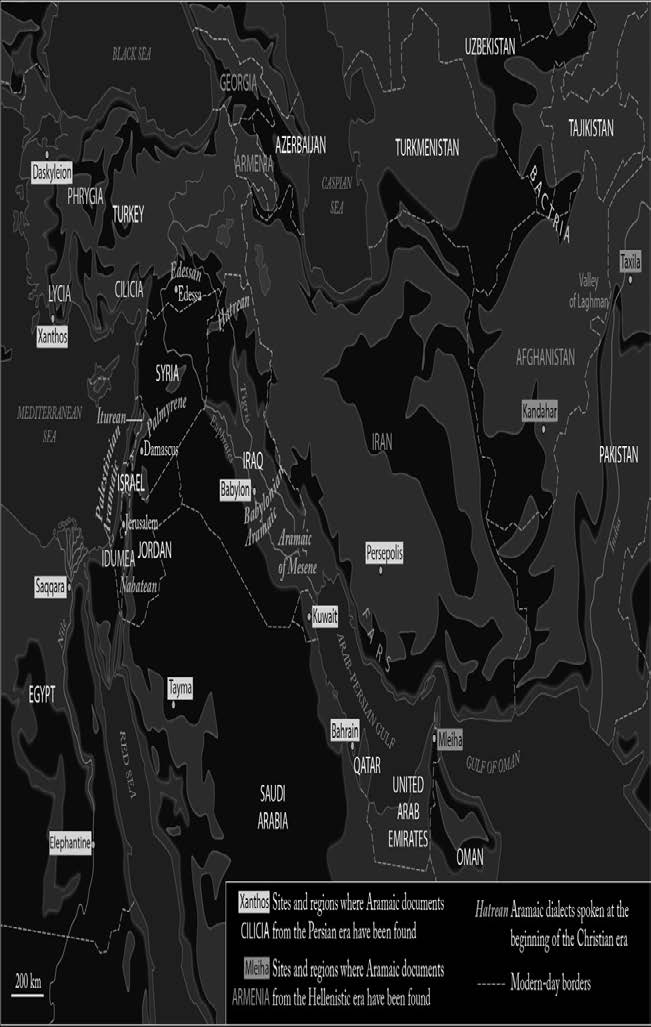
阿拉米语在希腊与波斯时期的传播
Edessa and Osrhoene
埃德萨 (Edessa) 与奥斯若恩 (Osrhoene)
the Jewish Aramaic of Babylon or Palestine. Not only are their gram- matical forms different, but also their writing, since each one developed its own alphabet. Among these local forms of Aramaic, the one that would be des- tined for an extraordinary future is Edessan Aramaic, the dialect spoken in Edessa and in the kingdom of Osrhoene. Edessa and Osrhoene We know very little of the ancient history of Edessa, but it is most likely the same place as the town of Adma mentioned in cuneiform Assyrian sources in the 7th century BC. The Aramaic and Syriac documents that mention it give it the name of Urhay, which is the root of the Turkish name of Urfa and later, in 1984, S¸anlıurfa, or “Glorious Urfa,” to cel- ebrate the victory of the Turkish army over the French in 1920, who had occupied the area as part of their mandate in Syria. GREEK FOUNDATION, ARAMAIC KINGDOM, AND ROMAN COLONY Edessa, the center of Osrhoene, had been founded by the general Se- leucus as a Greek city at the end of the 4th century BC (around 303 or 302) for Macedonian colonists from the army of Alexander the Great. In doing so, he was following a model that fl ourished across the Al- exandrian Near East, from Seleucia and Antioch (named after their founders) to Apamea and Laodicea (named after their spouses). In this case, the Macedonian colonists who settled there thought that the land looked similar to their native Edessa in Macedonia; hence, the town was called Edessa. It was also known by the nickname Callirhoe, or “from the beautiful source,” in order to celebrate its water source, the river Daisan/Scyrtos, which ran through the city and fi lled the pools that made up its water reserves. Edessa fl ourished because of its location on the route that ran from Syria—and specifi cally one of the capitals of the kingdom, Antioch on the Orontes, near the Mediterranean—to the Tigris valley, where an- other capital stood, Seleucia on the Tigris. It is also connected to Birecik,
巴比伦(Babylon)或巴勒斯坦(Palestine)的犹太阿拉米语(Jewish Aramaic)。不仅它们的语法形式不同,书写体系也不同,因为每一种都发展出了自己的字母表。 在这些阿拉米语的地方形式中,注定拥有非凡未来的是埃德萨阿拉米语(Edessan Aramaic),即在埃德萨(Edessa)和奥斯若恩王国(kingdom of Osrhoene)使用的方言。 埃德萨(Edessa)与奥斯若恩(Osrhoene) 我们对埃德萨(Edessa)的古代历史知之甚少,但它很可能就是公元前 7 世纪楔形文字亚述文献中提到的阿德玛(Adma)镇。提及它的阿拉米语(Aramaic)和叙利亚语(Syriac)文献将其命名为乌尔海(Urhay),这是土耳其名称乌尔法(Urfa)的词根,后来在 1984 年改为尚勒乌尔法(Şanlıurfa),意为“光荣的乌尔法”,以庆祝 1920 年土耳其军队战胜法国人,后者曾作为叙利亚(Syria)委任统治的一部分占领该地区。 希腊奠基、阿拉米王国与罗马殖民地 埃德萨(Edessa)作为奥斯若恩(Osrhoene)的中心,由将军塞琉古(Seleucus)于公元前 4 世纪末(约公元前 303 年或 302 年)建立为一座希腊城市,供来自亚历山大帝(Alexander the Great)军队的马其顿殖民者居住。这样做时,他遵循的是在整个亚历山大式近东(Alexandrian Near East)盛行的模式,从塞琉西亚(Seleucia)和安条克(Antioch)(以其创始人命名)到阿帕米亚(Apamea)和劳迪西亚(Laodicea)(以其配偶命名)。在这种情况下,定居那里的马其顿殖民者认为这片土地看起来类似于他们在马其顿(Macedonia)的故乡埃德萨(Edessa);因此,该镇被称为埃德萨(Edessa)。它也被称为卡利罗埃(Callirhoe),意为“来自美丽的源泉”,以纪念其水源——代桑/斯基尔托斯河(Daisan/Scyrtos),该河流经城市,填满了构成其水库的水池。 埃德萨(Edessa)因其地理位置而繁荣,位于从叙利亚(Syria)——具体来说是王国首都之一、靠近地中海(Mediterranean)的奥龙特斯河畔安条克(Antioch on the Orontes)——到底格里斯河谷(Tigris valley)的路线上,另一座首都底格里斯河畔塞琉西亚(Seleucia on the Tigris)就矗立在那里。它还与比雷吉克(Birecik)相连,
The Cradle of Syriac
…
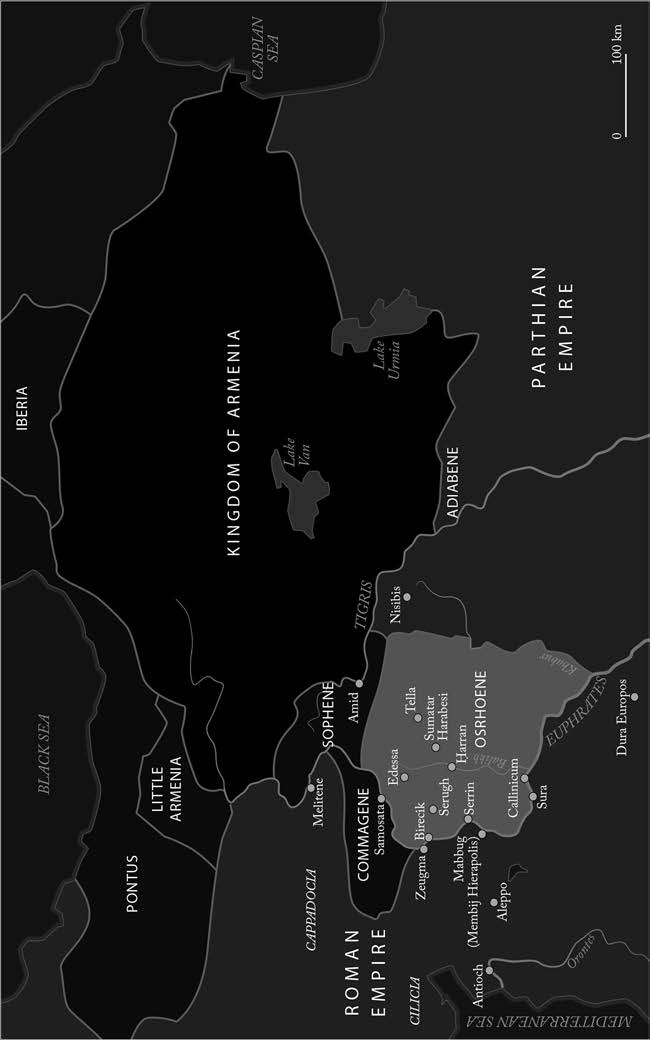
叙利亚语的摇篮
an important point of passage on the Euphrates, as well as to a route going northward to Armenia. As a result, it was not just a strategic site to build a city but an important commercial stop as well. the chronicle of michael the great After the Flood that took place in the days of Noah, King Nimrod, from among the sons of Canaan, built Urhoy and called it Ur, that is Quriat “city” in which the Chaldeans dwelled. Jacob of Edessa said about its destruction: Concerning its destruction, we did not fi nd who caused it, it is thought that it was destroyed during the time of Sennacherib who marched up against Jerusalem, and it remained desolate until the time of Alexander the Builder. Those who marched up with him from Macedonia rebuilt it and named it Edessa, that is the Beautiful One, after the name of their city in Macedonia, and for this reason, the Macedonian name was added to it. And on this account, the computation of years was carried from the beginning of [the reign of] Seleucus Nicator, because he rebuilt it. After three hundred years, Abgar son of Maʿnu, who believed in Christ, reigned in it. And after Abgar and his sons, it became part of the dominion of the Roman emperors who were still pagans, worshiping idols; it remained under their power for three hundred years. After King Constantine reigned, Christianity increased in it and great churches were built in it. The Parthian Empire, founded in the 3rd century BC on the Iranian plateau, largely developed during the next century, gradually absorbing Seleucid territory through conquest until it included all the regions east of the Euphrates. Consequently, Edessa passed into Parthian control. It is within the bounds of this empire that the kingdom of Osrhoene fi rst took shape sometime between 135 and 130 BC, beginning as a small vas- sal state led by rulers who are variously described as dynasts, phylarchs, or toparchs until around the 3rd century AD. Their succession can be traced both by their coinage and by the historical sources. They held lin-
幼发拉底河 (Euphrates) 上的一个重要通道,以及一条通往北方亚美尼亚 (Armenia) 的路线。因此,它不仅是一个建立城市的战略要地,也是一个重要的商业站点。 《米海尔大帝编年史》(Chronicle of Michael the Great) 在诺亚 (Noah) 时代的洪水之后,迦南 (Canaan) 子孙中的宁录王 (King Nimrod) 建造了乌尔霍伊 (Urhoy),称其为吾珥 (Ur),即迦勒底人 (Chaldeans) 居住的“城市”库里亚特 (Quriat)。埃德萨的雅各 (Jacob of Edessa) 论及其毁灭时说: 关于它的毁灭,我们未找到是谁造成的,据信是在进攻耶路撒冷 (Jerusalem) 的辛那赫里布 (Sennacherib) 时期被毁,此后一直荒废,直到建设者亚历山大 (Alexander the Builder) 时代。那些从马其顿 (Macedonia) 随他而来的人重建了它,并以他们在马其顿的城市名为其命名为埃德萨 (Edessa),即“美丽者”(Beautiful One),因此,马其顿的名字被加于其上。正因如此,纪年是从塞琉古·尼卡托 (Seleucus Nicator) [统治] 之初开始计算的,因为他重建了它。三百年后,信奉基督 (Christ) 的马努之子阿布加尔 (Abgar son of Maʿnu) 在此统治。阿布加尔 (Abgar) 及其子孙之后,它成为仍为异教徒 (pagans)、崇拜偶像的罗马皇帝 (Roman emperors) 领土的一部分;在其权力下持续了三百年。君士坦丁王 (King Constantine) 统治后,基督教 (Christianity) 在其中增长,并建造了伟大的教堂。 帕提亚帝国 (Parthian Empire) 成立于公元前 3 世纪的伊朗高原 (Iranian plateau),主要发展于下一个世纪,通过征服逐渐吸收塞琉古 (Seleucid) 领土,直到包括幼发拉底河 (Euphrates) 以东的所有地区。因此,埃德萨 (Edessa) 转入帕提亚 (Parthian) 控制之下。正是在这个帝国范围内,奥斯若恩王国 (kingdom of Osrhoene) 于公元前 135 年至 130 年之间的某个时候首次形成,最初是一个小型附庸国 (vassal state),由统治者领导,这些统治者被不同地描述为王朝统治者 (dynasts)、部落首领 (phylarchs) 或地方长官 (toparchs),直到大约公元 3 世纪。他们的继承序列可以通过他们的钱币 (coinage) 和历史资料 (historical sources) 来追溯。他们持有 lin-
guistically Arab names; a number of them are called Abgar, a name that would become famous in the Christian tradition, but they also include Waʾel, Maʿnu, and others. The arrival of Rome in the area, beginning with the campaigns of Pompey, made Osrhoene the object of clashes between the Romans and the Parthians, because the kingdom was situated in a strategic zone, vulnerable to attack from both sides. The kings of Edessa, while always staying within the Parthian sphere, tried their best to navigate between the two empires and sometimes suffered serious consequences as a re- sult. During the campaign of Trajan, Abgar VII, who fi rst submitted and then revolted against Rome, was deposed in 118 and replaced by a king chosen by Rome. Four years later, another Abgarid regained power. Other, similar crises punctuated the 2nd century. In 166, following the campaigns of Lucius Verus in Mesopotamia, Edessa moved temporar- ily to the Roman side. In 193 the governor of Syria, Pescennius Niger, revolted against the Roman emperor Septimius Severus (r. 193–211) and was supported by the kingdoms of Osrhoene and Adiabene. Edessa came under siege and was captured by the troops of Severus, as com- memorated in the triumphal arch in the Roman Forum. However, the king, Abgar VIII, managed to preserve the kingdom itself. Edessa passed defi nitively into the Roman orbit at the beginning of the 3rd century. In 212–213 it became a Roman colony, even though its dynasty still played a role and despite a brief restoration of its king- ship under Abgar X in 238–242. It stayed in the Eastern Roman Empire until its conquest by Arab-Islamic forces in 641, but only as a buffer province, vulnerable to Roman and Persian armies in each new war. THE CITY AND ITS TERRITORIES Without a written record, it is hard to know precisely what the urban landscape of Edessa looked like. The citadel of the city is still visible to- day, dominated by two Greek-style columns. The river that crosses the city, the Scyrtos (literally, “the bound river”), or Daisan as it is known in Aramaic, frequently rises above its bed, resulting in deadly fl oods, as recounted in Syriac chronicles of the city. It was partly diverted by the emperor Justinian in the 6th century. The Callirhoe spring is still at the
语言上的阿拉伯名字;其中许多人被称为阿布加尔(Abgar),这个名字在基督教传统中将变得闻名遐迩,但也包括瓦埃勒(Waʾel)、马努(Maʿnu)和其他人。 罗马(Rome)势力进入该地区,始于庞培(Pompey)的战役,使得奥斯若恩(Osrhoene)成为罗马人(Romans)与帕提亚人(Parthians)冲突的对象,因为该王国位于战略要地,易受双方攻击。埃德萨(Edessa)的国王们虽然始终保持在帕提亚(Parthian)势力范围内,但尽力在两大帝国之间周旋,有时也因此遭受严重后果。在图拉真(Trajan)战役期间,阿布加尔七世(Abgar VII)先臣服后反抗罗马(Rome),于 118 年被废黜,取而代之的是由罗马(Rome)选立的国王。四年后,另一位阿布加尔家族成员(Abgarid)重掌权力。其他类似的危机贯穿于 2 世纪。166 年,继卢修斯·维鲁斯(Lucius Verus)在美索不达米亚(Mesopotamia)的战役之后,埃德萨(Edessa)暂时转向罗马(Roman)一方。193 年,叙利亚(Syria)总督佩斯肯尼乌斯·尼格尔(Pescennius Niger)反抗罗马(Roman)皇帝塞普蒂米乌斯·塞维鲁(Septimius Severus,在位 r. 193–211),并得到奥斯若恩(Osrhoene)和阿迪亚贝尼(Adiabene)王国的支持。埃德萨(Edessa)遭围困并被塞维鲁(Severus)的军队攻占,此事纪念于罗马广场(Roman Forum)的凯旋门上。然而,国王阿布加尔八世(Abgar VIII)得以保全王国本身。 埃德萨(Edessa)在 3 世纪初彻底进入罗马(Roman)势力范围。212–213 年,它成为罗马(Roman)殖民地,尽管其王朝仍发挥作用,且在 238–242 年间阿布加尔十世(Abgar X)治下曾短暂恢复王权。它留在东罗马帝国(Eastern Roman Empire)境内,直到 641 年被阿拉伯 - 伊斯兰势力(Arab-Islamic forces)征服,但仅作为一个缓冲省份,在每次新战争中易受罗马(Roman)和波斯(Persian)军队的攻击。 城市及其领土(THE CITY AND ITS TERRITORIES) 没有书面记录,很难确切知道埃德萨(Edessa)的城市景观是什么样子的。城市的城堡至今仍可见,矗立着两根希腊(Greek)式柱子。穿过城市的河流,斯基尔托斯(Scyrtos,字面意为“被束缚的河流”),或在阿拉米语(Aramaic)中被称为代桑(Daisan),经常泛滥超出河床,导致致命洪水,正如该市叙利亚语(Syriac)编年史所述。它在 6 世纪被皇帝查士丁尼(Justinian)部分改道。卡利罗埃(Callirhoe)泉至今仍位于
base of the hill where the citadel was built. If one believes the Teaching of Addai, the archives were located in the center of the city, next to a large pagan temple. excerpt from the anonymous chronicle of edessa up to 540: the flood of ad 202
建造城堡的山脚下。若采信《阿代 (Addai) 教导》(Teaching of Addai) 之说,档案库位于城市中心,毗邻一座大型异教神庙。 选自《埃德萨 (Edessa) 匿名编年史(迄 540 年)》(Anonymous Chronicle of Edessa up to 540) 的摘录:公元 (AD) 202 年洪水
In the year 513 in the reign of [Septimius] Severus, and the reign of king Abgar, son of king Maʿnu, in the month of the latter Teshri [November], the spring of water that comes forth from the great palace of King Abgar the Great became abundant; and it rose abundantly as had been its wont previously and it became full and overfl owed on all sides. The royal courtyards and porticoes and rooms began to be fi lled with water. When our lord king Abgar saw this, he went up a safe place on the hill, above his palace where the workmen of the royal works reside and dwell … The river Daisan came before the usual time and month … the waters broke down the western wall of the city and entered into the city. They destroyed the great and beautiful palace of our lord king and removed everything that was found in their path—the charming and beautiful buildings of the city, everything that was near the river to the south and north. They caused damage moreover to the nave of the church of the Christians … Maryhab, the son of Shemesh, and Qayuma, the son of Magartat, the scribes of Edessa, recorded this incident and the decree of King Abgar in writing. Bardin and Bulid, the administrators of the archives of Edessa, received them and deposited them in these archives in their capacity of city offi cials. According to the famous account of the fl ood that took place in Edessa in 202, which is copied in the anonymous Syriac chronicle of 540 and which seems to have been stored in the city archives, the shops of the artisans were built along the river on the roads to the gate, which were lit at night with lanterns. The royal palace and the aristocratic houses were located not far away, while the poorest (beggars, palace servants) were located on the hill. The palace of the king was known as the apadana,
在 [塞普蒂米乌斯 (Septimius)] 塞维鲁 (Severus) 统治时期的第 513 年,以及马努 (Maʿnu) 国王之子阿布加尔 (Abgar) 国王统治期间,在后提什林月 (latter Teshri) [11 月 (November)],源自阿布加尔大王 (King Abgar the Great) 大宫殿的泉水变得充沛;它像往常一样充沛地涌出,变得满溢并向四周泛滥。皇家庭院、柱廊和房间开始被水充满。当我们的主上阿布加尔 (Abgar) 国王看到这一幕时,他登上了山上一个安全的地方,位于他的宫殿上方,那里是皇家工程工匠们居住和生活的地方……代桑河 (Daisan) 在通常的时间和月份之前到来……洪水冲垮了城市的西墙并进入城内。它们摧毁了我们主上国王的宏伟美丽的宫殿,并冲走了路径上发现的一切——城市中迷人美丽的建筑,以及河流南北附近的一切。此外,它们还损坏了基督徒教堂 (Church of the Christians) 的中殿……埃德萨 (Edessa) 的文书舍梅什 (Shemesh) 之子玛丽哈布 (Maryhab) 和马加尔塔特 (Magartat) 之子卡尤玛 (Qayuma) 记录了这一事件和阿布加尔 (Abgar) 国王的诏令。埃德萨 (Edessa) 档案管理员巴尔丁 (Bardin) 和布利德 (Bulid) 接收了它们,并以城市官员的身份将其存入了这些档案中。 根据著名的 202 年埃德萨 (Edessa) 洪水记载,该记载被抄录于《540 年无名氏叙利亚编年史》(anonymous Syriac chronicle of 540) 中,且似乎曾存放于城市档案中,工匠的店铺沿河建造在通往城门的道路上,夜间用灯笼照明。皇家宫殿和贵族宅邸位于不远处,而最贫穷的人(乞丐、宫殿仆人)则位于山上。国王的宫殿被称为阿帕达纳 (apadana),
a Persian word that was also used for the palace of Darius at Persepolis. The names of certain quarters are mentioned in various chronicles of the city. A hippodrome and theater, indispensable parts of the ancient city, provided a venue for circus games and mime shows, respectively. A tetrapylon was located at the intersection of the two main avenues, and several doors in the walls gave access to the main roads. Edessa was the capital of a kingdom, Osrhoene, whose borders are still unknown, but the distribution of inscriptions in Edessan Aramaic allows for some hypotheses. To the northwest, these inscriptions can be found up to the Euphrates, which for a long time marked the border between the Roman and Persian worlds. The two most ancient Edessan inscriptions put the western limits of Osrhoene on the Euphrates, and its southern limits in Serrin, in today’s Syria, around AD 73, and Birecik, probably in AD 106. To the east, it stretched beyond the Balikh River, at least to Sumatar, where there are a good number of inscriptions, ded- ications, and epitaphs, but not up to the source of the Tigris, which was part of the territory of the city of Amida. To the south, it included H. arran and Tell Matin, also in Syria, where a small altar with an Edessan Aramaic inscription was found. Edessan Culture: A Culture of Contact Osrhoene was a cosmopolitan region. To the old Aramaic population of the region were added settlers from Greece, Macedonia, and Syria, along with their families. Merchants from Syria and Mesopotamia trav- eled there, carrying with them the ancient Assyro-Babylonian culture as well with the heritage of Parthian Persia. The area east of Edessa, around Sumatar Harabesi, was inhabited by semi-nomadic or only re- cently sedentarized Arabs. The Edessan inscriptions that are found in that region mention several notables who have the title Š LYTʾ DʿRB, or “governor of the Arabs,” which one also fi nds in the inscriptions of H. atra. Strabo describes Arab Scenites—literally, “those who live in tents”—in Upper Mesopotamia. It is perhaps to this group that the Edessan dynasts—who, as mentioned above, bore Arab names—be- longed. This situation explains where Edessa drew the originality and
这是一个波斯语词汇,也曾用于指代大流士(Darius)在波斯波利斯(Persepolis)的宫殿。该城的各类编年史中提及了某些城区的名称。赛马场和剧场是这座古城不可或缺的部分,分别为竞技表演和哑剧演出提供了场所。一座四面拱门(tetrapylon)位于两条主干道的交汇处,城墙上的几座城门则通向主要道路。 埃德萨(Edessa)是一个王国——奥斯罗恩(Osrhoene)——的首都,其边界尚不清楚,但埃德萨阿拉米语(Edessan Aramaic)铭文的分布提供了一些假设的依据。在西北方向,这些铭文的发现范围可达幼发拉底河(Euphrates),该河在很长一段时间内标志着罗马(Roman)与波斯(Persian)世界的边界。两通最古老的埃德萨铭文将奥斯罗恩(Osrhoene)的西界定于幼发拉底河(Euphrates),南界定于今日叙利亚(Syria)境内的塞林(Serrin,约公元 73 年 (AD 73))和比雷吉克(Birecik,可能为公元 106 年 (AD 106))。向东,其疆域延伸至巴利赫河(Balikh River)以外,至少到达苏马塔尔(Sumatar),那里发现有大量铭文、奉献铭文和墓志铭,但未及底格里斯河(Tigris)源头,后者属于阿米达(Amida)城的领土。向南,其范围包括哈兰(Harran)和泰勒马廷(Tell Matin),这两地也位于叙利亚(Syria),在那里发现了一座刻有埃德萨阿拉米语铭文的小祭坛。 埃德萨文化:一种接触的文化 奥斯罗恩(Osrhoene)是一个世界主义的区域。除了该地区古老的阿拉米人人口外,还加入了来自希腊(Greece)、马其顿(Macedonia)和叙利亚(Syria)的定居者及其家属。来自叙利亚(Syria)和美索不达米亚(Mesopotamia)的商人往来于此,带来了古老的亚述 - 巴比伦(Assyro-Babylonian)文化以及帕提亚波斯(Parthian Persia)的遗产。埃德萨(Edessa)以东的地区,围绕苏马塔尔哈拉贝西(Sumatar Harabesi),居住着半游牧或仅最近才定居的阿拉伯人。在该地区发现的埃德萨铭文提及了几位拥有“阿拉伯总督”(Š LYTʾ DʿRB)头衔的显贵,这一头衔也见于哈特拉(Hatra)的铭文中。斯特拉波(Strabo)描述了上美索不达米亚(Upper Mesopotamia)的阿拉伯斯肯尼特人(Arab Scenites)——字面意为“住在帐篷里的人”。埃德萨(Edessa)的王朝统治者——如上所述,他们拥有阿拉伯名字——或许就属于这一群体。这种情况解释了埃德萨(Edessa)的原创性与
richness of its cosmopolitan character. The use of Greek and Aramaic languages is closely entangled in this region, and the two languages can be found together in inscriptions and civic texts. But we should also note the Mesopotamian, Jewish, Arab, and Persian infl uences in Edessa. From the Parthian Empire, Persian words relating to administrative and civic culture entered into the Syriac lexicon, including the words for the royal palace, ambassador, architect, and crown prince. beginning of the text on the parchment found in dura-europos (ad 243)
其世界主义特质的丰富性。希腊语 (Greek) 与亚兰语 (Aramaic) 的使用在该地区紧密交织,这两种语言可见于同一铭文和公共文本中。但我们也应注意埃德萨 (Edessa) 所受的美索不达米亚、犹太、阿拉伯和波斯影响。来自帕提亚帝国 (Parthian Empire) 的与行政和公共文化相关的波斯语 (Persian) 词汇进入了叙利亚语 (Syriac) 词汇库,包括表示王宫、大使、建筑师和王储的词汇。 发现于杜拉 - 欧罗波斯 (Dura-Europos) 的羊皮纸上的文本开头(公元 243 年 [AD 243])
In the year 6 of Autocrator Caesar Marcus Antonius Gordianus Eusebes Eutyches Sebastos, in the consulship of Annius Arrianus and of Cervonius Papus, in the month of Iyyar, the year fi ve hundred and fi fty-four in the former reckoning, and in the year thirty- one of the liberation of Antoniana Edessa the Glorious, Colonia, Metropolis Aurelia Alexandria … I, Marcia Aurelia Matarʿata daughter of Š amenbaraz son of Abgar, Edessene resident, I declare to Lucas Aurelius Tiro son of Barbaʿš amin, H. arranian, that I have received from him seven hundred denarii and I have sold Amatsin my female slave, purchased—she is aged twenty-eight years, more or less—from captivity … history of abgar and jesus (teaching of addai) As is the custom in the kingdom of King Abgar and in all kingdoms, everything which is said before him is written and placed among the records. Labubna, the son of Senaq the son of Abshadar, the scribe of the king, therefore, wrote the things concerning the Apostle Addai from the beginning to the end, while H. anan, the faithful archivist of the king, set the hand of witness and placed it among the records of the royal books, where the statutes and ordinances are placed. The matters belonging to those who buy and sell are also kept there with care and concern.
在独裁者凯撒 (Autocrator Caesar) 马库斯·安东尼乌斯·戈尔迪亚努斯 (Marcus Antonius Gordianus) 欧塞贝斯·欧提克斯·塞巴斯托斯 (Eusebes Eutyches Sebastos) 统治第六年,安尼乌斯·阿里亚努斯 (Annius Arrianus) 和凯尔沃尼乌斯·帕普斯 (Cervonius Papus) 任执政官 (consulship) 期间,伊亚尔月 (Iyyar),前历第五百五十四年,光荣的安东尼安纳埃德萨 (Antoniana Edessa)、科洛尼亚 (Colonia)、大都会奥勒莉亚亚历山大 (Metropolis Aurelia Alexandria) 解放第三十一年……我,埃德萨 (Edessa) 居民玛尔西娅·奥勒莉娅·玛塔尔阿塔 (Marcia Aurelia Matarʿata),阿布加尔 (Abgar) 之子沙门巴拉兹 (Šamenbaraz) 之女,向哈兰人 (Harranian) 巴尔巴沙明 (Barbaʿšamin) 之子卢卡斯·奥勒莉乌斯·提罗 (Lucas Aurelius Tiro) 声明,我已从他那里收到七百第纳尔 (denarii),并已出售我的女奴阿玛钦 (Amatsin)——她是购自被俘状态——年龄二十八岁,或多或少……《阿布加尔与耶稣史(阿代教导)》(History of Abgar and Jesus (Teaching of Addai)) 正如阿布加尔 (Abgar) 国王王国及所有王国的惯例,在他面前所说的一切都会被写下来并归档。因此,国王书记员阿布沙达尔 (Abshadar) 之子塞纳克 (Senaq) 之子拉布布纳 (Labubna),从头到尾写下了关于使徒 (Apostle) 阿代 (Addai) 的事情,而国王忠实的档案管理员哈南 (Hanan) 签署了见证之手,并将其置于皇家典籍 (royal books) 的记录中,即存放法令与条例 (statutes and ordinances) 的地方。买卖事宜也在此处得到细心和关切地保管。
Parchment from the Euphrates (240 BC). It describes the transfer of a debt corresponding to a prior loan that the debtor had not repaid. With this document, the new creditor who had purchased the debt is claiming his due. Below the text is the signature of two of the fi ve witnesses (the other three signatures are on the back). The document is dated to the “consulate” of King Abgar of Edessa, the second year of his rule. Institut de Papyrologie de la Sorbonne, P.Euphr.Inv.19, P Euphrate 18. © Adam Bülow-Jacobsen.
来自幼发拉底河(Euphrates)的羊皮纸(公元前 240 年 (240 BC))。它描述了一笔债务的转移,该债务对应于债务人尚未偿还的先前贷款。凭借这份文件,购买了该债务的新债权人正在主张其权利。文本下方是五位见证人中两位的签名(另外三个签名在背面)。该文件日期定为埃德萨(Edessa)的阿布加尔(Abgar)国王的“执政官” (consulate) 任期,即其统治的第二年。索邦大学纸草学研究所 (Institut de Papyrologie de la Sorbonne), P.Euphr.Inv.19, P Euphrate 18. © 亚当·比洛 - 雅各布森 (Adam Bülow-Jacobsen)。
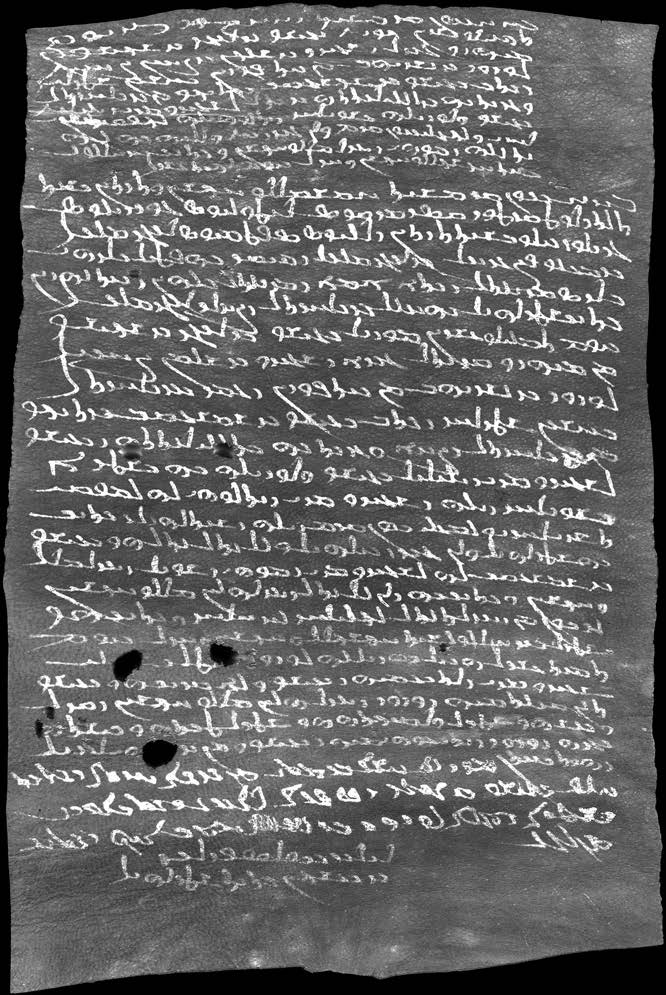
来自幼发拉底河(Euphrates)的羊皮纸(公元前 240 年 (240 BC))。它描述了一笔债务的转移,该债务对应于债务人尚未偿还的先前贷款。凭借这份文件,购买了该债务的新债权人正在主张其权利。文本下方是五位见证人中两位的签名(另外三个签名在背面)。该文件日期定为埃德萨(Edessa)的阿布加尔(Abgar)国王的"执政官" (consulate) 任期,即其统治的第二年。索邦大学纸草学研究所 (Institut de Papyrologie de la Sorbonne), P.Euphr.Inv.19, P Euphrate 18. © 亚当·比洛 - 雅各布森 (Adam Bülow-Jacobsen)。
ARCHIVAL PRACTICES Most likely, the archival practices of the small kingdom of Osrhoene are the reason behind the development of the Edessan Aramaic al- phabet. Administrative record-keeping had a prominent role in Edes- san culture, infl uenced by older Aramaic and Mesopotamian practices that endured in the kingdom of Osrhoene and passed into the Syriac tradition. There were offi cial scribes (sephre), which are mentioned in later commercial documents and literary texts. One famous parchment found in Dura Europos (P. Dura 28), dating to 243, contains a record of the sale of a slave by a woman from Edessa. It was written by one of the offi cial Edessan scribes, under the supervision of the superintendent of the archives, where, according to the document, a copy would be deposited. Besides a handful of documents from the Euphrates, the archives themselves were not preserved, but they are mentioned by the Greek historian Eusebius, the Armenian historian Movses Khorenats’i, and various Syriac texts. The Syriac Chronicle of 540, for instance, men- tions that the royal edicts meant to prevent the fl ooding of the city were put into writing by a royal scribe and deposited in the archives. In the 3rd century, the archives were still functional. A quick, cursive form of chancellery writing was taught to offi cial scribes, probably in schools specially designated for their training. These archives had an infl uence beyond writing and archival prac- tices. Some texts mention the archives to give an air of authenticity to certain fi ctional stories: the Teaching of Addai claims that the history of the conversion of Edessa was deposited there, and the writers of the Acts of the martyrs of the city claim that their sources were stored there as well. By claiming that the archives preserved records of these ac- counts—or had preserved them at one time—the writers bolstered the credibility of their stories. CULTS AND WORSHIP IN EDESSA Pre-Christian religion and cultic worship in Edessa also show its mixed culture. The Mesopotamian deities Bel, the supreme god, and Nabu, the
档案实践 奥斯罗恩 (Osrhoene) 小王国的档案实践很可能是埃德萨 (Edessa) 阿拉米语 (Aramaic) 字母发展的原因。行政记录保管在埃德萨 (Edessa) 文化中占有重要地位,受到古老的阿拉米语 (Aramaic) 和美索不达米亚 (Mesopotamian) 实践的影响,这些实践在奥斯罗恩 (Osrhoene) 王国中得以延续并传入叙利亚语 (Syriac) 传统。那里有官方文士 (sephre),后来的商业文献和文学文本中均提及了他们。一份发现于杜拉 - 欧罗波斯 (Dura Europos) 的著名羊皮卷(P. Dura 28),年代为 243 年,记载了一名埃德萨 (Edessa) 女子出售奴隶的记录。它由一名官方埃德萨 (Edessa) 文士书写,并在档案主管的监督下完成,根据文件记载,副本将存放于该档案处。 除了来自幼发拉底河 (Euphrates) 的少数文件外,档案本身并未保存下来,但它们被希腊历史学家优西比乌 (Eusebius)、亚美尼亚历史学家摩夫谢斯·霍雷纳齐 (Movses Khorenats’i) 以及各种叙利亚语 (Syriac) 文本所提及。例如,《540 年叙利亚语编年史》(Syriac Chronicle of 540) 提到,旨在防止城市洪水泛滥的王室敕令由王室文士书写并存入档案。在 3 世纪,档案室仍在运作。一种快速、草体的公文写作形式被教授给官方文士,可能是在专门指定用于他们训练的学校中。 这些档案的影响超出了书写和档案实践本身。一些文本提及档案是为了给某些虚构故事增添真实感:《阿代教导》(Teaching of Addai) 声称埃德萨 (Edessa) 皈依的历史存放于那里,而该城《殉道者行传》(Acts of the martyrs of the city) 的作者也声称他们的资料来源存储于那里。通过声称档案保存了这些记载的记录——或曾经保存过——作者们增强了他们故事的可信度。 埃德萨的崇拜与敬拜 埃德萨 (Edessa) 的基督教前宗教和崇拜仪式也显示了其混合文化。美索不达米亚 (Mesopotamian) 神祇贝尔 (Bel)(至高神)和纳布 (Nabu),这位
god of writing, were probably at the top of the Edessan pantheon, which also included the god of the underworld, Nergal. cults in edessa (teaching of addai)
文字之神,可能位居埃德萨 (Edessa) 万神殿之首,该万神殿 也包括冥界之神,涅伽尔 (Nergal)。 埃德萨 (Edessa) 的崇拜(《阿代教导》(Teaching of Addai))
I see that this city is fi lled with paganism which is contrary to God. Who is this [man-] made idol Nebo which you worship, and Bel which you honor? Behold there are those among you who worship Bath Nical, like the inhabitants of H. aran your neighbors, and Taratha, like the inhabitants of Mabbug, and the Eagle, like the Arabs, and the sun and the moon, like the rest of the inhabitants of Haran who are like you. Edessans also venerated the Syrian goddess Atargatis and the Ara- mean god Hadad, as well as the sun—under the name Shamash, which was common throughout the Semitic world—and the moon, under the name of the Mesopotamian god Sin, as well as under the name of the goddess Nikkal. Other gods included Azizos and Monimos, which we can recognize as the Arab divinities ʿAziz and Munʿim, or the planet Venus in the form of a morning and evening star, respectively. The ex- pression “Lord of the gods” in these inscriptions generally refers to Baal Shamin, the “Master of Heaven” in the Aramaic pantheon, but, at least in one case, it refers to the Greek god Zeus. One mosaic, known as the Marallahe, shows the adoption of Greek divinities but also the modes of thought that prevailed in the Roman world between Antioch and Alexandria in the 3rd century. It depicts fi ve gods: the most important, enthroned on the right side of the mosaic, is Zeus, but the writing identifi es him by the Aramaic title mar allahe (Lord of the gods). Next to him, the Greek name of his wife, Hera, is written in Aramaic letters, as is that of Prometheus and, most likely, Cosmos. Athena, although without a legend of her own, is easily recognizable to his left. Below him is a scene where Hermes puts a small winged soul into a body, just as a pair seems to emerge from the sleep of death, evoking themes from Neoplatonic philosophy. The Syriac letter of Mara Bar Serapion bears witness to the importance of Greek philo- sophical thought in Osrhoene; probably written between the 1st and
我看到这座城充满了违背神的异教信仰。你们所敬拜的这尊〔人造〕偶像尼波 (Nebo) 是谁?你们所尊崇的贝尔 (Bel) 又是谁?看哪,你们中间有人敬拜巴特·尼卡尔 (Bath Nical),就像你们邻居哈兰 (Haran) 的居民一样;有人敬拜塔拉塔 (Taratha),就像马布格 (Mabbug) 的居民一样;有人敬拜鹰,就像阿拉伯人 (Arabs) 一样;还有人敬拜日月,就像其余那些与你们相似的哈兰 (Haran) 居民一样。 埃德萨人 (Edessans) 也尊崇叙利亚女神阿塔伽提斯 (Atargatis) 和亚兰 (Aramean) 神哈达德 (Hadad),以及太阳——在整个闪米特 (Semitic) 世界通用的名字沙马什 (Shamash)——还有月亮,使用的是美索不达米亚 (Mesopotamian) 神辛 (Sin) 的名字,以及女神尼卡尔 (Nikkal) 的名字。其他神祇包括阿齐佐斯 (Azizos) 和莫尼莫斯 (Monimos),我们可以将其识别为阿拉伯 (Arab) 神祇阿齐兹 (ʿAziz) 和蒙伊姆 (Munʿim),或者分别是作为晨星和昏星形式的金星 (Venus) 行星。这些铭文中的“众神之主”一词通常指亚兰 (Aramaic) 万神殿中的“天国之主”巴尔·沙明 (Baal Shamin),但在至少一个案例中,它指的是希腊 (Greek) 神宙斯 (Zeus)。 一幅被称为马拉拉赫 (Marallahe) 的马赛克镶嵌画,展示了希腊 (Greek) 神祇的采纳,同时也反映了 3 世纪安提阿 (Antioch) 与亚历山大 (Alexandria) 之间罗马 (Roman) 世界盛行的思想模式。它描绘了五位神祇:最重要的一位坐在马赛克的右侧宝座上,是宙斯 (Zeus),但文字用亚兰 (Aramaic) 头衔“众神之主” (mar allahe) 来标识他。在他旁边,他妻子赫拉 (Hera) 的希腊名字用亚兰 (Aramaic) 字母书写,普罗米修斯 (Prometheus) 的名字也是如此,最可能还有科斯莫斯 (Cosmos)。雅典娜 (Athena) 虽然没有自己的铭文,但在他的左侧很容易辨认。在他下方是一个场景,赫尔墨斯 (Hermes) 将一个带翅膀的小灵魂放入身体中,就像一对灵魂似乎从死亡的睡眠中出现一样,唤起了新柏拉图主义 (Neoplatonic) 哲学的主题。《马拉·巴尔·塞拉皮翁的叙利亚书信》(Syriac letter of Mara Bar Serapion) 见证了希腊 (Greek) 哲学思想在奥斯若恩 (Osrhoene) 的重要性;可能写于 1 世纪至
Edessan mosaic of Marallahe. © William A. Haseltine. 3rd century AD, it contains an exhortation from a father to a son to study Greek thought. Judaism was also highly visible in Edessa, and the story of the Teaching of Addai shows the apostle staying at the house of a Jewish man named Tobit on his arrival in the city. Perhaps roughly 10 percent of the population of the city was Jewish at the beginning of the Christian era. Manichaeism, the religion created by Mani in the 3rd century AD in Mesopotamia, spread to Edessa as well and represented a rival to Chris- tianity in its nascent forms. Various other groups, including the Quqites and the Bardaisanites, were excluded and labeled heretical by the grow-
埃德萨 (Edessa) 的马拉拉赫 (Marallahe) 马赛克。© 威廉·A·哈斯尔廷 (William A. Haseltine)。 公元 3 世纪,它包含了一位父亲劝勉儿子研究希腊思想的内容。 犹太教 (Judaism) 在埃德萨 (Edessa) 也非常显著,《阿代教导》(Teaching of Addai) 的故事显示,这位使徒抵达该城时住在一位名叫托比特 (Tobit) 的犹太人家中。在基督教时代 (Christian era) 伊始,该市人口中或许约有 10% 是犹太人。 摩尼教 (Manichaeism) 是摩尼 (Mani) 于公元 3 世纪在美索不达米亚 (Mesopotamia) 创立的宗教,也传播到了埃德萨 (Edessa),在其早期形态中构成了基督教 (Christianity) 的竞争者。各种其他群体,包括库奎特派 (Quqites) 和巴尔代萨尼派 (Bardaisanites),都被成长中的 (grow-) 教会排除在外并贴上异端标签。
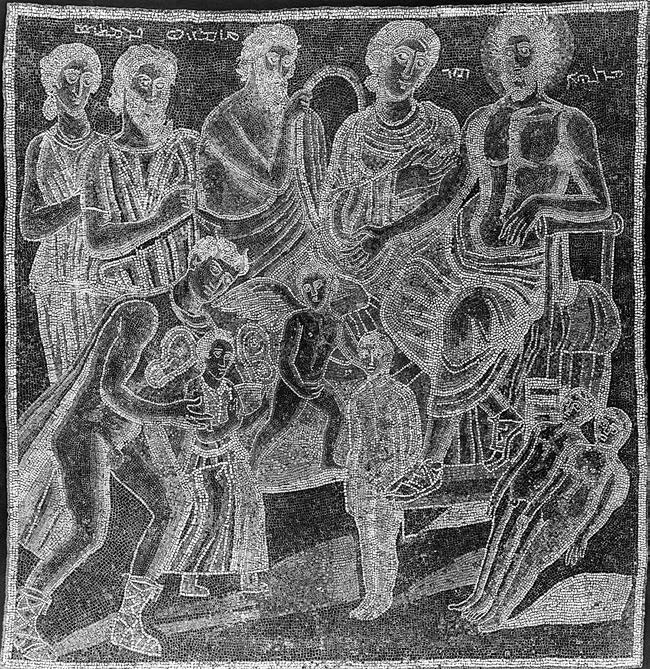
埃德萨 (Edessa) 的马拉拉赫 (Marallahe) 马赛克。© 威廉·A·哈斯尔廷 (William A. Haseltine)。
ing consensus of offi cial Christianity. When the Christians became the majority, they of course passed down only their own texts, but in the be- ginning Syriac was not only a Christian language in ancient Edessa but also the language of all these other religious groups, including the Jews (who contributed to the translation of the Old Testament version of the Peshit.ta, or Syriac Bible), polytheists (at least until the 9th century), and the Manichaeans, even if little remains of their writings. ORNAMENTAL AND FUNERARY MOSAICS: A MIRROR OF EDESSAN SOCIETY As in the rest of Syria, mosaics were known in Edessa as part of the fl ourishing of Roman culture, but they also captured local artistic trends. Rich Edessans decorated their homes with lavish mosaics using the style—and probably the same materials and artisans as well—that originally came from Antioch, famous for this kind of work. The most spectacular, already mentioned, is the Marallahe mosaic. Another is a series of panels that would have decorated a reception area. It is made up of scenes depicting episodes from Homer: we see Achilles and Patro- clus, Priam and Hecuba, Briseis with a servant, and, further on, Troi- los, although the writing on these Greek images is entirely in Edessan Aramaic. These scenes show the infl uence of Greek culture through its most emblematic work, The Iliad, as does the Syriac translation of the Hypomnemata of Ambrosios, which mentions the same fi gures. A mo- saic from another cycle shows Andromeda. Discovered in 2007, the mo- saics of the palace of Haleplibahçe, part of S¸anlıurfa where a new mosaic museum has been constructed, show the taste of aristocratic Edessans from the 3rd or 4th century with a string of Greek mythological motifs, featuring the queens of the Amazons, Hippolytus, Antiope, Melanippe, and Penthesilea, hunting, as well as episodes from the life of Achilles. There is also an exotic twist: an image of a black man dragging a zebra by a bridle. If these images give a glimpse into a common culture, the art of the mosaic also saw developments original to Edessa. Among the most typical monuments of Edessan culture are funerary mosaics, both fi gu- rative and written, which decorate the tombs of rich nobles belonging
…主导共识。当基督徒成为多数时,他们当然只传承了自己的文本,但在起初,叙利亚语 (Syriac) 不仅是古代埃德萨 (Edessa) 的基督教语言,也是所有其他宗教群体的语言,包括犹太人(他们参与了旧约 (OT) 版本即别西大译本 (Peshitta) 或叙利亚语圣经的翻译)、多神教徒(至少直到 9 世纪)以及摩尼教徒,尽管他们的著作留存甚少。 装饰性与丧葬镶嵌画:埃德萨 (Edessa) 社会的一面镜子 如同叙利亚 (Syria) 其他地区一样,镶嵌画作为罗马文化繁荣的一部分在埃德萨 (Edessa) 为人所知,但它们也捕捉到了当地的艺术趋势。富有的埃德萨人用奢华的镶嵌画装饰他们的家园,使用的是最初源自安条克 (Antioch) 的风格——可能还有相同的材料和工匠——那里以这类作品闻名。最壮观的,前面已提及,是马拉拉赫镶嵌画 (Marallahe mosaic)。另一组是一系列原本用于装饰接待区的嵌板。它由描绘荷马 (Homer) 史诗片段的场景组成:我们看到阿喀琉斯 (Achilles) 和帕特罗克洛斯 (Patroclus),普里阿摩斯 (Priam) 和赫卡柏 (Hecuba),布里塞伊斯 (Briseis) 与一名仆人,以及更远处的特罗伊洛斯 (Troilos),尽管这些希腊图像上的文字完全是埃德萨阿拉米语 (Edessan Aramaic)。这些场景展示了希腊文化通过其最具象征意义的作品《伊利亚特》(The Iliad) 所产生的影响,安布罗斯的《回忆录》(Hypomnemata of Ambrosios) 的叙利亚语译本也是如此,其中提到了相同的人物。另一个循环的镶嵌画展示了安德罗墨达 (Andromeda)。2007 年发现的哈利勒巴赫切 (Haleplibahçe) 宫殿镶嵌画,位于新建了镶嵌画博物馆的尚勒乌尔法 (Şanlıurfa) 的一部分,展示了 3 或 4 世纪贵族埃德萨人的品味,包含一系列希腊神话母题,以亚马逊人 (Amazons) 的女王们为特色,包括希波吕托斯 (Hippolytus)、安提奥佩 (Antiope)、梅拉尼佩 (Melanippe) 和彭忒西勒亚 (Penthesilea) 狩猎,以及阿喀琉斯 (Achilles) 生平中的片段。 还有一个异国情调的转折:一个黑人男子牵着斑马辔头的图像。 如果这些图像让人瞥见了一种共同文化,那么镶嵌画艺术也见证了埃德萨 (Edessa) 原创的发展。埃德萨 (Edessa) 文化中最典型的纪念碑式作品之一是丧葬镶嵌画,包括具象和文字两种,装饰着属于富有的贵族的坟墓
Edessan mosaic representing Achilles and Patroclus. Courtesy of the Bible Lands Museum Jerusalem, Israel. to the 3rd century. It is a form typical of Edessa, whereas in Palmyra and the Roman world of the East these inscriptions are always carved on stone and not on mosaic. A number of these mosaics represent a family group: the father and the founder of the tomb in the center, surrounded by his wife and children, each of whom are identifi ed by their name and surname written in Edessan Aramaic by their heads. In certain cases, a more detailed inscription, placed in the frame, mentions the foundation of the tomb. The men generally wear a type of Parthian clothing, with large pleated pants, long tunics embroidered with elaborate motifs, as well as a beard and a Persian hat. The women wear a kind of robe close to classical dress, attached to the shoulders by fi bulae, and often a very tall device covered by a veil. This kind of clothing was also worn by notables in Palmyra, where one also fi nds fi gural reliefs on tombstones. Other Edessans chose to decorate their tombstones not with a gallery of familial portraits but with motifs of Greek mythology tied to symbolism of death and life after death: two motifs representing Orpheus, the van-
埃德萨 (Edessa) 马赛克,描绘阿喀琉斯 (Achilles) 和帕特罗克洛斯 (Patroclus)。承蒙以色列耶路撒冷圣经之地博物馆 (Bible Lands Museum Jerusalem, Israel) 惠允。 至 3 世纪。这是埃德萨 (Edessa) 典型的一种形式,而在帕尔米拉 (Palmyra) 和东方罗马世界,这些铭文总是刻在石头上,而不是马赛克上。这些马赛克中有许多表现了一个家族群体:父亲和墓葬的创立者位于中央,周围环绕着他的妻子和孩子,每个人的身份都由写在他们头旁的埃德萨阿拉米语 (Edessan Aramaic) 姓名标识。在某些情况下,位于边框中的更详细的铭文会提及墓葬的建立。男性通常穿着一种帕提亚 (Parthian) 风格的服装,配有宽大的褶皱裤子、绣有复杂图案的长束腰外衣,以及胡须和波斯 (Persian) 帽。女性穿着一种接近古典服饰的长袍,用饰针 (fibulae) 固定在肩部,通常还有一个覆盖着面纱的非常高大的头饰。这种服装也被帕尔米拉 (Palmyra) 的显贵所穿着,在那里也能在墓碑上找到人物浮雕。其他埃德萨人 (Edessans) 选择装饰他们的墓碑,不是用家族肖像画廊,而是用与死亡和死后生命象征相关的希腊神话主题:两个代表俄耳甫斯 (Orpheus) 的主题,即征服者 (van-)
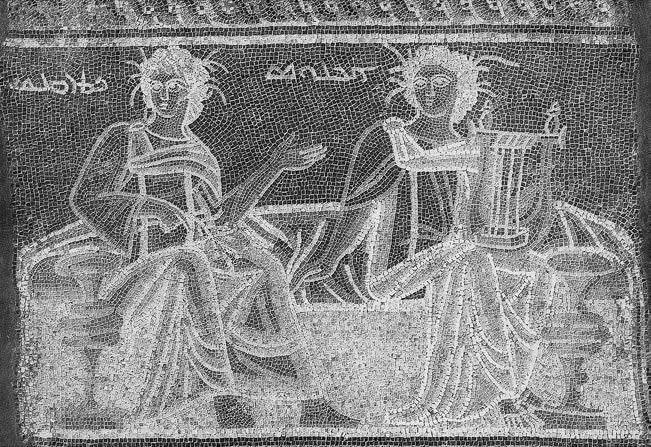
埃德萨 (Edessa) 马赛克,描绘阿喀琉斯 (Achilles) 和帕特罗克洛斯 (Patroclus)。承蒙以色列耶路撒冷圣经之地博物馆 (Bible Lands Museum Jerusalem, Israel) 惠允。
quisher of the underworld, calming the animals with the sound of his lyre; another of the phoenix, the mythical bird that after death is born again from its ashes. In the absence of other evidence, it is impossible to say whether these suggestions of life after death come from pagans, Jews, or Christians. A very recent discovery of a funerary mosaic with a cross Votive stele with two people in Parthian dress. The accompanying inscription is in Greek. Photo by Françoise Briquel Chatonnet.
冥界的征服者,用里拉琴的声音安抚动物;另一幅描绘的是凤凰,这种神话中的鸟死后会从灰烬中重生。在没有其他证据的情况下,无法断定这些关于死后的暗示来自异教徒、犹太人还是基督徒。最近发现了一幅带有十字架的丧葬镶嵌画 身穿帕提亚 (Parthian) 服饰的两人的还愿石碑。 随附铭文为希腊语 (Greek)。照片来源:弗朗索瓦丝·布里凯尔·查托内 (Françoise Briquel Chatonnet)。
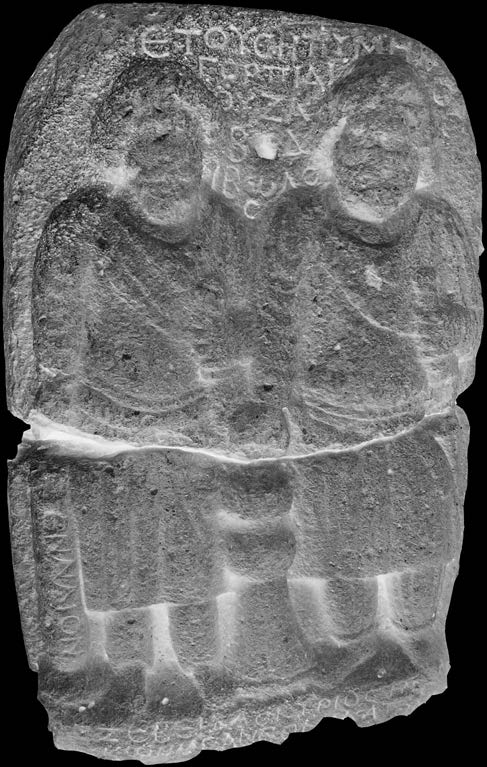
身穿帕提亚 (Parthian) 服饰的两人的还愿石碑。随附铭文为希腊语 (Greek)。照片来源:弗朗索瓦丝·布里凯尔·查托内 (Françoise Briquel Chatonnet)。
but nonfi gurative decorations shows that this last possibility should not be excluded. The names of certain deceased persons are also mentioned on fu- nerary steles in either Greek or Aramaic inscriptions: for instance, there is an inscription in Greek on a bas-relief featuring the deceased in Par- thian clothing, showing the hybridity of this culture. It was in this milieu of cultural interaction, bringing together mul- tiple infl uences, that Aramaic, or Syriac, Christianity was born.
但非具象装饰表明,不应排除这最后一种可能性。 某些逝者的名字也出现在丧葬石碑上,铭文为希腊语或阿拉米语(Aramaic):例如,有一块浅浮雕上的希腊语铭文,描绘了身着帕提亚(Parthian)服饰的逝者,显示了这种文化的混合性。 正是在这种汇聚了多重影响的文化互动环境中,阿拉米语(Aramaic)或叙利亚语(Syriac)基督教诞生了。