布洛克《叙利亚传统研究导论》(中英文对照版)第四部分
阿甲按:这本中文译作参考了DeepL的翻译,经笔者修订而成,其中定有许多不足之处,欢迎各位读者,专家指正。
凡例:
- 翻译自:Brock, S. P. (2017). An introduction to Syriac studies. Gorgias Press.
- 本连载中的人名,地名,书名和专业术语的中译未必准确「有很多事第一次出现,也请各位方家指正」,若要参考具体细节,欢迎请参考这里
- 翻译采用双语对照模式,并附上原作页码信息,以方便读者参阅原文,引用具体出处。
- 版权申明:若要引用,请采用以下格式:S. Brock,《叙利亚「教会传统」研究导论4》,袁永甲中译(伦敦:教父原文中译计划,2026年4月25日),某年某月某日引用,本文网址。
布洛克《叙利亚传统研究导论》(中英文对照版)第四部分
EPILOGUE: THE DELIGHTS OF MANUSCRIPTS
后记:手稿的乐趣
To read, as one sits in the Oriental Studies Room of the British Library, the words “this volume was completed in the month Teshri II of the year 723 in Urhay, capital of Beth Nahrin” is a moving experience, for at the end of this, the earliest of all dated Syriac manuscripts (411 of the Christian era), is also a list of names of Persian martyrs, almost certainly brought back from Seleucia-Ktesiphon only a few months previously by Marutha, bishop of Martyropolis, who had been serving as ambassador to the Sasanid court. It does not take much imagination to find oneself transported back across time and space to Edessa in November 411. This moving experience was repeated when, in 2005, in the course of cataloguing, with Lucas van Rompay, the Syriac materials in the Library of Deir al-Surian, I suddently recognized, on a diminutive fragment, the very distinctive small script of the same manuscript: indeed it turned out to be part of the torn final folio of the manuscript now in the British Library; equally moving was the discovery that this fragment contained the names of the women martyrs.
坐在大英图书馆的东方研究室里,读到 “本卷完成于 723 年 Teshri II 月,地点在贝思纳赫林的首府乌尔海 “这样的字眼,令人感动,因为在这份手稿的末尾、因为在这份叙利亚最早的手稿(基督教时代的 411 年)的末尾,还有一份波斯殉教者的名单,几乎可以肯定是几个月前由马蒂ropolis 的主教马鲁塔从塞琉西亚-克铁西彭带回的,当时他正在萨珊王朝宫廷担任大使。不需要太多想象力,就能发现自己穿越时空回到了 411 年 11 月的埃德萨。2005 年,在与卢卡斯-范-罗姆佩(Lucas van Rompay)一起为迪尔苏里南图书馆的叙利亚文资料编目时,我突然在一个小碎片上发现了同一份手稿非常独特的小字体,这种令人感动的经历再次重演:事实上,它就是现藏于大英图书馆的手稿最后对开撕毁部分的一部分;同样令人感动的是,我发现这个碎片上有女殉道者的名字。
As a matter of fact the first Syriac manuscript I ever had the joy of handling was a rather scruffy and torn fragment on a visit to Beirut as an undergraduate; although it was no more than a couple of hundred years old at the most, my curiosity was aroused by the mention of the fifth century emperor Marcian. On return home I managed to identify the text as a fragment of the Life of the fierce monk Barsoma who successfully scared off his theological opponents at the second council of Ephesus in 449. The excitement caused me by this very minor discovery proved addictive, but fortunately for one’s pocket one does not necessarily have to go to the Middle East to browse among Syriac manuscripts; London and Birmingham happen to possess two of the largest collections of Syriac manuscripts in the world. The bulk of those in the British Library are exceptionally old, some belonging to the fifth and sixth centuries—thanks to their having been preserved until the mid-nineteenth century in the Syrian monastery (Deir al-Surian, now Coptic Orthodox) the Nitrian desert, between Alexandria and Cairo. The manuscripts in the Mingana Collection
事实上,我有幸处理的第一份叙利亚文手稿是在大学期间访问贝鲁特时看到的一个相当邋遢和破损的片段;虽然它最多只有几百年的历史,但其中提到五世纪的皇帝马尔西安(Marcian)引起了我的好奇心。回国后,我设法确认了该文本是凶猛的僧侣巴索马的生平片段,他在 449 年第二次以弗所会议上成功地吓退了他的神学对手。这一小小的发现让我兴奋不已,但幸运的是,我的口袋不一定非要去中东才能浏览叙利亚文手稿;伦敦和伯明翰恰好拥有世界上最大的两处叙利亚文手稿收藏地。大英图书馆收藏的大部分手稿都非常古老,有些属于五世纪和六世纪的作品,因为它们在十九世纪中叶之前一直保存在亚历山大和开罗之间尼特里亚沙漠的叙利亚修道院(Deir al-Surian,现为科普特东正教修道院)中。明加纳收藏的手稿
to the Syriac cultural world.
叙利亚文化世界。
A few words should be said about each of these Churches, which all belong of the Selly Oak Colleges Library, Birmingham, on the other hand, are mostly very recent (one was copied as late as 1932), but nevertheless they contain several works not otherwise represented in Western libraries. They were collected by Alphonse Mingana (whose name has figured earlier) during the course of two journeys to the Middle East financed by the generosity of Edward Cadbury.
这些教堂都属于伯明翰塞利橡树学院图书馆(Selly Oak Colleges Library),它们大多是最近的作品(其中一本抄写于 1932 年),但它们包含了西方图书馆中没有的几部作品。这些作品是阿尔方斯-明加纳(Alphonse Mingana)(他的名字已在前面提及)在爱德华-卡德伯里(Edward Cadbury)的慷慨资助下两次前往中东期间收集的。
Syriac scribes usually follow the old tradition, already found in ancient Mesopotamia, of adding at the end of the text they are copying a colophon, giving details of the date and place of writing, as well as their own name; and if there was empty space still available, their horror vacui might lead them to fill it with imprecations against anyone who borrowed the book and failed to return it. Jottings about some contemporary event might also find their way into empty end leaves, and one of the earliest accounts, and probably contemporary, of the Arab invasion of Palestine is to be found on the fly leaf of a sixth-century Gospel manuscript in the British Library. The scribe of a much more recent (late nineteenth-century) Mingana manuscript has left us with a moving narrative of several pages describing the massacre just suffered by the Syrian Orthodox communities of southeastern Turkey in 1895–96. indicate separate Churches. thing in the Middle East, and quite another in India! Separate numbers noticed that, to add to the confusion, the term “Chaldean” denotes one those names in italics refer to Churches of Syriac tradition in India; it will be
叙利亚文抄写员通常遵循古美索不达米亚的古老传统,在他们抄写的文本末尾加上一个题记,详细说明写作日期和地点,以及他们自己的名字;如果还有空位,他们可能会在空位上写上对借书不还者的咒骂。大英图书馆收藏的一本六世纪福音书手稿的扉页上就有关于阿拉伯人入侵巴勒斯坦的最早记载,而且很可能是当代的记载。一份更近期(19 世纪晚期)的明加那手稿的抄写员为我们留下了长达数页的动人叙述,描述了 1895-96 年土耳其东南部叙利亚东正教社区刚刚遭受的大屠杀!我们注意到,为了混淆视听,“迦勒底 “一词指的是在印度的叙利亚传统教会中的一个,而斜体中的名字指的是在印度的叙利亚传统教会中的一个。
Churches can best be set out diagrammatically. In the following Table 3
这些教会最好用图表来表示。下表 3
The confusing situation presented by the various different Syriac
各种不同的叙利亚教会所造成的混乱局面
Orthodox Church, the Mar Thoma Syrian Church. in India (mainly in the State of Kerala); these include the only Reformed there are no less than seven different Churches of Syriac liturgical tradition led to fragmentation of the once single ecclesiastical tradition, and today da Gama in 1498). The misguided attempt to latinize the liturgical tradition
在印度(主要在喀拉拉邦),包括唯一的改革宗在内,有不少于七个不同的叙利亚礼仪传统教会,导致曾经单一的教会传统支离破碎,而今天的达伽马教会则是在 1498 年建立的)。将礼仪传统拉丁化的错误尝试
Habent sua fata libelli. Later owners, as well as the original scribes, were apt to add their names to manuscripts, sometimes even mentioning the price they paid for it. One such owner, to whom Syriac scholarship owes an inestimable debt, was Moses of Nisibis, abbot of Deir al-Surian. Shortly after 926 he went to Baghdad to petition the Caliph on the matter of the tax problems faced by his own and other Egyptian monasteries. Sorting out tax affairs was a slow business then, just as it often is now, and before he finally returned to his monastery in 932 he took the opportunity to visit various Mesopotamian monasteries, buying up old Syrian manuscripts wherever he could. In this way he accumulated a magnificent collection of texts—which today form the nucleus of both the Vatican and the British Library holdings of Syriac manuscripts (some of those in the Vatican, bought in the early eighteenth century, still bear the marks of a mishap on the journey to Rome, when a load of them fell into the Nile). An attempt to reconstruct the contents of Moses’ superb library, on the basis of his various notes of ownership, was made by H. Evelyn White in his The History of the Monasteries of Nitria and Scetis (New York, 1923). records are available prior to the arrival of the Portuguese (first with Vasco the Church of the East in Mesopotamia. Unfortunately very few historical certainly establised there by an early date, its hierarchical links being with tradition. This is not inconceivable, and a Christian community was
Habent sua fata libelli.后来的所有者和最初的抄写员都会在手稿上加上自己的名字,有时甚至会提到他们为之付出的代价。Deir al-Surian 的修道院院长尼西比斯的摩西(Moses of Nisibis)就是这样一位手稿所有者,他为叙利亚语学术研究做出了不可估量的贡献。926 年后不久,他就自己的修道院和其他埃及修道院面临的税收问题前往巴格达向哈里发请愿。和现在一样,当时解决税收问题也是一件缓慢的事情,在他最终于 932 年返回修道院之前,他利用这个机会访问了美索不达米亚的许多修道院,并在可能的地方购买了叙利亚的旧手稿。通过这种方式,他积累了大量的文稿—这些文稿如今已成为梵蒂冈和大英图书馆收藏的叙利亚文手稿的核心(梵蒂冈收藏的一些手稿是 18 世纪初购买的,至今仍留有运往罗马途中发生事故的痕迹,当时有一车手稿掉进了尼罗河)。H. Evelyn White 在他的《尼特里亚和斯凯提斯修道院史》(纽约,1923 年)中,试图根据摩西的各种所有权说明,重建摩西一流图书馆的内容。 在葡萄牙人(首先是东方教会的瓦斯科)到达美索不达米亚之前,有一些记录。不幸的是,很少有历史记载表明,该教会很早就在那里建立了,其等级联系与传统有关。这并不是不可想象的,在美索不达米亚出现了一个基督教社区。
Although the authorities of the British Museum were led to believe that they had bought up from the monastery all remaining Syriac manuscripts that had been left by Elias Assemani in 1707, it is now known that several dozen old Syriac manuscripts still remain in the monastery;
虽然大英博物馆当局认为他们已经从修道院买走了埃利亚斯-阿斯马尼(Elias Assemani)1707 年留下的所有叙利亚文手稿,但现在人们知道,修道院里还保存着几十份古老的叙利亚文手稿;
Christianity reached south India with St. Thomas, according to an early
基督教随着圣托马斯传到了南印度,根据早期的
these have now been described by Lucas van Rompay and myself in our Catalogue of the Syriac Manuscripts and Fragments in the Library of Deir al-Surian, Wadi al-Natrun (Egypt) (Orientalia Lovaniensia Analecta 227; Leuven, 2014), accompanied by over 300 pages of images of manuscripts.
Lucas van Rompay 和我本人在《埃及 Wadi al-Natrun Deir al-Surian 图书馆的叙利亚文手稿和残片目录》(Orientalia Lovaniensia Analecta 227;鲁汶,2014 年)中对这些手稿和残片进行了描述,并附有 300 多页的手稿图片。
Owners of manuscripts, both ancient and modern, sometimes like to obliterate any too telling evidence of a manuscript’s origin. In the Mingana collection there is a group of single leaves of early manuscripts cut out with scissors from their rightful home, and in several cases it is possible to mate them up—at least figuratively—with the original manuscripts from which they were taken—all at St. Catharine’s Monastery on Mount Sinai: one pair of leaves indeed proved to be part of a unique manuscript containing the works of the seventh-century mystic Sahdona (or Martyrius), the author of a very fine work on spirituality. Today this manuscript, not quite complete, is divided up between Birmingham, Strassbourg, St Petersburg, and Milan. The publication of Mother Philothea of Sinai’s catalogue of the “New Finds” at the Monastery has happily revealed that part of the manuscript in fact still remains in the Monastery.1 A word of warning: such chance discoveries of “marriages” between loose leaves in different libraries can have unexpected, and time-consuming consequences: one turned out to involve me in the writing of an entire book.[^22] But this is part of the fascination of the whole business.
古今手稿的所有者有时喜欢抹去手稿来源的任何明显证据。在明加纳的藏品中,有一组早期手稿的单叶被剪刀从原处剪下,在一些情况下,我们可以将它们—至少是象征性地—与原手稿配对,这些手稿均出自西奈山的圣凯瑟琳修道院:其中一对单叶被证明是一份独特手稿的一部分,该手稿收录了七世纪神秘主义者萨多纳(或马蒂尤斯)的作品,他是一部非常优秀的灵性著作的作者。如今,这份并不完整的手稿被分散在伯明翰、斯特拉斯堡、圣彼得堡和米兰。西奈修道院院长菲洛蒂娅的 “新发现 “目录出版后,令人欣慰的是,该手稿的一部分实际上仍保存在修道院中1。需要提醒的是:这种在不同图书馆中偶然发现的散页之间的 “联姻”,可能会产生意想不到的后果,而且会耗费大量时间:其中一次结果是我参与了一整本书的写作。[^22]
European and American libraries are usually reasonably well catalogued, but catalogues do not always give away the true nature of a manuscript’s actual contents. I would never have looked at “Initium martyrii Maximi Palaestinensis” if I had not been interested in another text in the same manuscript, yet this turned out to be an astonishing document—an early “anti-life” of Maximus the Confessor (died 662), written by a theological opponent, evidently within a few decades of his death. According to this work, Maximus was born and educated in Palestine, and not Constantinople—which would nicely explain his friendship with Sophronius, patriarch of Jerusalem. The manuscript in
欧洲和美国的图书馆通常都有相当完善的目录,但目录并不总能揭示手稿实际内容的真实性质。如果不是对同一手稿中的另一篇文章感兴趣,我绝不会去看 “Initium martyrii Maximi Palaestinensis”,但这竟然是一份惊人的文献—忏悔者马克西姆斯(卒于 662 年)的早期 “反生平”,作者是一位神学反对者,显然是在他死后几十年内写的。根据这部作品,马克西姆斯出生在巴勒斯坦,并在那里接受教育,而不是君士坦丁堡—这就很好地解释了他与耶路撒冷元老索福罗尼乌斯的友谊。手稿
question proved to be a very rare example of an early Maronite text, and it incidentally threw some light on the exceedingly obscure origins of the Maronites themselves.
这个问题被证明是早期马龙派教派文本中非常罕见的一个例子,它还顺便揭示了马龙派教派本身极其模糊的起源。
In the case of Middle Eastern libraries, for which catalogues are a rarity, the unexpected is always present (provided one can get access in the first place!). What treasures are still to be found there can be seen from the lengthy list of Arthur Vööbus’ discoveries as a result of his systematic examination of these collections (the bibliography of his publications, given in the recent Festschrift in his honour, runs to over 50 monographs and 200 articles!). Fortunately today, thanks to the work of the Hill Museum & Monastic Library (HMML) at St John’s University, Collegeville, many of these Middle Eastern collection have been digitized and catalogued, thus making them immensely more accessible to scholars.
中东图书馆的目录非常罕见,但总是会出现意想不到的情况(前提是首先能进入图书馆!)。阿瑟-沃布斯(Arthur Vööbus)在对这些藏书进行系统研究后,发现了许多珍宝(最近为纪念他而出版的纪念文集中列出了他的出版物书目,共有 50 多部专著和 200 多篇文章!)。幸运的是,今天,由于科利克维尔圣约翰大学希尔博物馆和修道院图书馆(HMML)的工作,这些中东藏品中的许多都已数字化并编入目录,从而使学者们更容易获得这些藏品。
One exciting moment in my own experience was when I came across a note going back to the great twelfth-century Patriarch, Michael the Great, author of the largest and most important Syriac Chronicle. The note was to the effect that it was he who was behind the copying of the huge twovolume collection of Lives of the Saints which I had perched precariously on a diminutive coffee table in the office of the secretary to the Syrian Orthodox Patriarch in Damascus. (On a subsequent visit the Patriarch, His Holiness Mar Ignatius Yakub III, had very kindly allowed me to work in the library itself—almost an embarras de richesse!).
在我的亲身经历中,一个令人兴奋的时刻是我发现了一份可以追溯到十二世纪伟大的牧首迈克尔大帝的笔记,他是最大、最重要的叙利亚编年史的作者。字条的大意是,正是他参与了两卷本巨著《圣人传》的抄写工作,而我当时就把这两卷本《圣人传》放在大马士革叙利亚东正教牧首秘书办公室的一张小茶几上,岌岌可危。(在随后的一次访问中,宗主教伊格纳修斯-雅库布三世陛下非常友好地允许我在图书馆里工作—这几乎是一种 “财富的尴尬”!)。
It is usually only in the larger episcopal libraries that really old manuscripts are now to be found, but almost every village church will have a small collection of liturgical manuscripts (for the most part printed books are not used in church services). The colophons of these can often prove to be an unexpected source for local history. An unusually long colophon in a Fenqitho (the approximate equivalent of a Western breviary) which I once saw at the Syrian Orthodox monastery of Mar Gabriel in Tur Abdin told how the manuscript had originally been written in 1838 by a novice called Zaytun at Mar Gabriel, then recently repopulated after it had lain desolate for 120 years as a result of various pillages. Probably in 1915, called “the year of the sword” in local tradition (because of the large-scale massacres), it had been taken as plunder by Muslims from the monastery, but eventually in 1929 it had been bought back by a certain sub-deacon George, who then donated it to the village church of Keferze (also in Tur ‛Abdin), where it had remained until some years ago, when the abbot of Mar Gabriel, Rabban Samuel Aktash (now Mar Timotheos, bishop of Tur ‛Abdin), together with the head of the monastic school there, Malfono Isa Gülten (Garis), happened to visit the church and read the colophon; they arranged to have
现在通常只有在较大的主教图书馆才能找到真正古老的手稿,但几乎每个乡村教堂都有少量的礼仪手稿收藏(大部分印刷书籍不用于教堂礼拜)。这些手稿的副标题往往会成为地方历史的意想不到的资料来源。我曾在图尔阿布丁的叙利亚东正教马加布里埃尔修道院(Mar Gabriel)看到过一本 Fenqitho(近似于西方的教经),其中有一段异常冗长的序言,讲述了手稿最初是由马加布里埃尔修道院一位名叫扎伊屯(Zaytun)的新手于 1838 年写成的,当时马加布里埃尔修道院由于各种掠夺荒废了 120 年,最近才重新有人居住。可能是在 1915 年,即当地传统的 “刀剑之年”(因为发生了大规模屠杀),这本书被穆斯林从修道院抢走,但最终在 1929 年被一位名叫乔治的副执事买了回来,然后他把这本书捐给了凯费尔泽村教堂(也在图尔‛阿卜丁)、玛尔-加布里埃尔修道院院长拉班-塞缪尔-阿克塔什(现任图尔阿布丁主教玛尔-提摩太斯)和那里的修道院学校校长马尔福诺-伊萨-居尔滕(加里斯)偶然参观了这座教堂并看到了碑铭;他们安排
another Fenqitho copied for the church, and so the manuscript of 1838 (a fine piece of calligraphy) has now been returned to its original home where it is greatly cherished.
因此,1838 年的手稿(一幅精美的书法作品)现已被送回原处,受到人们的珍爱。
As my experience with the Life of Maximus the Confessor had indicated, it is not always necessary to travel far in order to make an exciting discovery. One that was almost literally on my doorstep took place in the Bodleian Library in Oxford. Idly looking through a card index of uncatalogued manuscripts I noticed one containing works by the seventhcentury monastic author, Isaac of Niniveh, whose works have come to be widely read in many European languages, thanks to a Greek translation made at the Monastery of St. Saba, near Jerusalem, in the late eighth or early ninth century. As the Bodleian manuscript was said to be an early one, I ordered it up—to discover that it was a further volume of his writings, of which the only other complete manuscript had been destroyed during the First World War. The interest of these new texts can be gauged from the fact that there have already been translations into English, French, Italian, Catalan, Russian, Romanian, and Arabic.
正如我在《忏悔者马克西姆斯的一生》中的经历所表明的那样,要想有令人兴奋的发现,并不一定非要长途跋涉不可。牛津大学博德雷恩图书馆就有一个几乎就在我家门口的发现。在翻阅未编入目录的手稿索引卡时,我注意到其中一份手稿收录了七世纪修道士作家尼尼微的以撒的作品,由于八世纪末或九世纪初耶路撒冷附近圣萨巴修道院的希腊文译本,他的作品在欧洲多种语言中广为流传。据说这份博德雷亚手稿是他早期的作品,于是我订购了这份手稿,结果发现这是他的另一卷著作,其中唯一一份完整的手稿已在第一次世界大战期间被毁。这些新的文本已经被翻译成英语、法语、意大利语、加泰罗尼亚语、俄语、罗马尼亚语和阿拉伯语,由此可以看出人们对它们的兴趣。
It will come as a surprise to many to learn that Syriac manuscripts are still being copied in the Middle East. Facilities for printing Syriac are rare, and the printing press, donated by Queen Victoria, which the previous Syrian Orthodox metropolitan of Mardin, Mar Yuhannon Dolabani (+ 1969), had used for publishing a Syriac periodical, ceased to be active after 1956. The scribes are normally deacons, priests, or monks; the late Father Butrus Ögünc, who was a priest to one of the émigré Syriac communities in Germany, whom I first met when he was schoolmaster in the small town of Midyat in Tur ‛Abdin, had written some 100 manuscripts by the time he was thirty years old! At first all the various liturgical books (and several literary texts) published from the Monastery of St. Ephrem in the Netherlands in the 1970s and 1980s were reproduced from the beautiful handwriting of Mor Julius Çiçek (died 2005), the first Syrian Orthodox bishop in Europe. With the advent of the possibility of printing Syriac with the computer, this has of course now changed. There is, however, a nice example of continuity: at the end of many of the books published by Mor Julius using computer technology he has retained a colophon that he had previously used when copying manuscripts; this reads “As the sailor rejoices when his boat reaches harbour, so does the scribe when he writes the last line.” This happens to be a very ancient and widespread colophon, for it is also found in both Greek and Latin manuscripts in the Middle Ages; the earliest example of its use, however, is in Syriac, in a manuscript dated AD
许多人可能会惊讶地发现,叙利亚文手稿仍在中东地区被复制。印刷叙利亚文的设施很少,由维多利亚女王捐赠的印刷机在 1956 年后就停止使用了,马尔丁的前任叙利亚东正教都主教于汉农-多拉巴尼(Mar Yuhannon Dolabani,+ 1969 年)曾用这台印刷机出版叙利亚文期刊。抄写员通常是执事、牧师或僧侣;已故的布特鲁斯-奥古恩茨(Butrus Ögünc)神父是德国一个移居国外的叙利亚社区的牧师,我第一次见到他时,他还是图尔艾布丁(Tur ‛Abdin)米迪亚特(Midyat)小镇的校长!20 世纪 70 年代和 80 年代,荷兰圣艾弗勒姆修道院出版的各种礼仪书籍(以及一些文学作品)最初都是根据欧洲第一位叙利亚东正教主教莫尔-朱利叶斯-奇切克(卒于 2005 年)的精美手迹复制的。当然,随着用电脑打印叙利亚文的可能性的出现,现在情况已经发生了变化。不过,有一个很好的连续性例子:在莫尔-朱利叶斯利用计算机技术出版的许多书籍末尾,他都保留了以前抄写手稿时使用的副标题,内容是 “正如水手在船靠港时欢欣鼓舞,抄写员在写下最后一行时也是如此”。这恰好是一个非常古老且广泛使用的副标题,因为在中世纪的希腊文和拉丁文手稿中都有出现;不过,最早使用该副标题的例子是叙利亚文,出现在一份公元
543, and this happens to antedate the earliest Greek use of it by over a century.
543 年,而这恰好比希腊最早使用该词的时间早了一个多世纪。
If one has the privilege of meeting people from the different communities of Syriac tradition, such as Mar Aprem, Mor Gregorios Ibrahim, Mor Julius Çiçek, Fr. Yusuf Habbi, Chorepiscopus Pierre Yousif, Fr. Jacob Thekeparampil, Dr. George Kiraz, and Malphono Abrohom Nouro, to mention only some of those whose names have come up in the course of this Introduction, one quickly becomes aware that to study Syriac is to study a tradition which is still very much alive.
如果我们有幸见到来自叙利亚语传统不同社区的人,如阿普雷姆(Mar Aprem)、格雷戈里奥斯-易卜拉欣(Mor Gregorios Ibrahim)、朱利叶斯-奇切克(Mor Julius Çiçek)、优素福-哈比(Yusuf Habbi)神父、皮埃尔-优素福(Chorepiscopus Pierre Yousif)、雅各布-泰克帕兰皮尔(Jacob Thekeparampil)神父、乔治-基拉兹(George Kiraz)博士和马尔福诺-阿布罗霍姆-努罗(Malphono Abrohom Nouro)—仅提及在本导言中提到的其中一些人的名字—我们很快就会意识到,研究叙利亚语就是研究一种仍然非常有生命力的传统。
For further reading: There are helpful contributions on different aspects of Syriac manuscripts and codicology by E. Balicka-Witakowska, A. Binggeli, P.-G. Borbone, F. Briquel-Chatonnet, A. Desreumaux, G. Kessel, A. Mengozzi, A. Schmidt, and W. Witakoswki in A. Bausi (ed.), Comparative Oriental Manuscript Studies. An Introduction (Hamburg, 2015). Some basic information can also be found in chapter 8, “The Art of the Scribe”, in vol. II of The Hidden Pearl (for which, see Section H, at the end).
供进一步阅读:E. Balicka-Witakowska、A. Binggeli、P.-G. Borbone、F. Briquel 等人撰写的关于叙利亚文手稿和编纂学不同方面的文章很有帮助。Borbone, F. Briquel-Chatonnet, A. Desreumaux, G. Kessel, A. Mengozzi, A. Schmidt, and W. Witakoswki in A. Bausi (ed.), Comparative Oriental Manuscript Studies.导论》(汉堡,2015 年)。一些基本信息也可在《隐珠》第二卷第 8 章 “抄写员的艺术 “中找到(参见末尾的 H 部分)。
APPENDIX: THE SYRIAC CHURCHES
附录:叙利亚教会
Syriac literature is closely tied to church history, and the variety of names in use for the various Syriac churches, coupled with the popular misconceptions which are current (even in otherwise reliable modern works) about their theological position, combine to increase the bewilderment of the outsider and the newcomer to the subject.
叙利亚文学与教会历史密切相关,各种叙利亚教会的名称五花八门,再加上目前(甚至在可靠的现代著作中)流行的关于其神学地位的误解,使外来者和初学者对这一主题更加迷惑不解。
First of all it will be helpful to clarify the confusing terminology by means of a table:
首先,通过一个表格来澄清混乱的术语会有所帮助:
The terms “Nestorian” and “Monophysite” were originally devised as opprobrious epithets, and imply the holding of heretical opinions; as such they are misleading and should definitely be avoided. “Jacobite” derives from Jacob Baradaeus who reorganized the Syrian Orthodox Church in the mid-sixth century at a time when the emperor Justinian was trying to suppress its hierarchy. “Assyrian,” very popular today in the Middle East and émigré communities (since for many it provides a much sought for “national” identity) seems to originate, as far as its present day connotations are concerned, with the conjecture of some nineteenth-century archaeologists and missionaries that the modern Christian population of
景教 “和 “基督一性一 “这两个词最初是作为蔑称使用的,意味着持有异端观点;因此,这两个词具有误导性,应绝对避免使用。“雅各派 “源于雅各布-巴拉达乌斯(Jacob Baradaeus),他在六世纪中叶重组了叙利亚东正教会,当时查士丁尼皇帝正试图压制该教会的等级制度。“亚述人 “如今在中东和移民社区非常流行(因为对许多人来说,它提供了一种孜孜以求的 “民族 “身份),就其今天的内涵而言,似乎起源于 19 世纪一些考古学家和传教士的猜测,即叙利亚的现代基督徒人口是亚述人。
northern Iraq are descendants of the ancient Assyrians. 2 This was taken up especially among people in the Church of the East. (One consequence of the adoption of an Assyrian identity has been the giving of names such as Sargon and Hammurabi to children). As it happens, “Assyrian” serves well alongside the term “Chaldean” which applies to that part of the Church of the East which first entered into union with Rome (in the mid-sixteenth century).
23 特别是在东方教会的人们中间,亚述人的后裔被接受了。(采用亚述人身份的一个后果就是给孩子取名为萨尔贡和汉谟拉比)。亚述人 “一词恰好与 “迦勒底人 “一词并用,后者适用于东方教会中最早与罗马联合的那部分人(16 世纪中叶)。
The need felt for a recognizable ethnic (as opposed to religious) designation arises above all in the large diaspora communities in Europe, the Americas, and Australia. For the Syrian Orthodox, the term “Syrian” has been usurped by the modern state of Syria, and for those who come from other Middle Eastern countries this is particularly problematic. Various alternatives have been adopted, including (by the more secularminded) “Assyrian,” which has caused considerable controversy (and trouble in some countries);24 a better choice would seem to be “Aramaean.” Another recent solution is to use “Syriac” as an ethnic term, as well as referring to the language and the literature. In the present Introduction I have used “East Syriac” and “West Syriac” as the most practical general designations.
欧洲、美洲和澳大利亚的大型散居社区尤其需要一个可识别的种族(而非宗教)名称。对于叙利亚东正教来说,“叙利亚 “一词已被现代叙利亚国家所篡夺,而对于那些来自其他中东国家的人来说,这尤其成问题。人们采用了各种替代名称,包括(世俗化程度较高的)“亚述人”,但这一名称引起了相当大的争议(并在一些国家造成了麻烦);24 更好的选择似乎是 “阿拉米人”。最近的另一种解决方案是使用 “叙利亚语 “作为民族术语,同时也指语言和文学。在本导言中,我使用 “东叙利亚语 “和 “西叙利亚语 “作为最实用的通用名称。
The matter is in fact even more complicated by the fact that there are today eight different Churches which have a Syriac liturgical tradition (even if only a few of them actually still employ the language Syriac in their liturgy). At their roots, the divisions that exist today between the various Syriac (and other Eastern) Churches originate in the different stands taken over the christological controversies of the fifth century. Convenient touchstones are provided by the two main councils of that century: the Council of Ephesus in 431, and the Council of Chalcedon in 451. The mainstream of Christian tradition, represented today by the Eastern Orthodox Churches (Greek, Russian, etc.), the Maronite and other Eastern Rite Catholic Churches, the Roman Catholic Church together with the various derived Western reformed Churches, accept both Councils, whereas the Syrian Orthodox Church (along with the other Oriental Orthodox Churches, Armenian, Coptic, Ethiopic) accepts Ephesus but rejects the
事实上,由于今天有八个不同的教会拥有叙利亚语礼仪传统(尽管其中只有少数教会在其礼仪中仍然使用叙利亚语),这一问题就更加复杂了。叙利亚(和其他东方)教会之间今天存在的分歧,其根源在于对五世纪基督论争论所采取的不同立场。该世纪的两个主要会议提供了方便的试金石:431 年的以弗所会议和 451 年的卡尔西顿会议。基督教传统的主流,即今天的东正教会(希腊、俄罗斯等)、马龙派和其他东方礼仪天主教会、罗马天主教会以及各种派生的西方改革教会,都接受这两个大公会议,而叙利亚东正教会(以及其他东方东正教会、亚美尼亚、科普特、埃塞俄比亚等)则接受以弗所大公会议,但拒绝接受卡尔西顿大公会议。
Assyrians—name and nation’, in R. Contini and others (eds.), Semitica. Serta Philologica C. Tsereteli dicata (Turin, 1993), pp. 99–114.
亚述人—名称和民族”,见 R. Contini 等人(编),Semitica.Serta Philologica C. Tsereteli dicata》(都灵,1993 年),第 99-114 页。
definition of faith laid down at Chalcedon (which eventually became the official doctrine of the Roman Empire from the reign of Justin I (518–27) onwards). The Church of the East, situated outside the Roman Empire at the time of the Councils convened by the Roman Emperor, had no part in either, but disapproves of the Council of Ephesus and finds the Chalcedonian Definition of Faith illogical.
在卡尔西顿制定的信仰定义(从查士丁一世统治时期(518-27 年)起最终成为罗马帝国的官方教义)。在罗马皇帝召开宗教会议期间,东方教会位于罗马帝国之外,没有参与这两次宗教会议,但不赞成以弗所宗教会议,认为卡尔西顿信仰定义不合逻辑。
Looked at theologically, the Church of the East represents one end of the theological spectrum, making a distinction between the divine and human natures in the incarnate Christ (with the consequence that they do not give Mary the title of Theotokos, “bearer of God,” but only Christotokos). The mainstream Christian also makes a distinction between the two natures, while the Syrian Orthodox (and other Oriental Orthodox) speak of see only one nature in the incarnate Christ, “composed” out of two: to them, the presence of any duality in the incarnate Christ would vitiate the full reality of the incarnation. Ironically the Chalcedonian definition of faith, which ended up by declaring that the incarnate Christ existed “in two natures,” had in the text of its earlier draft “out of two natures”—a formula which is perfectly acceptable to the Oriental Orthodox Churches. Here it should be emphatically stressed that, contrary to widespread Western opinion, the Syrian Orthodox do not hold that the one nature in Christ is only the divine, having “swallowed up” the human: this is the Eutychian position, which the Syrian Orthodox have always condemned as completely heretical. Thus the term “Miaphysite”, recently introducied, rather than “Monophysite,” is a much more appropriate one by which to describe the Oriental Orthodox Churches, in contrast to the “Dyophysite” Churches which accept Chalcedon.3
从神学角度看,东方教会代表了神学光谱的一端,他们区分了道成肉身的基督的神性和人性(其结果是,他们不给马利亚 “神的使者”(Theotokos)的称号,而只给她 “基督使者”(Christotokos)的称号)。主流基督徒也区分了两个本性,而叙利亚东正教(和其他东方东正教)则认为道成肉身的基督只有一个本性,由两个本性 “组成”:对他们来说,道成肉身的基督中存在的任何二重性都会削弱道成肉身的全部真实性。具有讽刺意味的是,卡尔西信仰定义最后宣布道成肉身的基督 “以两种本性 “存在,而在其早期草案的文本中,却有 “出于两种本性”—东方东正教会完全接受这一说法。在此应着重强调的是,与西方普遍的观点相反,叙利亚东正教并不认为基督的一个本性只是神性,“吞没 “了人性:这是尤蒂奇派的立场,叙利亚东正教一直将其视为完全的异端加以谴责。因此,最近引入的 “Miaphysite “一词比 “Monophysite “一词更适合用来描述东方正教会,与接受卡尔西的 “Dyophysite “教会形成鲜明对比。
In the course of the sixteenth to eighteenth centuries contact with the Roman Catholic Church led to the creation of separate Eastern Rite Catholic hierarchies, thus bringing into existence the Chaldean Catholic Church (in the mid-sixteenth century) and the Syrian Catholic Church in the seventeenth.
在十六至十八世纪期间,与罗马天主教会的接触导致建立了独立的东方礼仪天主教会,从而产生了迦勒底天主教会(十六世纪中叶)和叙利亚天主教会(十七世纪)。
The following Table will help to illustrate the place of the various Syriac Churches within the Christian tradition as a whole (the Syriac Churches are indicated in bold):
下表有助于说明各叙利亚教会在整个基督教传统中的地位(叙利亚教会以粗体标出):
Christianity reached south India with St. Thomas, according to an early tradition. This is not inconceivable, and a Christian community was certainly establised there by an early date, its hierarchical links being with the Church of the East in Mesopotamia. Unfortunately very few historical records are available prior to the arrival of the Portuguese (first with Vasco da Gama in 1498). The misguided attempt to latinize the liturgical tradition led to fragmentation of the once single ecclesiastical tradition, and today there are no less than seven different Churches of Syriac liturgical tradition in India (mainly in the State of Kerala); these include the only Reformed Orthodox Church, the Mar Thoma Syrian Church.
根据早期的传统,基督教是随着圣托马斯传到南印度的。这并非不可想象,那里很早就有了基督教社区,它与美索不达米亚的东方教会有着等级联系。遗憾的是,在葡萄牙人(1498 年首先是瓦斯科-达-伽马)到达之前的历史记录很少。将礼仪传统拉丁化的错误尝试导致曾经单一的教会传统支离破碎,如今在印度(主要在喀拉拉邦)至少有七个不同的叙利亚礼仪传统教会;其中包括唯一的改革派东正教会—马-托马叙利亚教会。
The confusing situation presented by the various different Syriac Churches can best be set out diagrammatically. In the following Table 3 those names in italics refer to Churches of Syriac tradition in India; it will be noticed that, to add to the confusion, the term “Chaldean” denotes one thing in the Middle East, and quite another in India! Separate numbers indicate separate Churches.
各种不同的叙利亚教会所造成的混乱局面最好用图表来说明。在下面的表 3 中,斜体名称指的是印度的叙利亚传统教会;需要注意的是,“迦勒底 “一词在中东是一个意思,而在印度则是另一个意思,这就更加混乱了!不同的数字表示不同的教会。
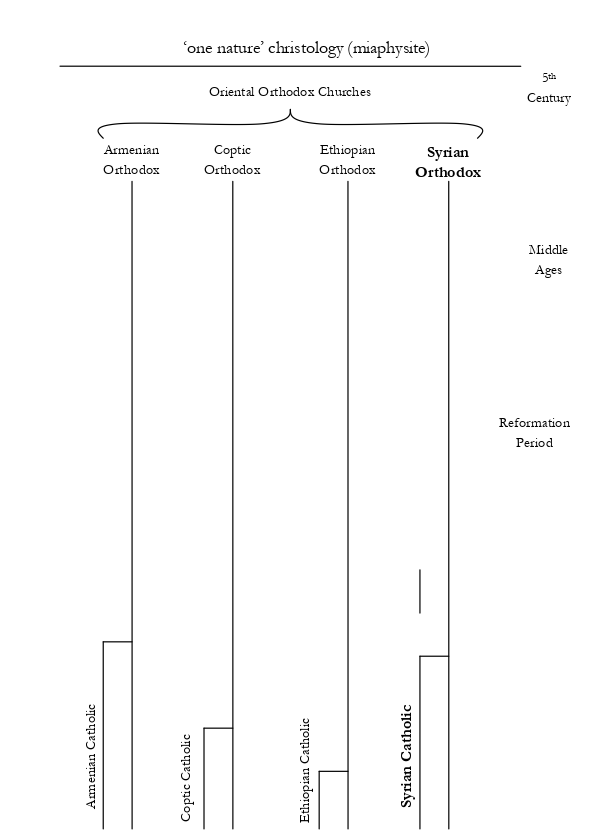
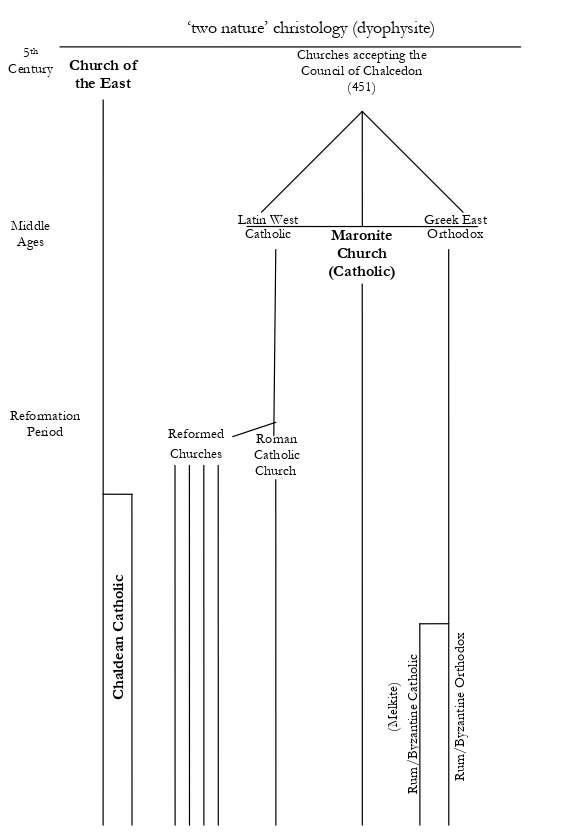
A few words should be said about each of these Churches, which all belong to the Syriac cultural world.
关于这些教会中的每一个,我们都应该说几句,它们都属于叙利亚文化世界。
THE WEST SYRIAC LITURGICAL TRADITION
西叙利亚礼仪传统
The Syrian Orthodox Church only gradually became separated from the mainstream church in the course of the late fifth and the sixth century, and it was not until the first half of the sixth century that a separate hierarchy developed as a result of the deposition, by the emperor Justin, of the antiChalcedonian patriarch of Antioch, Severus. Since then their patriarch (one of five patriarchs of Antioch today) has never resided at Antioch; the present patriarch, His Holiness Mor Ignatius Aphram II resides in Damascus. Syrian Orthodox communities are now chiefly to be found in Syria, Lebanon, Turkey (Tur ‛Abdin in the southeast, and Istanbul), Iraq, and India (Kerala); there are also very sizable émigré communities in Western Europe (Germany, the Netherlands, Sweden, and several other countries) and the Americas: the first Syrian Orthodox Archbishop of North America, Mor Athanasius Yeshue Samuel, was the first purchaser of the famous Isaiah scroll from Qumran; there is a fascinating account of this episode in his Treasure of Qumran: My Story of the Dead Sea Scrolls (London, 1968), though this should now be read in conjunction with George Kiraz (ed.), Anton Kiraz’s Archive on the Dead Sea Scrolls (Piscataway NJ, 2005).
叙利亚东正教在五世纪末和六世纪期间才逐渐从主流教会中分离出来,直到六世纪上半叶,由于贾斯汀皇帝废黜了安提阿的反卡尔西顿教派宗主教塞维鲁,才形成了独立的教派。从那时起,他们的族长(如今安提阿的五位族长之一)就从未在安提阿居住过;现任族长莫尔-伊格纳修斯-阿夫拉姆二世陛下居住在大马士革。叙利亚东正教社区目前主要分布在叙利亚、黎巴嫩、土耳其(东南部的图尔‛阿卜丁和伊斯坦布尔)、伊拉克和印度(喀拉拉邦);在西欧(德国、荷兰、瑞典和其他几个国家)和美洲也有相当大的移民社区:北美第一位叙利亚东正教大主教 Mor Athanasius Yeshue Samuel 是库姆兰著名的以赛亚书卷的第一位购买者;在他的《库姆兰的宝藏》(Treasure of Qumran:在他的《库姆兰的宝藏:我的死海古卷故事》(伦敦,1968 年)中有一段精彩的叙述,不过现在应该结合 George Kiraz(编)的《Anton Kiraz’s Archive on the Dead Sea Scrolls》(新泽西州皮斯卡塔韦,2005 年)一起阅读。
The Syrian Catholic Church, with its own Patriarch (in Beirut), has its origins in the late seventeenth century.
叙利亚天主教会有自己的牧首(在贝鲁特),起源于 17 世纪晚期。
The twentieth century has witnessed two great scholar patriarchs, the Syrian Catholic Ephrem Rahmani (died 1929), and the Syrian Orthodox Ephrem (Afram) Barsoum (died 1957), the latter being the author of the important history of Syriac literature entitled The Scattered Pearls, mentioned earlier.
二十世纪有两位伟大的学者宗主教,一位是叙利亚天主教的 Ephrem Rahmani(卒于 1929 年),另一位是叙利亚东正教的 Ephrem (Afram) Barsoum(卒于 1957 年)。
The presence of a West Syriac hierarchy and liturgical tradition in India goes back to the mid-seventeenth century and the reaction against the Portuguese policy of latinization. Both the Malankara Syrian Orthodox and Orthodox Syrian Churches now have their own Catholicos, the former being under the Patriarchate of Antioch; this sad schism goes back to the early twentieth century and attempts to heal it have unfortunately been short-lived. The Malabar Independent Syrian Church (a single diocese) goes back to 1774, while the reformed Mar Thoma Church came into existence at the end of the nineteenth century. The Malankara Catholic Church goes back to 1930, when Mar Ivanios and his flock entered into communion with Rome.
西叙利亚教的等级制度和礼仪传统在印度的存在可以追溯到十七世纪中叶和对葡萄牙拉丁化政策的反动。马兰卡拉叙利亚东正教会和东正教叙利亚教会现在都有自己的主教,前者隶属于安提阿教区;这一可悲的分裂可以追溯到 20 世纪初,遗憾的是,试图弥合这一分裂的努力都昙花一现。马拉巴尔独立叙利亚教会(单一教区)可追溯到 1774 年,而改革后的马-托马教会则出现于十九世纪末。马拉卡拉天主教会的历史可以追溯到 1930 年,当时马-伊万尼奥斯和他的教友们加入了罗马教会。
THE EAST SYRIAC LITURGICAL TRADITION
东叙利亚礼仪传统
The Church of the East was from the first based outside the Roman Empire, and so its history has always been distinct from that of the other Churches, whose roots all lie within the Roman Empire. It is indicative of the poor communication between Christians in the two Empires that it was only in 410 that the Council of Nicaea (325) became known to, and was officially accepted by, the Church of the East. Whereas martyrdom was effectively brought to an end in the Roman Empire by the conversion of Constantine, it was only in the mid-fourth century that Persian Christians experienced their first serious bout of persecution from the Zoroastrian authorities. Persecution was to continue intermittently right up to the collapse of the Sasanid Empire in the seventh century; in many instances the martyrs were converts from Zoraoastianism who came from prominent families. A remarkable feature of the history of this Church is its missionary expansion across Asia, reaching China by 635—an event recorded on a bilingual Syriac-Chinese stele erected in 781, mentioned above.
东方教会从一开始就建立在罗马帝国之外,因此它的历史一直有别于其他教会的历史,其他教会的根源都在罗马帝国。直到 410 年,尼西亚大公会议(325 年)才为东方教会所知并被正式接受,这说明两个帝国的基督徒之间交流不畅。君士坦丁的改变有效地结束了殉教在罗马帝国的历史,而波斯基督徒直到四世纪中叶才经历了来自拜火教当局的第一次严重迫害。迫害一直断断续续地持续到七世纪萨珊帝国的灭亡;在许多情况下,殉教者都是出身名门望族的拜火教皈依者。该教会历史上的一个显著特点是它在亚洲各地的传教扩张,635 年时传到了中国—上文提到的 781 年竖立的叙利亚文和中文双语石碑上记录了这一事件。
Although European writers have derogatively called this Church “Nestorian,” its connections with Nestorius are rather tenuous, and the term is definitely misleading since it means very different things to different people.4 As a matter of fact, beside their own great theologian, Babai (died 628), the East Syrian Church’s main source of theological inspiration was provided by the writings of the Greek Theodore of Mopsuestia (died 428), several of whose works survive complete only in Syriac translation.
虽然欧洲作家贬损地称该教会为 “聂斯脱利派”,但它与聂斯脱利的联系相当微弱,而且这个词绝对具有误导性,因为它对不同的人有着截然不同的含义。26 事实上,除了他们自己的伟大神学家巴拜(卒于 628 年)之外,东叙利亚教会神学灵感的主要来源是希腊人 Theodore of Mopsuestia(卒于 428 年)的著作,他的几部作品只有叙利亚文译本完整地保存了下来。
During the last hundred years or so the history of this Church has been a particularly tragic one, and since 1972 there has been a schism: currently there are two patriarchs, one, Mar Dinkha IV (and from 2015, Mar Gewargis III Sliwa), of the Assyrian Church of the East (which follows the Gregorian, or New, Calendar), the other, Mar Addai II, of the Ancient Church of the East (which follows the Julian, or Old, Calendar). It so happened that the late patriarch, Mar Dinkha, was consecrated in England, in St. Barnabas’ Church, Ealing (on October 17, 1976), but was resident in the United States, whereas Mar Addai is in Baghdad; Mar Gewargis, who had been Metropolitan of Baghdad, has remained in Iraq, based in Erbil. Their people are to be found in Syria, Lebanon, Iraq, Iran, and south India (Kerala), though today, with the large-scale emigration of Christians from the Middle East, there are probably many more living in America, Europe,
在过去的一百多年里,该教会的历史尤为悲惨,自 1972 年以来一直处于分裂状态:目前有两位元老,一位是东亚述教会(采用格里高利历,即新历)的马尔-丁哈四世(自 2015 年起为马尔-格瓦吉斯三世-斯利瓦),另一位是东古教会(采用儒略历,即旧历)的马尔-阿代二世。已故宗主教马尔-丁哈(Mar Dinkha)是在英国伊灵的圣巴拿巴教堂(1976 年 10 月 17 日)被祝圣的,但他居住在美国,而马尔-阿代则在巴格达;曾担任巴格达都主教的马尔-格瓦吉斯(Mar Gewargis)一直留在伊拉克,以埃尔比勒为基地。叙利亚、黎巴嫩、伊拉克、伊朗和印度南部(喀拉拉邦)都有他们的信徒,不过,随着中东基督徒的大规模移民,今天可能有更多的基督徒生活在美国和欧洲、
and Australia. This also applies to the vigorous Chaldean Catholic Church, whose Patriarch still resides in Iraq.
和澳大利亚。这也适用于充满活力的迦勒底天主教会,其牧首仍居住在伊拉克。
The Chaldean Church (in particular through the work of the late Fr. Yusuf Habbi) was the moving force behind the creation of Babel College in Baghdad (in 1991), which offered courses in Theology and Philosophy for the benefit of all the Christian communities in Iraq—a remarkable contribution to ecumenism in the field of theological education; alas, however, recent events have brough all this to an end. Among the cultural publications of the Chaldean Church, the periodical Bayn al-Nahrayn (“Mesopotamia”) has many acticles of academic interest for Syriac studies. In recent years there have been important moves aimed at bringing the Chaldean Catholic Church and the Assyrian Church of the East together.
迦勒底教会(特别是通过已故的优素福-哈比神父的工作)是在巴格达创建巴别学院(1991 年)的幕后推手,该学院为伊拉克的所有基督教社区提供神学和哲学课程—这是对神学教育领域普世主义的卓越贡献;然而,最近发生的事件使这一切戛然而止。在迦勒底教会的文化出版物中,《Bayn al-Nahrayn》(《美索不达米亚》)期刊有许多与叙利亚语研究有关的学术文章。近年来,旨在将迦勒底天主教会和东亚述教会联系在一起的重要举措不断涌现。
Needless to say, the Gulf War of 1990 and the invasion of Iraq in 2003 have had a disastrous effect on all the Christian communities in that country, causing massive emigration as well as destruction.
毋庸讳言,1990 年的海湾战争和 2003 年对伊拉克的入侵对该国的所有基督教社区都造成了灾难性的影响,导致了大规模的移民和破坏。
THE MARONITE CHURCH
马龙派教会
The origins of the Maronites as a separate church are obscure, although they are evidently tied up somehow with the monothelete/dyothelete controversy of the seventh and early eighth century. The Maronite Church has accepted the authority of Rome since the time of the Crusades and their Patriarch Jeremiah II assisted at the Fourth Lateran Council in 1215. The Maronite Patriarch (one of the five Patriarchs of Antioch) now resides outside Beirut; over the last century or so, in particular, the Maronite patriarchate has played an important role in Lebanese politics.
马龙派作为一个独立教会的起源并不清楚,但显然与七世纪和八世纪初的一神教/二神教之争有某种联系。自十字军东征以来,马龙派教会一直接受罗马的权威,他们的牧首耶利米二世在 1215 年第四次拉特兰会议上提供了协助。马龙派牧首(安提阿五大牧首之一)现居住在贝鲁特郊外;特别是在过去的一个多世纪里,马龙派牧首在黎巴嫩政治中发挥了重要作用。
At Kaslik, just south of Jounieh in the Lebanon, there is a Maronite university run by the Order of Lebanese Monks, the Université SaintEsprit, which produces the excellent periodical Parole de l’Orient, mentioned earlier. Another monastic order, that of the Antonines, is also active in promoting a better knowledge of the Syriac heritage, and their Centre d’études et de recherches orientales (CERO), at Antelias, has organised the annual colloquia on the “Patrimoine syriaque,” also mentioned earlier.
在黎巴嫩朱尼耶南部的卡斯里克,有一所由黎巴嫩僧侣会开办的马龙派大学,即 SaintEsprit 大学,该大学出版了前面提到的优秀期刊《东方 Parole》。另一个僧侣修道会,即安东尼修道会,也在积极促进更好地了解叙利亚遗产,他们在安特利亚斯的东方研究中心(CERO)组织了关于 “叙利亚遗产 “的年度座谈会,这在前面也提到过。
As has already been seen, the Maronites played an important role in the history of Syriac scholarship in Europe ever since the establishment in Rome of the Maronite College (in 1584). In the seventeenth century it was a Maronite, Gabriel Sionita, who was largely responsible for the Syriac text in the great Paris Polyglot Bible, while in the eighteenth century the Assemani family produced a notable succession of Syriac scholars, chief among whom was Joseph Simon Assemani (+ 1768): his Bibliotheca Orientalis, a survey of Syriac literature based on the riches of the Vatican Library (Rome, 1719–
如前所述,自马龙派教徒在罗马建立马龙派学院(1584 年)以来,马龙派教徒在欧洲的叙利亚语学术史上发挥了重要作用。十七世纪,马龙派教徒加布里埃尔-西奥尼塔(Gabriel Sionita)在很大程度上负责了伟大的《巴黎多语种圣经》中的叙利亚文文本,而在十八世纪,阿塞马尼家族培养出了一批著名的叙利亚文学者,其中最主要的是约瑟夫-西蒙-阿塞马尼(Joseph Simon Assemani,+1768 年):他的《东方书目》(Bibliotheca Orientalis)是根据梵蒂冈图书馆的丰富藏书而编写的叙利亚文文献概览(罗马,1719-1760 年)。
28), has already been mentioned as still being a basic resource for Syriac studies.
28)中已经提到,它仍然是研究叙利亚语的基本资料。
THE BYZANTINE (RUM) ORTHODOX PATRIARCHATE OF ANTIOCH
安提阿拜占庭(朗姆)正统教区
Besides the Syrian Orthodox, Syrian Catholic, and Maronite Patriarchs of Antioch, there are two further ones, both belonging to the Chalcedonian tradition, the Byzantine (Rum) Orthodox and Melkite Catholic. The Chalcedonian Patriarchate of Antioch historically belongs to the Churches which have a Syriac heritage, for one of its literary and liturgical languages was once Syriac: Syriac, however, was replaced as a literary language by Arabic from the ninth century onwards, though it continued in use as a liturgical language in certain areas until as late as the seventeenth century. Furthermore, its liturgical tradition was once Antiochene (and thus closely related to the Syrian Orthodox and Maronite traditions), but in about the tenth and eleventh centuries (when part of north Syria was termporarily reconconquered by the Byzantine Empire), its rite was completely adapted to that of Constantinople.
除了叙利亚东正教、叙利亚天主教和马龙派的安提阿牧首之外,还有两个都属于卡尔西顿传统的牧首,即拜占庭(朗姆)东正教和梅尔基特天主教。安提阿的卡尔西宗主教区在历史上属于拥有叙利亚语遗产的教会,因为其文学和礼仪语言之一曾经是叙利亚语:然而,从九世纪起,叙利亚语作为一种文学语言被阿拉伯语所取代,但直到十七世纪,叙利亚语仍在某些地区作为一种礼仪语言继续使用。此外,它的礼仪传统曾经是安提阿语(因此与叙利亚东正教和马龙派传统密切相关),但大约在十世纪和十一世纪(当时叙利亚北部的部分地区被拜占庭帝国暂时重新征服),它的礼仪被完全改编为君士坦丁堡的礼仪。
The term “Melkite” is regularly used when speaking of Syriac manuscripts belonging to this tradition, but it should be noted that when “Melkite” is used as an ecclesiastical term it refers specifically to the Eastern Rite Catholic Patriarchate of Antioch (which came into existence in the eighteenth century), and not to the Orthodox one.
在谈到属于这一传统的叙利亚文手稿时,“梅尔基特 “一词经常被使用,但需要注意的是,当 “梅尔基特 “作为一个教会术语使用时,它特指东正教的天主教安提阿教区(18 世纪成立),而不是东正教的教区。
ECUMENICAL DIALOGUE
普世对话
All the different Syriac Churches are now involved in ecumenical dialogue. Particularly important events have been the joint declarations of faith made by the Syrian Orthodox Patriarch, Ignatius Zakka I and Pope John Paul II in 1984, and by the Patriarch of the Assyrian Church of the East, Dinkha IV, and Pope John Paul II in 1994. It was also in the year 1994 that the PRO ORIENTE Foundation in Vienna initiated its series of “Syriac Dialogue,” involving all the different Churches of Syriac tradition, Chalcedonian, Oriental Orthodox, and Church of the East. The papers produced for these meetings are published under the title Syriac Dialogue (1, 1994; 2, 1996; 3, 1998; 4, 2001; 5, 2003; 6, 2004).
现在,所有不同的叙利亚教会都参与了普世对话。尤其重要的是,叙利亚东正教牧首伊格内修斯-扎卡一世和教皇约翰-保罗二世于 1984 年发表了联合信仰宣言,东亚述教会牧首丁哈四世和教皇约翰-保罗二世于 1994 年发表了联合信仰宣言。也是在 1994 年,维也纳的 PRO ORIENTE 基金会发起了 “叙利亚对话 “系列活动,叙利亚传统的所有不同教会、卡尔西教派、东方东正教和东方教会都参与其中。为这些会议撰写的论文以《叙利亚对话》为题出版(1,1994 年;2,1996 年;3,1998 年;4,2001 年;5,2003 年;6,2004 年)。
SOME LITERATURE
一些文献
A general historical survey of all the various oriental churches is given in A. S. Atiya, A History of Eastern Christianity (London, 1968). For the modern
A. S. Atiya, A History of Eastern Christianity(伦敦,1968 年)对所有东方教会进行了一般性的历史考察。关于现代
period both D. Attwater’s The Christian Churches of the East (2 volumes; London, 1968), which gives information on ecclesiastical matters, and R. B. Betts’ Christians in the Arab East (London, 1979), which is concerned more with demography and politics, are still useful. A listing of the current hierarchy of all the Syriac Churches is given by J. Madey, The Hierarch of the Churches of East and West Syriac Traditions (Moran Etho 17; Kottayam, 2002).
在此期间,D. Attwater 的《东方基督教会》(两卷;伦敦,1968 年)和 R. B. Betts 的《阿拉伯东方的基督徒》(伦敦,1979 年)仍然有用,前者提供了教会事务方面的信息,后者则更多地关注人口和政治。J. Madey 的 The Hierarch of the Churches of East and West Syriac Traditions(Moran Etho 17;Kottayam,2002 年)列出了目前所有叙利亚教会的等级制度。
Helpful introductory works on the individual Syriac Churches today include the following: Syrian Orthodox and Syrian Catholic:
有关当今各个叙利亚教会的有用的介绍性著作包括以下几本:叙利亚东正教和叙利亚天主教:
• S. P. Brock, with D.G.K. Taylor (eds.), The Hidden Pearl, III. At the Turn of the Third Millennium: the Syrian Orthodox Witness (Rome, 2001). [For the contents, see above, at the end of Ch.V H]. | • C. Chaillot, The Syrian Orthodox Church of Antioch and all the East. A Brief Introduction to its Life and Spirituality (Geneva, 1998). This delightful personal account provides a lot of information that is not readily available elsewhere. | • C. Sélis, Les syriens orthodoxes et catholiques (Turnhout, 1988).
- S. P. Brock,与 D.G.K. Taylor(编),《隐藏的珍珠》,III.在第三个千年之交:叙利亚东正教的见证》(罗马,2001 年)。[内容见上文第五章 H 节末尾]。| C. Chaillot, The Syrian Orthodox Church of Antioch and all the East.其生活和灵修简介》(日内瓦,1998 年)。这本令人愉悦的个人文集提供了大量其他地方无法获得的信息。| C. Sélis, Les syriens orthodoxes et catholiques (Turnhout, 1988).
Church of the East and Chaldean Church:
东方教会和迦勒底教会:
• Mar Aprem, The Assyrian Church of the East in the Twentieth Century (Kottayam, 2003). | • W. Baum and D. Winkler, The Apostolic Church of the East (London 2003), ch. 5. | • C. Baumer, The Church of the East. An Illustrated History of Assyrian Christianity (London, 2006).
- Mar Aprem,《二十世纪的东方亚述教会》(Kottayam,2003 年)。| W. Baum 和 D. Winkler,《东方使徒教会》(伦敦,2003 年),第 5 章。| - C. Baumer, The Church of the East.亚述基督教插图史》(伦敦,2006 年)。
• H. Teule, Les Assyro-Chaldéens. Chrétiens d’Iraq, d’Iran et de
- H. Teule, Les Assyro-Chaldéens.Chrétiens d’Iraq, d’Iran et de
Turquie (Turnhout, 2008). An excellent general introduction. The Maronite Church:
Turquie》(Turnhout,2008 年)。这是一本很好的一般性介绍。马龙派教会:
• P. Dib, History of the Maronite Church (Detroit, 1971). | • J. Mahfouz, Short History of the Maronite Church (Jounieh, 1987). | • R. Mouawad, Les Maronites (Turnhout, 2009). An excellent general introduction.
- P. Dib,《马龙派教会史》(底特律,1971 年)。| J. Mahfouz,《马龙派教会简史》(朱尼耶,1987 年)。| - R. Mouawad,《马龙派教徒》(Turnhout,2009 年)。这是一本很好的一般性介绍。
The Chalcedonian Patriarchates of Antioch, Orthodox and Catholic:
安提阿、东正教和天主教的卡尔西宗主教:
• I. Dick, Les Melkites. Grec-orthodoxes et grec-catholiques des patriarcats d’Antioche, d’Alexandrie et de Jérusalem (Turnhout, 1994). English translation 2004.
- I. Dick, Les Melkites.Grec-orthodoxes et grec-catholiques des patriarcats d’Antioche, d’Alexandrie et de Jérusalem (Turnhout, 1994).英译本 2004 年。
Middle Eastern Christianity in general See especially the various contributions to A. O’Mahony (ed.), Eastern Christianity: Studies in Modern History, Religion and Politics (London, 2004), and Christianity in the Middle East. Studies in Modern History, Theology and Politics (London, 2008); and A. O’Mahony and E. Loosley (eds), Eastern Christianity in the Modern Middle East (London, 2010).
中东基督教概况 见 A. O’Mahony (ed.), Eastern Christianity:现代历史、宗教和政治研究》(伦敦,2004 年)和《中东的基督教》。现代历史、神学和政治研究》(伦敦,2008 年);以及 A. O’Mahony 和 E. Loosley(编),《现代中东的东方基督教》(伦敦,2010 年)。
India:
印度:
• L. W. Brown, The Indian Christians of St Thomas (2nd ed., Cambridge, 1982). | • C. Chaillot, The Malankara Orthodox Church (Geneva, 1996). | • D. Daniel, The Orthodox Church of India. A History (2nd ed. New Delhi, 1986).
- L. W. Brown,《圣托马斯的印度基督徒》(第二版,剑桥,1982 年)。| C. Chaillot,《马兰卡拉东正教会》(日内瓦,1996 年)。| - D. Daniel, The Orthodox Church of India.历史》(第 2 版,新德里,1986 年)。
Among the many late nineteenth- and early twentieth-century works, a particularly fascinating account of the Syrian Orthodox Church at the end of the nineteenth century is given by O. H. Parry, Six Months in a Syrian Monastery (London, 1895)—the monastery was Deir ez Zafaran, on the edge
在十九世纪末和二十世纪初的众多著作中,O. H. Parry 的《叙利亚修道院的六个月》(伦敦,1895 年)对十九世纪末的叙利亚东正教会进行了特别精彩的描述。
of Tur ‛Abdin in southeastern Turkey; at that time it was the seat of the patriarch. Thanks to the Anglican educational missions to the Church of the East there are several readable accounts of this Church and its people, notably A. J. Maclean and W. H. Browne, The Catholicos of the East and his People (London, 1892), and W. A. Wigram, The Assyrians and their Neighbours (London, 1929). The older work by G. P. Badger, The Nestorians and their Rituals (two volumes; London, 1852) has become something of a classic.
土耳其东南部的 Tur ‛Abdin,当时是教长的所在地。由于英国圣公会向东方教会派遣了教育使团,因此关于该教会及其人民的记载有很多可读性,特别是 A. J. Maclean 和 W. H. Browne 的《东方天主教及其人民》(伦敦,1892 年),以及 W. A. Wigram 的《亚述人及其邻居》(伦敦,1929 年)。G. P. Badger 的旧作《景教及其仪式》(两卷,伦敦,1852 年)已成为经典。
An outline of ecumenical developments involving the Syriac Churches can be found in my “The Syriac Churches in ecumenical dialogue on christology,” in A. O’Mahony (ed.), Eastern Christianity. Studies on Modern History, Religion and Politics (London, 2004), pp. 44–65, and “The Syriac Churches of the Middle East and Dialogue with the Catholic Church”, in A. O’Mahony and J. Flannery (eds), The Catholic Church in the Contemporary Middle East (London, 2010), pp. 107–18. Regular updates on dialogue can be found in the journal Proche Orient Chrétien. For Oriental-Eastern Orthodox Dialogue, see the contributions by Mor Polycarpus Aydin and B. Varghese in C. Chaillot (ed.), The Dialogue between the Eastern Orthodox and Oriental Orthodox Churches (Volos, Greece, 2016).
关于涉及叙利亚教会的普世教会发展的概述,见我的 “叙利亚教会在普世教会对话中的基督论”,载于 A. O’Mahony(编辑)的《东方基督教》。关于现代历史、宗教和政治的研究》(伦敦,2004 年),第 44-65 页,以及《中东叙利亚教会与天主教会的对话》,载于 A. O’Mahony 和 J. Flannery(编),《当代中东的天主教会》(伦敦,2010 年),第 107-18 页。有关对话的定期更新可查阅《Proche Orient Chrétien》杂志。关于东方-东正教对话,请参阅 Mor Polycarpus Aydin 和 B. Varghese 在 C. Chaillot(编)《东正教与东方东正教之间的对话》(希腊沃洛斯,2016 年)中的文章。
Footnotes
-
Syriac M45N in Philothée du Sinaï, Nouveaux manuscrits syriaques du Sinaï (Athens, 2008), pp. 474–8. Small fragments, not covered in her catalogue, are described in my Catalogue of Syriac Fragments (New Finds) in the Library of the Monastery of Saint Catherine, Mount Sinai (Athens, 1995). A scholar who has done a great deal in recent years joining up prts of Sinai manuscripts which are now scattered all of the world is Paul Géhin, notably in a series of articles in Oriens Christianus 90, 91 and 94 (2006–7, 2010). | 22 The Syriac Version of the Pseudo-Nonnos Mythological Scholia (Cambridge, 1971). ↩ ↩2
-
23 For the origins of the adoption of the name, there is a well-documented ↩
-
See the various contributions to Cristianesimo nella Storia 37 (2016) on the subject. ↩
-
See my “The ‘Nestorian’ Church: a lamentable misnomer,” in J. F. Coakley and K. Parry (eds.), The Church of the East. Life and Thought (= Bulletin of the John Rylands University Library, Manchester, 78:3; 1996), pp. 22–35. ↩